
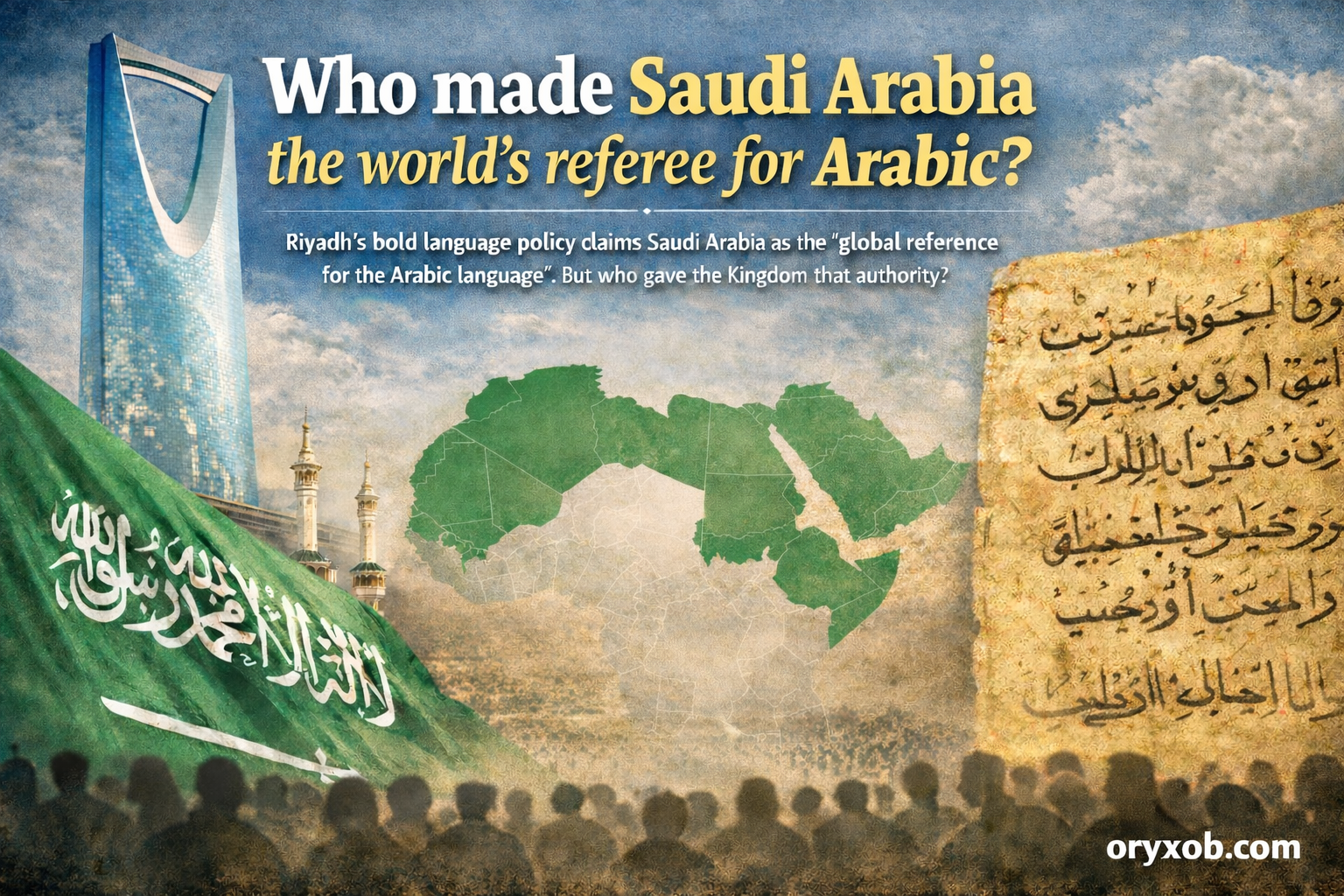
A recent Saudi government decision adopting a national language policy has triggered an unusually sharp question across the Arab world: can any single state appoint itself the “global reference” for Arabic — and on what authority?
The policy’s wording is strikingly assertive. It describes Saudi Arabia as “بوصفها المرجعية العالمية في اللغة العربية” — “as the global reference for the Arabic language” — and declares that “المملكة هي موطن اللغة العربية الأول” — “the Kingdom is the first homeland of the Arabic language.”
On paper, the initiative presents itself as cultural stewardship: standardising Arabic usage, strengthening its presence in education and public administration, and elevating the language’s status in daily life. Few would dispute the value of improving Arabic teaching, protecting linguistic standards, and expanding Arabic’s use in government and the private sector.
The controversy lies elsewhere: not in the encouragement of Arabic inside Saudi Arabia, but in the implication that Saudi Arabia can position itself above other Arab states — and above a century of scholarly and institutional work — as the language’s ultimate authority.
A national policy with supranational ambitions
Language policy is usually domestic: a state decides how schools teach, how government communicates, and what rules shape public signage, media, and official documentation. This policy, however, goes further by embedding a claim of international leadership in its own framing.
“Global reference” is not a technical phrase; it is a political one. It suggests gatekeeping power: the ability to define standards, settle disputes, certify institutions, and speak with final authority over what counts as correct Arabic.
In practice, Arabic has never had a single global “centre” in the modern era. Its norms have been shaped through a wide ecosystem: universities, academies, dictionaries, publishing houses, religious seminaries, and language institutes across multiple countries. Standards emerge through argument, consensus and gradual adoption — not through ministerial decree.
That is why the Saudi phrasing is seen by critics as an attempt to convert financial capacity and state power into linguistic sovereignty over others.
“The first homeland”: history doesn’t fit modern borders
Saudi Arabia’s assertion that it is the “first homeland” of Arabic draws on a widely held association between Arabic and the Arabian Peninsula. Yet language history rarely cooperates with the neat certainty of national slogans.
Arabic developed over centuries through a complex interplay of dialects, migration, trade routes, cultural exchange and evolving scripts. The classical language was then consolidated through literature, state formation, religious texts, and scholarship that quickly became transregional.
Even if one accepts that early Arabic communities were rooted in the Peninsula, the modern Arabic language — as a living and standardised system — was shaped across many centres. The editorial, lexicographical and terminological traditions that govern modern usage were forged in multiple capitals and institutions, not one.
That reality does not diminish Saudi Arabia’s cultural weight. It simply challenges the policy’s implied premise: that a historical connection can be converted into a present-day monopoly on authority.
Who gave Saudi Arabia the right?
This is the central problem with the “global reference” claim: no one did — at least not in any publicly visible, regional or international mandate.
If Saudi Arabia intends the phrase as symbolic pride, it will still be read as institutional ambition, because language “reference” is about control. If the Kingdom intends it literally, the policy raises immediate questions:
- Will Saudi institutions begin issuing “authoritative” rulings on Arabic usage beyond Saudi borders?
- Will they seek to certify curricula, examinations, or language proficiency standards internationally?
- Will they attempt to define “acceptable” terminology in politics, religion, or culture?
- What happens when other academies disagree — and they will?
Without a multilateral framework, any attempt to operationalise “global reference” risks being perceived not as cultural leadership, but as soft-power overreach.
A crowded field of guardianship
The Saudi policy arrives in an Arab world where language institutions already exist — many with deep archives, established committees, and long-running projects in terminology, lexicography and Arabisation.
Across the region, academies and scholarly bodies have produced dictionaries, coined modern technical terms, debated usage in media and education, and defended Arabic in the face of globalisation. They have done so while negotiating the language’s internal diversity: classical forms, modern standard usage, and rich local dialects.
For those institutions, Saudi Arabia’s claim to be the “global reference” reads less like cooperation and more like a unilateral bid to sit at the head of the table — a table that others built and maintained for decades.
The issue is not whether Saudi Arabia can contribute — it can, and it already does — but whether it can declare supremacy over a shared linguistic heritage.
The Vision 2030 paradox: Arabic “sovereignty”, English branding
The policy’s timing also exposes a conspicuous contradiction: while Saudi Arabia asserts global guardianship over Arabic, the Kingdom’s most famous national projects have been branded to the world with non-Arabic names.
The flagship initiatives of the Crown Prince’s Vision 2030 agenda are marketed primarily through English naming and globalised branding. These titles have become the international shorthand for Saudi Arabia’s future: futuristic cities, giga-projects, and investment zones whose public identity is communicated in English first.
This does not, by itself, undermine the policy — many countries brand projects globally — but it does sharpen the scrutiny.
If the state is serious about positioning Arabic as a core pillar of national identity and global leadership, why is the Kingdom’s most visible modernisation drive narrated in a vocabulary that is not Arabic? If Arabic is central to sovereignty, why is English the default language of the future-facing brand?
Critics argue that this makes the language policy feel less like a consistent cultural programme and more like a reputational intervention — a way to claim heritage authority even as the state’s outward image leans heavily on international marketing logic.
The political uses of language
To understand why this matters, one must recognise what language policy often becomes in statecraft: a tool for legitimacy.
By proclaiming itself the “first homeland” and “global reference”, Saudi Arabia is not merely protecting Arabic inside its borders; it is attempting to anchor a broader narrative: that Riyadh is the natural centre of Arab identity, culture and leadership.
That narrative has clear strategic utility. It amplifies Saudi influence in cultural diplomacy, education partnerships, media initiatives, and international conferences. It strengthens a claim to leadership that can complement Saudi Arabia’s economic power and regional ambitions.
But cultural leadership is earned through trust and collaboration. Declaring oneself the global reference risks doing the opposite: provoking scepticism, resentment, and quiet resistance — especially among societies that see Arabic as a shared inheritance, not a Saudi asset.
What “reference” could mean in practice — and why people worry
The policy’s defenders may argue that “global reference” is aspirational: a statement of intent to invest in Arabic, fund research, support technology and translation, and elevate the language internationally.
If that is all it means, the phrasing remains careless — because it is easily interpreted as dominance rather than contribution.
And if Saudi Arabia intends more than aspiration, the implications are larger:
- Standard-setting power can shape education across borders.
- Terminology decisions can influence politics, religion and media framing.
- Funding dominance can quietly steer what scholarship flourishes, and what becomes marginal.
- Cultural branding can recast Arabic as a Saudi-led project, rather than a plural heritage.
This is why the wording is not a minor detail. In language politics, a single phrase can signal an entire worldview: partnership, or hierarchy.
A better path: leadership without monopolies
Saudi Arabia can play a major role in strengthening Arabic — and the region would benefit from serious investment in language technology, publishing, education quality, translation, and research.
But there is a crucial difference between leading and claiming ownership.
If the Kingdom wishes to be seen as a credible champion of Arabic, it would gain more legitimacy by presenting itself as part of a cooperative network: working openly with existing language academies, supporting regional joint projects, and building consensus rather than asserting supremacy.
A truly confident cultural strategy would not need to proclaim “global reference” in a government text. It would show leadership through outputs: authoritative dictionaries created with regional collaboration, transparent standards, open research, and educational results that speak for themselves.
The unanswered questions
Until the Saudi government clarifies how it interprets its own phrasing, the scepticism will remain. Key questions include:
- What does “global reference” mean operationally — symbolic aspiration, or institutional authority?
- Will Saudi institutions seek to define standards beyond Saudi Arabia?
- Will other Arab academies and scholars be treated as partners, or as secondary voices?
- How does the policy square with state branding that prioritises English for the Kingdom’s most prominent projects?
Arabic does not belong to any one state. It is carried by hundreds of millions of speakers, and shaped by centuries of scholarship across multiple lands. Any attempt to centralise its authority in one capital will inevitably be contested — not because others oppose Saudi investment in Arabic, but because the language’s legitimacy is collective.
In that sense, the policy’s most controversial lines have already achieved something — just not what they may have intended. They have turned a domestic language initiative into a regional debate about ownership, identity and power: who speaks for Arabic, and who gets to decide.