
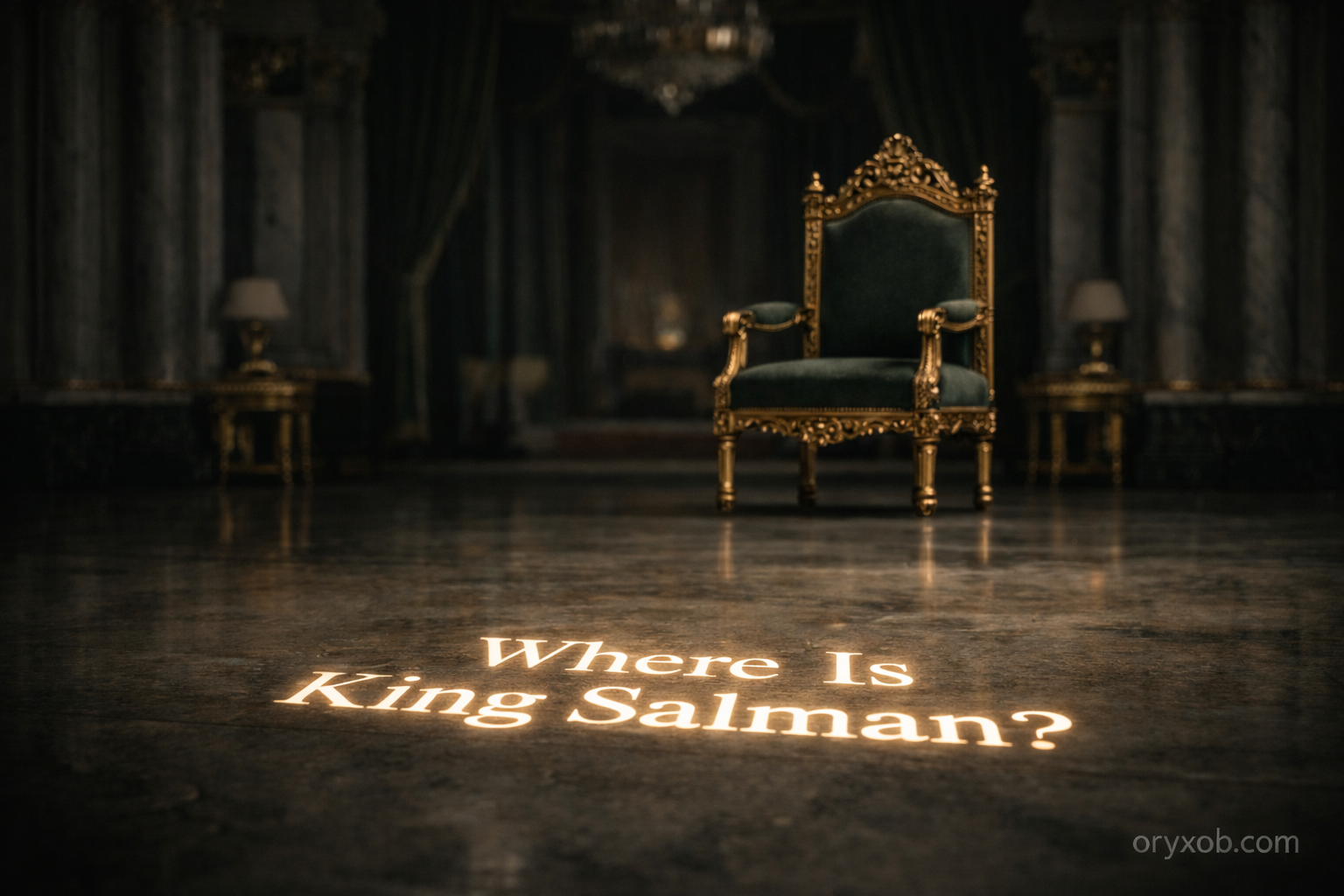
By any conventional standard of modern statecraft, a head of state is expected to be seen: to receive visiting leaders, to address the nation in moments of crisis or ceremony, and to appear — in motion and in time — before cameras that do not flinch or freeze.
King Salman bin Abdulaziz Alsaud, King of Saudi Arabia since 2015, increasingly does none of these things.
This investigation does not claim to know where King Salman is. It examines, instead, what can be documented with precision: how rarely he is seen, when he is absent, what has replaced his presence, and what the Saudi state has chosen not to explain.
The Vanishing of a Public Figure
Over the past several years, King Salman’s public visibility has diminished to a degree unusual even by the opaque standards of absolute monarchies.
There is a critical distinction to be made here — one well understood by seasoned investigators:
- Still photographs released by state media versus Live or recorded video, uninterrupted, contemporaneous, and verifiable
The Saudi press continues to publish occasional still images of the King, often seated, often in highly controlled settings, often without sound or moving footage. What has largely disappeared is video evidence of the King acting as a sovereign: greeting foreign leaders, chairing summits, or addressing his people directly.
In journalism, this matters. A photograph proves a moment was staged. A video proves a moment happened.
The Last Documented Public Appearances
Saudi state media (primarily the Saudi Press Agency) has, in recent years, reported that King Salman chaired cabinet meetings or received briefings. Yet these reports are increasingly accompanied by:
- One or two still photographs
- No raw video footage
- No extended speech
- No independent access
The last widely circulated, uninterrupted video footage of King Salman performing core sovereign duties — speaking at length, engaging in real-time with others — dates back at least several years, with no comparable material released since.
Since then, the public record shows a pattern:
- Announcements about the King
- Images of the King
- Decisions issued in his name
But almost never the King himself, speaking or moving in real time.
Absences That Demand Explanation
The question becomes sharper when examining events where his presence would normally be expected.
International Summits
Over multiple years, Saudi Arabia has been represented at:
- G20 summits
- Arab League meetings
- Major international conferences
In each case, representation has been led not by the King, but by Crown Prince Mohammed bin Salman, sometimes as prime minister, sometimes as de facto head of state.
This is not a single substitution. It is a pattern.
Visits by Foreign Leaders
High-level visits to Riyadh — including by presidents, prime ministers, and monarchs — are now routinely received by the Crown Prince. Meetings with the King, once a diplomatic centrepiece, have quietly disappeared from itineraries.
No official explanation has been offered.
National Addresses
In moments that traditionally call for a monarch’s voice — religious holidays, moments of regional crisis, or major policy shifts — the King does not address the nation via video.
Silence, in politics, is rarely accidental.
Health, Power, and the Unsaid
Saudi officials have acknowledged in broad terms that the King has faced health issues. What they have not done is clarify how these issues affect his ability to govern, or why they necessitate such an extreme withdrawal from public life.
In constitutional monarchies, transparency fills this gap. In Saudi Arabia, the gap remains — and widens.
Meanwhile:
- Executive authority is exercised by the Crown Prince
- International diplomacy is conducted by the Crown Prince
- Strategic announcements are delivered by the Crown Prince
The King reigns. The Crown Prince rules.
Why the Photographs Are Not Enough
Authoritarian systems have long understood the power of imagery. A still photograph can be curated, timed, and controlled. It can be old, selectively framed, or context-free.
What cannot be faked so easily is:
- A live address
- A sustained video interaction
- An unscripted diplomatic encounter
The absence of these forms is itself a form of evidence — not of death or disappearance, but of removal from public function.
What We Can Say — And What We Cannot
This investigation does not claim:
- That King Salman is dead
- That he has been formally incapacitated
- That he is being deliberately hidden
What it can state, based on the public record, is this:
King Salman has not been visibly, verifiably present as an acting head of state in any sustained or transparent manner for an extended period.
Since at least the last confirmed, widely verifiable video appearance of the King performing core sovereign duties, the Saudi public — and the world — has been asked to accept governance without visibility, authority without voice, and continuity without evidence.
The Final Question
Where is King Salman?
The honest answer is that we do not know — and more importantly, we are not meant to know.
What remains is a monarchy defined not by presence, but by absence; not by speech, but by silence; and not by transparency, but by carefully managed ambiguity.