
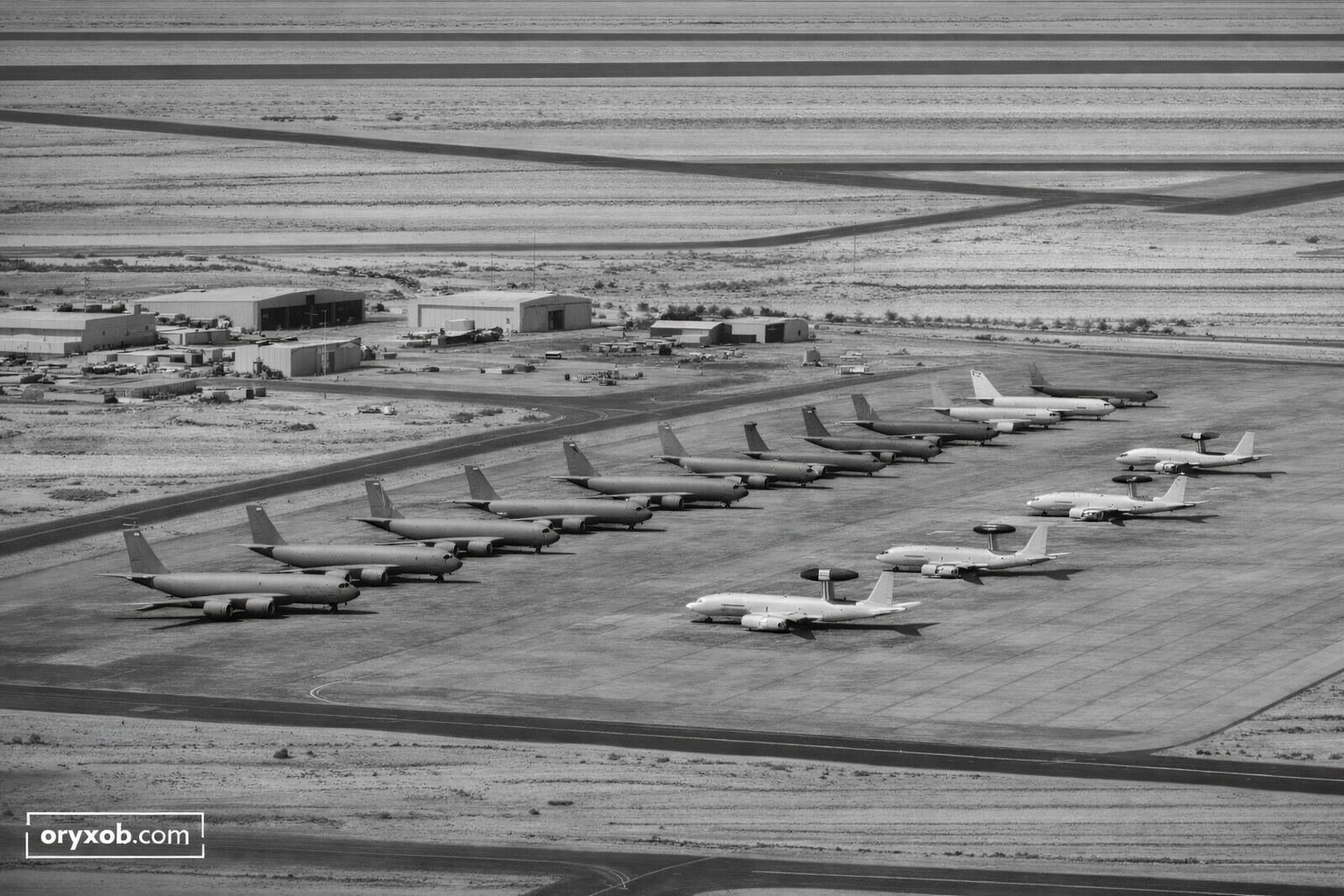
Satellite imagery has shown a sharp jump in the number of US military aircraft parked at Prince Sultan Air Base in Al Kharj, underscoring how Saudi Arabia is quietly serving as a key staging hub as Washington ramps up pressure on Iran.
In high-resolution images dated 21 February, at least 43 aircraft were visible on the base’s apron, up from 27 seen on 17 February. The total later fell to 38 aircraft in imagery dated 25 February.
The aircraft observed were heavily weighted towards the kinds of platforms that enable and coordinate long-range operations: aerial refuelling tankers and airborne surveillance and command-and-control aircraft. Analysts identified 13 KC-135 Stratotankers and six E-3 Sentry aircraft (AWACS) among 29 large aircraft in the 21 February image.
The build-up sits uneasily alongside Saudi messaging to Tehran. In late January, Saudi Crown Prince Mohammed bin Salman told Iran’s president that the kingdom would not allow its airspace or territory to be used for military action against Iran. Yet refuellers and AWACS are precisely the assets that make an air campaign feasible — even if strike aircraft launch from elsewhere — raising questions about whether Riyadh’s assurances are political theatre rather than policy.
For Saudi citizens, there is a deeper issue: a major strategic decision with potentially catastrophic consequences is being made behind closed doors, without parliamentary oversight, public debate, or accountability. If tensions spiral into open conflict, Saudi Arabia would likely be viewed as part of the operational backbone — and could find itself exposed to retaliation — while the leadership markets “stability” abroad and “reform” at home.
The aircraft movements come as US–Iran nuclear talks continue under Omani mediation, with further technical discussions expected in Vienna, even as Washington signals it is preparing for military options.