
Toua Centre for Research and Studies
Introduction
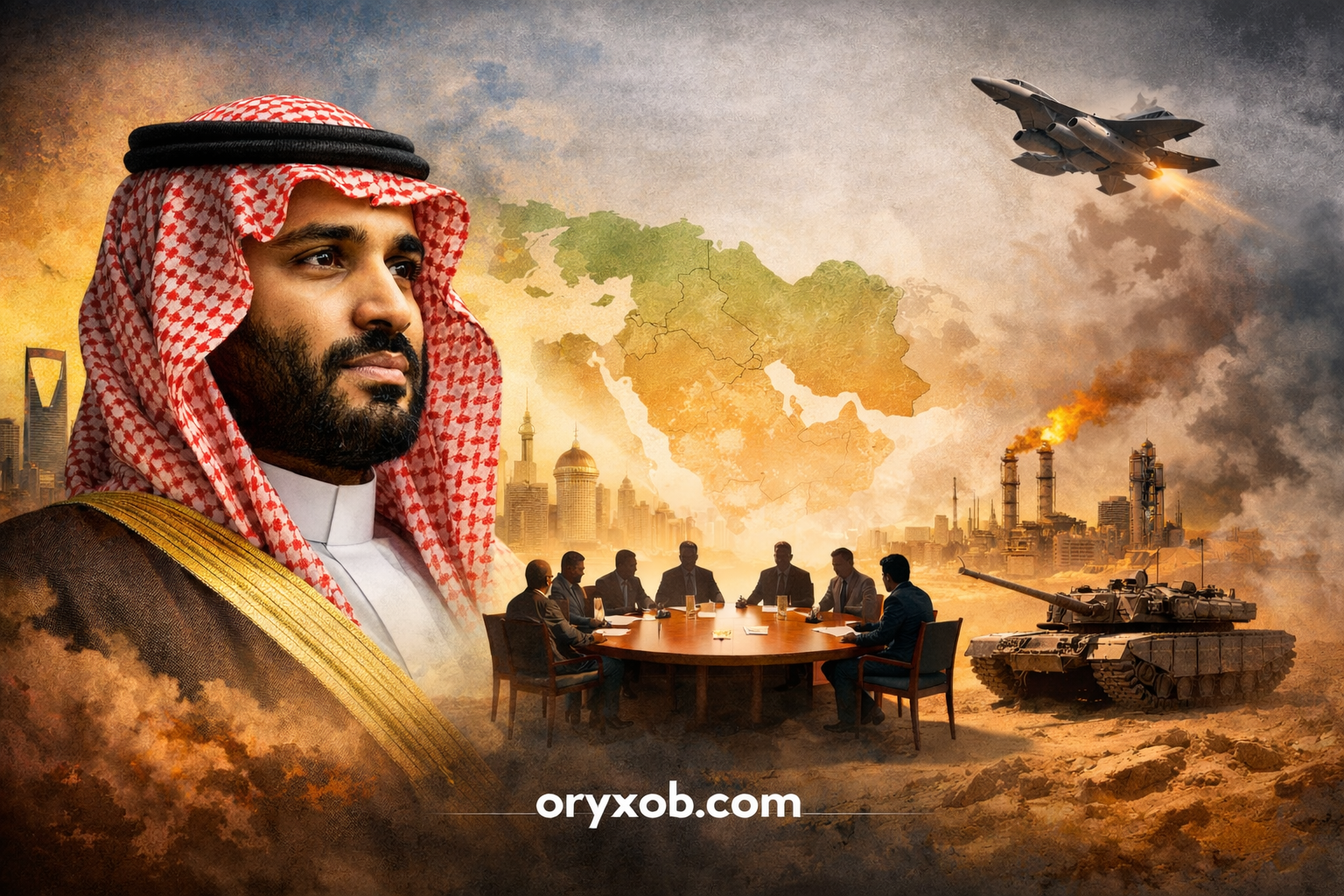
Under the authority of Mohammed bin Salman, the Kingdom of Saudi Arabia is undergoing a radical transformation in its foreign policy, shifting from a long-standing approach of caution and preservation of the status quo to a proactive and interventionist strategy that seeks to position Saudi Arabia as an indispensable player in West Asia. Riyadh is striving to leverage its religious and economic weight, alongside political backing from major allies such as the United States (particularly during the Trump era), in order to play the role of mediator in regional conflicts — from the Gulf crisis, to US–Iranian relations, and extending to Sudan and Syria.
This raises a number of questions: what opportunities have enabled Mohammed bin Salman to pursue such a role? And what structural obstacles and challenges does he face, whether at the Arab or international level?
It is important to note that Saudi foreign policy is no longer what it was in previous decades. For a long time, Saudi Arabia functioned as a “silent power”, operating through regional institutions such as the Gulf Cooperation Council and the Organisation of Islamic Cooperation, favouring behind-the-scenes solutions, traditional alliances, and indirect diplomacy. Today, driven by Mohammed bin Salman’s assertive vision, Saudi Arabia is emerging as a “high-profile power” seeking to redraw the regional map.
This transformation is driven by two main factors. First, the pressing need for a stable regional environment to ensure the success of the ambitious economic project known as Vision 2030. Second, the concentration of political authority in the hands of Mohammed bin Salman, which enables him to take bold decisions that were previously impossible due to the requirement for consensus within the royal family.
This study proceeds from the assumption that Mohammed bin Salman, the de facto ruler of Saudi Arabia — long characterised as a “rentier state allied with the United States” — is attempting to resolve Saudi Arabia’s transformation into a “middle regional power” that utilises its economic, energy, and religious weight, alongside the political cover provided by a second Trump administration, to play the role of mediator in regional crises: between Washington and Tehran, across the Syria–Lebanon track, in Sudan, Yemen, and elsewhere.
The study is divided into interconnected sections and draws on recent research in order, as far as possible, to outline future scenarios for the Saudi role, in light of the dynamics of political change and the opportunities that may emerge within the context of Saudi diplomatic activity at both the regional and international levels.
Foundations of Saudi Ambition: Drivers and Capabilities of the Regional Role
To understand the boldness of Saudi Arabia’s recent diplomatic movement, it is necessary to analyse both the tools at Riyadh’s disposal and the motivations driving its behaviour.
Historical and Religious Weight (Soft Power)
a. Custodianship of the Two Holy Mosques
The Arabian Peninsula — large parts of which fall under Saudi sovereignty — occupies a unique position as the custodian of Islam’s two holiest sites: the Sacred Mosque in Mecca and the Prophet Muhammad’s Mosque in Medina. This status grants Saudi Arabia immense spiritual influence over more than one billion Muslims worldwide. Such religious prestige can be converted into political influence, particularly in mediation efforts that require trust from multiple parties.
b. Leadership of the Sunni World
Historically, Saudi Arabia has been the principal competitor to major Sunni centres in Egypt and Turkey, and later to Iran, albeit on the basis of sectarian divergence. This position grants Riyadh a form of legitimacy in representing a large Sunni bloc, which it has used as leverage in Arab, Islamic, and even international political files.
Economic Power (A Tool of Incentives and Pressure)
Vision 2030 and the Public Investment Fund
Saudi Arabia no longer relies solely on oil. Its vast sovereign wealth fund has become a powerful diplomatic instrument, capable of offering investments and economic assistance to states in crisis — such as Pakistan, Egypt, Sudan, Syria, and Lebanon — in exchange for political positions or mediation roles.
Energy Power
Despite economic diversification efforts, Saudi Arabia remains the world’s largest oil exporter. Its ability to influence global energy markets provides it with substantial leverage in major decision-making capitals, particularly Washington.
Political Will and the Centralisation of Power
Rapid Decision-Making
Unlike the previous system, which required consensus among senior princes through what was known as the “Family Council”, Mohammed bin Salman now controls the key levers of political, security, and economic decision-making without referring to other senior or junior princes. This allows him to act swiftly and discreetly — a crucial requirement for successful mediation.
American Cover (The Trump Factor)
US President Donald Trump described Mohammed bin Salman, during their meeting on 18 November 2025, as the “King of the Future”, offering him unprecedented political support. This backing gave Riyadh a sense of immunity and encouraged it to adopt more daring policies, under the belief that Washington would stand by it regardless of circumstances.
From the “Oil for Protection” Formula to Vision 2030
The Golden Era of the Formula (1945–1990)
Following the Second World War, the United States was searching for reliable sources of energy, while King Abdulaziz was in the process of building a nascent state and required a powerful ally capable of guaranteeing its security. The implicit agreement between Ibn Saud and Franklin D. Roosevelt proved ideal for both parties.
Washington secured vast oil concessions through the Arabian American Oil Company (Aramco) and ensured the steady flow of oil at reasonable prices. In return, Riyadh obtained American political and military backing, which consolidated its regional standing.
During the meeting between Ibn Saud and Roosevelt aboard the USS Quincy on 14 February 1945, the American side requested Saudi mediation in the Palestinian question. According to Robert Lacey, Roosevelt believed that the British were mishandling the issue and that Jewish lobbying groups in the United States were exaggerating the need for a Jewish national homeland, turning it into a major domestic political issue.
Throughout this period, Saudi Arabia played a largely conservative role within the Arab system, functioning as a “stabilising force” that counterbalanced nationalist and revolutionary currents, particularly during the era of Gamal Abdel Nasser in Egypt. This formula reached its peak during the 1991 Gulf War, when the United States and Saudi Arabia allied to liberate Kuwait — a direct application of the security (protection) component of the agreement.
The Beginning of the Cracks (2001–2015)
The relationship began to fracture following the 11 September 2001 attacks. The involvement of fifteen Saudi nationals among the nineteen hijackers placed enormous strain on relations with the United States and led to a gradual erosion of trust. This was followed by the US invasion of Iraq in 2003, which Riyadh opposed, resulting in a security vacuum that increased Iranian influence — Saudi Arabia’s principal regional rival — a development Riyadh viewed as a failure on Washington’s part to uphold its promised security guarantees.
With the outbreak of the Arab Spring in 2011, the rift widened further. Riyadh perceived popular uprisings as an existential threat to traditional ruling systems, while Washington initially expressed sympathy for democratic aspirations across the region. Saudi leaders came to feel that the United States was no longer a reliable security guarantor, particularly as it began to “pivot to Asia” and reduce its commitment to the Middle East.
The End of the Old Formula and the Beginning of a Strategic Transformation
With the rise of Mohammed bin Salman, an entirely new phase began — one no longer grounded in the traditional formula. The contours of the MbS era can be summarised across three main axes:
Economic Transformation (Vision 2030)
At the core of Vision 2030 lies economic diversification and the reduction of total dependence on oil. This reflects Saudi Arabia’s desire to move beyond the role of a mere “petrol station for the world”. Consequently, the “oil” component of the old equation has lost its relative importance as a singular political tool, becoming instead one element within a more diversified and resilient economic structure.
That said, oil remains fundamental to the national economy and a principal source of state revenue (accounting for no less than 60 per cent at minimum). Moreover, the promise of complete emancipation from oil by 2020 — as previously stated by Mohammed bin Salman — remains distant, with no clear indicators suggesting its realisation in the foreseeable future.
A More Independent and Assertive Foreign Policy
Saudi Arabia no longer waits for a “green light” from Washington before acting. The military intervention in Yemen in 2015, the diplomatic boycott of Qatar in June 2017, and energy policy decisions within OPEC+ that angered the Biden administration all point to a state seeking to impose its own regional agenda, even when it clashes with short-term American interests.
Diversification of Strategic Partnerships
Riyadh has increasingly focused on building strong relationships with other global powers. Russia has become a key partner in managing oil markets through OPEC+. Saudi Arabia has also strengthened ties with China, which has become its largest trading partner, and joined the BRICS grouping (before later withdrawing under US pressure). These moves — both symbolic and substantive — aim to reduce exclusive reliance on the United States in both security and economic domains.
A Preliminary Conclusion
The “oil for protection” formula no longer governs Saudi–American relations. Instead, the relationship has evolved into a more complex strategic partnership, driven primarily by overlapping interests. Saudi Arabia is no longer merely a security client; it has become a regional actor seeking to shape its own destiny, propelled by an ambitious vision of the future and a deep awareness that the world is no longer unipolar, as it was in 1945.
The Structural Context of the Saudi Role under Mohammed bin Salman
1. From an “Allied State” to a “Middle Power”
For nearly seven decades, the “oil for protection” formula served as the foundation of the Saudi–American alliance. Saudi Arabia guaranteed stable oil supplies to the West in exchange for an American security umbrella that shielded it from regional threats. This model, however, was never static; it underwent significant evolution and periods of strain, culminating in a profound turning point during the era of Mohammed bin Salman.
Three major transformations can be identified under MbS:
– An initially aggressive, then corrective, foreign policy posture
This trajectory is evident in the war in Yemen, the crisis with Qatar, and the blockade of Lebanon, followed by a subsequent return to de-escalation and diplomatic openness.
– The linkage of foreign policy to a vast domestic project — Vision 2030
This linkage imposes an imperative for regional stability in order to attract investment and develop tourism and technology sectors.
– An attempt to construct the image of a “middle power”
Saudi Arabia seeks to balance its partnerships — with the United States, China, Russia, and Europe — rather than being tethered to a single axis.
2. Soft Power and Image-Making
Recent studies suggest that soft power has become a central instrument of Saudi foreign policy. This includes investment in sports, culture, entertainment, and public diplomacy, aimed at improving the Kingdom’s image following crises such as the killing of Jamal Khashoggi, the war in Yemen, the Ritz-Carlton detentions, and the abduction and forced resignation of Lebanon’s prime minister from Riyadh. These efforts seek to reinforce the legitimacy of Saudi Arabia’s new regional role.
3. Regional Repositioning after 2019–2023
Several developments have pushed Riyadh towards diversifying partnerships and adopting a policy of “hedging” rather than rigid alignment. These include the gradual American withdrawal from West Asia, the war in Ukraine, and intensifying US–China tensions.
The 2019 attacks on Aramco facilities, and the events that followed, convinced Saudi decision-makers that full security dependence on Washington was costly. This paved the way for a policy of de-escalation with Iran, re-engagement with Damascus, and the reorganisation of Gulf relations.
Structural Implications
In this sense, the structural environment — shaped by shifts in the international system, domestic pressures, and the Vision 2030 project — creates a strong incentive for Saudi Arabia to assume the role of mediator and de-escalator among parties embroiled in conflict, much as it did during the early years of King Salman’s reign.
Features of Saudi “Mediation Diplomacy” over the Past Decade
1. The Saudi–Iranian Agreement (Beijing 2023) as a Turning Point
On 10 March 2023, Saudi Arabia and Iran announced the resumption of diplomatic relations and the reopening of embassies, following an agreement signed in Beijing under Chinese sponsorship. The agreement included the reactivation of a security accord originally signed in 2001, as well as a commitment to respect state sovereignty and refrain from interference in internal affairs.
Symbolically, the agreement reflected Saudi Arabia’s transition from the position of a direct “adversary” to that of a cautious partner within fragile regional security arrangements. It also paved the way for a reduction in escalation in Yemen and the Gulf.
At the same time, however, the agreement exposed the limits of Saudi Arabia’s capacity as an independent mediator. China played the primary mediating role, while Saudi Arabia itself was one of the conflict’s principal parties rather than an external intermediary.
Nevertheless, Riyadh has since utilised the agreement as diplomatic capital vis-à-vis both Washington and Tehran. It remains the only Gulf state maintaining active and effective channels of communication with both capitals simultaneously.
In practical terms, Saudi Arabia seeks to position itself as a mediator between its two most formidable adversaries, with the aim of preventing a destructive regional war that would threaten Vision 2030. Concurrently, Riyadh seeks to ensure that any future nuclear agreement does not strengthen Iran at Saudi Arabia’s expense.
Saudi Arabia succeeded in opening discreet communication channels with Tehran, culminating in the historic Chinese-brokered agreement of 2023 to restore diplomatic relations — a step that restored part of Riyadh’s diplomatic prestige.
The Syria and Lebanon Files
Syria: From Boycott to Leading the “Arab Return”
In May 2023, Jeddah hosted the Arab League summit that marked the return of the Syrian regime, led by Bashar al-Assad, to its seat after a suspension that had lasted since 2012. Shortly thereafter, Saudi Arabia appointed its first ambassador to Damascus in over a decade, signalling a gradual normalisation of relations.
Following the fall of Bashar al-Assad on 8 December 2024, Saudi Arabia emerged as one of the most prominent Arab actors in what became known as “the new Syria”. Riyadh hosted the foreign minister of the new Syrian government and imposed itself as a key partner in reconstruction efforts and in facilitating Syria’s return to the regional system under conditions designed to reduce Iranian influence.
In this file, Saudi Arabia appears closer to a “balancing power” vis-à-vis Turkey, and some analysts describe it less as a neutral mediator than as a “leader of an Arab settlement”. Riyadh is actively reshaping the Syrian environment in line with its own interests: combating the Captagon trade, curbing Iranian influence, opening new markets for Saudi capital, and counterbalancing Turkish and Qatari influence.
Lebanon: From Rupture to Conditional Re-Engagement
Saudi–Lebanese relations witnessed sharp deterioration from 2021 onwards, including the expulsion of ambassadors and the ban on Lebanese imports, following Lebanese criticism of the war in Yemen and the growing influence of Hezbollah.
The crisis was triggered by remarks made by Lebanese Information Minister George Kordahi, broadcast on 26 October 2021 but recorded earlier that August, prior to the formation of Lebanon’s new government. In relation to the Yemen war, Kordahi stated that “the time has come to stop this war because it is futile”, adding that Ansar Allah were “defending themselves against external aggression”.
Saudi Arabia responded on 27 October 2021 with a brief Foreign Ministry statement expressing “regret” over the “offensive” remarks, and announced that its ambassador in Beirut had submitted an official protest to the Lebanese Foreign Ministry.
Riyadh had expected Kordahi to resign voluntarily or be forced to step down, as had occurred earlier that year with Foreign Minister Charbel Wehbe, who resigned after remarks accusing Gulf states of contributing to the rise of the so-called Islamic State.
However, following Israel’s war on Lebanon in September 2024 and the election of Joseph Aoun as president in early 2025 with Saudi and Western backing, Riyadh began a process of conditional political and economic re-engagement aimed at curbing Hezbollah’s influence.
Saudi Arabia intervened directly to pressure its parliamentary and ministerial allies into supporting the appointment of Nawaf Salam as prime minister, reversing the previous consensus around the reappointment of Najib Mikati.
In this context, Saudi Arabia is not merely a mediator between Lebanese factions, but a principal actor in the internal balance of power. It links aid and investment to reshaping the domestic political equilibrium in confrontation with Hezbollah and its allies, going beyond mediation to active participation in redefining Lebanon’s “new era”.
Sudan: The Jeddah Platform and the Limits of Mediation
With the outbreak of war between the Sudanese Armed Forces and the Rapid Support Forces in April 2023, Saudi Arabia played a prominent role in the evacuation of foreign nationals, earning significant humanitarian capital.
Riyadh subsequently hosted two rounds of talks between the Sudanese army and the Rapid Support Forces in Jeddah. Officially, this role was framed as an effort to prevent the collapse of a neighbouring state, avert the flow of refugees and armed groups, and secure the eastern coast of the Red Sea. Unofficially, it also aimed to prevent Mohamed Hamdan Dagalo (Hemeti) from achieving a decisive victory that would favour the United Arab Emirates.
Had Saudi mediation succeeded, it would have substantially enhanced Riyadh’s image as a regional stabilising power.
In May 2023, Saudi Arabia, in partnership with the United States, launched the “Jeddah Platform”, which produced the Jeddah Declaration — a set of principles aimed at protecting civilians — alongside repeated attempts to secure a ceasefire. These efforts, however, collapsed due to the lack of commitment from the warring parties.
Subsequently, the effectiveness of the Jeddah Platform declined as the centre of mediation shifted towards alternative tracks, including the Horn of Africa, the African Union, and United Nations envoys. This occurred amid accusations that certain regional actors — particularly the United Arab Emirates — were fuelling the conflict militarily.
Recent studies on Saudi “niche diplomacy” classify Sudan as one of the clearest examples of Saudi Arabia’s multi-role mediation approach, in which Riyadh acts simultaneously as mediator, investor, and member of a regional “quartet”. This multiplicity of roles has raised serious questions regarding Saudi Arabia’s neutrality.
Yemen: The Mediator–Adversary
Yemen represents the most complex and contentious case. Saudi Arabia is not a neutral mediator but a direct party to the conflict. Nevertheless, Riyadh has led mediation efforts aimed at reaching a political settlement, particularly in light of the immense human and material costs of the war. Mediation here proceeds from a “position of power”, as Saudi Arabia seeks to impose conditions that ensure Yemen does not transform into a competing force within the axis of resistance opposed to the American project in the region.
In Yemen, this contradiction manifests clearly in several ways:
– Saudi Arabia has been a direct participant in the war since 2015 and the leader of the military coalition.
– At the same time, Riyadh has hosted negotiations and ceasefire talks with Sana’a (the Ansar Allah movement), supported the UN envoy’s efforts to halt the war and launch a political process, and presented itself as a guarantor of any future agreement.
This dual role has been rejected by the Sana’a authorities, who continue to view Saudi Arabia as a principal party in the aggression against Yemen rather than a credible mediator.
Specialised studies demonstrate that Saudi Arabia’s multiple roles — as military power, financier, and mediator — have made it difficult to regard it as a neutral intermediary, despite its logistical and political importance to any eventual settlement.
A Preliminary Assessment
The most likely scenario is that Saudi Arabia will assume the role of “party–guarantor” within a UN- or regionally sponsored agreement, possibly led by Oman or the United Nations. Consequently, Riyadh’s capacity to function as a purely neutral mediator in Yemen remains constrained by its extensive military record in the country.
The Second Trump Cover and the Defence Agreement Equation
1. The Defence–Normalisation Track
Reports published in 2024 spoke of a draft US–Saudi defence treaty “similar to the US–Japan alliance”, accompanied by an executive defence cooperation agreement, in exchange for Saudi steps towards normalisation with Israel and a civilian nuclear agreement.
This track faltered as a result of the war in Gaza and widespread Arab public opposition. By late 2024, Saudi Arabia announced that it had abandoned efforts to pursue a formal defence treaty, citing Congress’s insistence on linking it to normalisation with Israel. Riyadh instead settled for a less binding military cooperation memorandum.
In 2025, the defence agreement file returned to the forefront with the advent of a second Trump administration, particularly following Mohammed bin Salman’s visit to Washington on 18 November of that year, during which a defence agreement was announced. According to the White House “fact sheet” summarising the outcomes of the meeting between Trump and Mohammed bin Salman:
President Trump and Crown Prince Mohammed bin Salman signed the US–Saudi Strategic Defence Agreement, a historic accord that strengthens our defence partnership spanning more than 80 years and reinforces deterrence in the Middle East. This agreement represents a victory for the “America First” policy, as it facilitates the operation of US defence companies in the Kingdom of Saudi Arabia, ensures substantial new funding from the Kingdom to share the burden of covering American costs, and confirms that the Kingdom considers the United States its primary strategic partner.
The defence agreement, alongside other elements such as the purchase of F-35 fighter jets and a civilian nuclear programme, was framed as part of a comprehensive deal linked to regional security arrangements and intended to pave the way for an expansion of the so-called “Abraham Accords”.
Implications of This Cover for the Mediation Role
Potential advantages:
– An American security guarantee that bolsters regime confidence in pursuing diplomatic risk-taking without fear of major external threats.
– Access to advanced military technology, positioning Saudi Arabia as a security actor that cannot be ignored in regional arrangements.
– Political bargaining leverage, allowing Riyadh to market itself in Washington as an indispensable mediator with Tehran, the “new Syria”, Lebanon, and Sudan, in exchange for reinforcing its status as the Gulf’s primary security partner.
However, this also entails significant risks:
– It exposes Saudi Arabia to accusations of alignment with the US–Israeli agenda, thereby undermining its credibility as a mediator in sensitive files such as Gaza, Iran, Syria, and Lebanon.
– It opens the door to competition from other actors — notably China, Qatar, and Turkey — who present themselves as “less biased” mediators.
Why Saudi Arabia Has Hesitated on Normalisation
In any case, Mohammed bin Salman’s hesitation to proceed with normalisation with Israel is not primarily driven by popular sentiment alone, but rather by a set of strategic calculations, most notably:
1. Israeli Intransigence Regarding:
– The arming of Saudi Arabia with F-35 fighter jets and approval of a civilian nuclear programme.
– Israel’s refusal to offer even symbolic commitments towards facilitating the establishment of a future Palestinian state.
2. Hollow American Promises Regarding:
– The F-35 deal, which has remained largely symbolic.
– A civilian nuclear programme lacking a clear roadmap.
– A defence agreement that does not carry binding obligations comparable to US treaties with Japan, South Korea, or other formal allies.
A number of writers and analysts have argued openly that Saudi Arabia is unlikely to complete normalisation with Israel unless it secures “substantial strategic gains” in advance — including a robust US defence treaty, advanced weaponry, support for a civilian nuclear programme, and guarantees or facilitation measures related to the future establishment of a Palestinian state.
This assessment is not populist in nature. It has appeared in credible political analyses examining the Saudi–American–Israeli negotiation track. Studies by the Washington Institute for Near East Policy, for example, clearly indicate that Saudi Arabia was not merely seeking diplomatic normalisation with Israel, but was demanding security guarantees, access to advanced weapons, and support for a civilian nuclear programme as prerequisites for any future agreement. This effectively ties Riyadh’s normalisation to tangible strategic gains, not only to the Palestinian issue.
At the same time, major international media outlets have extensively discussed Saudi Arabia’s pursuit of a civilian nuclear programme, viewing it as part of a broader strategy aimed at enhancing technological sovereignty and strategic security, alongside expanded security guarantees in exchange for normalisation. Some of these demands have been described by Israeli and American sources as an “excessive price” for a normalisation agreement.
Nuclear–Defence Negotiations and the Normalisation Linkage
Even prior to Trump’s visit to Riyadh in May 2025, discussions had already linked civilian nuclear cooperation, a defence agreement, and dialogue over normalisation with Israel. Although some sources later suggested that the linkage between the civilian nuclear file and normalisation had been loosened, this in itself indicates that Saudi Arabia viewed these issues as interdependent packages.
Other analyses reiterate the same conclusion: Saudi Arabia has pressed for support for a civilian nuclear programme and comprehensive upgrades to its military capabilities in exchange for any normalisation step. This reflects a strategic reading in Riyadh that prioritises strengthening its security position before entering politically risky arrangements such as public normalisation.
From this perspective, the Saudi strategic calculus can be summarised as follows:
– Saudi Arabia is unwilling to pursue political normalisation with Israel without sufficient security guarantees that shield it from the repercussions of regional conflict.
– Advanced weaponry and defence assurances place Riyadh in a position of strength rather than one of political concession.
– A civilian nuclear programme is viewed as a key component of technological sovereignty and long-term strategic security.
Offering a major political concession such as normalisation before securing substantial security and economic gains would likely be perceived domestically as weakness or premature compromise.
Accordingly, the most likely option in Saudi–Israeli relations remains the continuation of covert cooperation rather than overt peace.
Mohammed bin Salman’s Opportunities to Play the Role of Mediator in Specific Files
1. The US–Iran Track
Sources of Strength
Saudi Arabia today is the only Arab state that simultaneously combines:
– A strategic alliance with Washington, including efforts to secure a formal defence agreement.
– Renewed diplomatic and security relations with Tehran following the Beijing Agreement.
The linkage between Gulf stability, oil prices, and Saudi security makes Riyadh an actor that cannot be bypassed in any US–Iranian negotiations concerning the nuclear file, maritime security, or energy markets. The experience of 2015 — when the Obama administration concluded a nuclear agreement with Iran without Saudi knowledge — demonstrated that Riyadh is capable of playing a decisive role in either facilitating or obstructing any future agreement between Washington and Tehran.
Constraints
The primary mediating role in the 2023 agreement was played by China, meaning that Beijing now holds key “major mediation” cards between Riyadh and Tehran — and potentially between Tehran and Washington in the future — particularly given China’s growing ambition to act as a global mediator.
Moreover, any advanced Saudi–American defence agreement or overt normalisation with Israel would weaken Tehran’s confidence in Saudi neutrality, pushing Iran to favour alternative channels such as Muscat, Doha, or Baghdad. Indeed, Iran’s Supreme Leader, Ali Khamenei, has denied the existence of any mediation by third parties between Iran and the United States, while the Iranian Foreign Ministry has also denied that Tehran requested Saudi mediation with Washington to facilitate negotiations.
Assessment of the Opportunity
Mohammed bin Salman may be able to position Saudi Arabia as a supportive “back-channel” that helps to de-escalate US–Iranian tensions, rather than as a principal or formal mediator. In other words, Riyadh’s role would be closer to that of a facilitator than that of a neutral intermediary.
Testing the Mediation Role: Case Models
a. Syria and Lebanon: From Rehabilitation to Engineering Balances
Syria
Following the fall of Bashar al-Assad, Saudi Arabia emerged as the leading Arab actor in sponsoring Syria’s return to the formal Arab regional order. Riyadh hosted senior representatives of the new Syrian authorities and linked reconstruction efforts to curbing Iranian influence and combating the Captagon trade.
This positioning has granted Saudi Arabia a privileged role as a potential regional guarantor in any future understandings between competing Syrian actors, as well as an intermediary between “the new Syria” and Western states. This is precisely the role Mohammed bin Salman is currently attempting to perform, particularly in mediation between Donald Trump and Ahmed al-Sharaa.
However, Saudi Arabia enters this arena not as a neutral mediator, but as a party with a clear agenda: weakening the Iranian–Turkish–Qatari axis in favour of a new Arab محور led directly by Riyadh.
Lebanon
In Lebanon, Saudi Arabia is now exerting pressure to rebalance the political system in the aftermath of the war with Israel. This includes backing President Joseph Aoun and insisting on a gradual plan to disarm Hezbollah.
Furthermore, Riyadh conditions economic re-engagement on the fulfilment of requirements closely aligned with American and Israeli demands — particularly those related to disarming the resistance and reducing Hezbollah’s influence within the state, including through the closure of its financial, educational, and cultural institutions.
This approach grants Saudi Arabia considerable leverage, but it simultaneously positions it closer to a partisan actor within Lebanon’s internal power struggle rather than as a supra-factional mediator.
Assessment of the Opportunity
In both Syria and Lebanon, Saudi Arabia’s interest in reshaping the regional environment to serve its own strategic priorities introduces a structural bias into its mediation role. Nevertheless, Riyadh may still act as a “guarantor” of agreements brokered by other actors — such as the United Nations, France, Qatar, or Egypt — provided it is willing to share influence rather than monopolise the mediation process.
b. Sudan: A Test Between Influence and Neutrality
Sources of Strength
Saudi Arabia’s hosting of the Jeddah Platform, its participation in the regional “quartet”, and its capacity to offer financial incentives to Sudanese actors position it as a central player in any ceasefire or transitional arrangement.
Moreover, recent statements by Donald Trump expressing support for prioritising a political settlement in Sudan — reportedly following a request by Mohammed bin Salman — provide potential American cover for a Saudi-led mediation track.
Constraints
The entanglement of regional interests — particularly those of the United Arab Emirates, Egypt, and Russia — limits Saudi Arabia’s ability to act independently and exposes it to accusations of complicity or bias.
The previous failure of the Jeddah Platform undermined confidence in its effectiveness, unless the conditions of negotiation undergo substantial change.
Assessment of the Opportunity
Mohammed bin Salman could attempt to transform “Saudi–American mediation” in Sudan into a successful model, provided he is able to neutralise contradictions among allies — especially the United Arab Emirates — and accept a greater role for the African Union and the United Nations in sharing the burden of mediation.
c. Yemen: Mediation Entangled in a Protracted Conflict
Saudi Arabia possesses key levers that could contribute to ending the war in Yemen: control over airspace and maritime access, influence over the Presidential Leadership Council and coalition forces, the capacity to offer substantial economic incentives within a reconstruction framework, and close ties with Washington and London.
At the same time, however, Saudi Arabia remains a principal party to the conflict and bears responsibility for a significant share of the destruction. This renders its acceptance as a mediator by the Sana’a authorities highly problematic, even if it is accepted as a negotiating party.
Recent studies indicate that Saudi Arabia’s multiplicity of roles — as a military power, financier, and mediator — undermines confidence in its neutrality unless the terms of mediation are fundamentally altered.
Assessment of the Opportunity
The most plausible scenario is that Saudi Arabia assumes the role of a “party–guarantor” within a UN- or regionally sponsored agreement led by Oman or the United Nations. Accordingly, Riyadh’s ability to act as a purely neutral mediator in Yemen remains limited by its military record and direct involvement in the conflict.
Structural and Self-Imposed Obstacles to Consolidating Saudi Arabia’s Role as a Mediator
Despite the available opportunities, Saudi ambitions face fundamental obstacles that may constrain their effectiveness.
1. The Credibility Gap
The war in Yemen
The war led by Saudi Arabia has inflicted severe damage on its image as a force for peace, particularly in light of harrowing images of civilian casualties.
The killing of Jamal Khashoggi
This event not only damaged the personal image of Mohammed bin Salman, but also Saudi Arabia’s standing as a state accused of violating international law. It is difficult to function as a neutral and credible mediator while being associated with such a blatant human rights violation.
As such, Saudi Arabia’s human rights record constitutes one of the most significant obstacles to any mediation role Mohammed bin Salman might personally seek to play. The Khashoggi case, mass arrests of dissidents, and politically motivated death sentences remain highly visible in Western media and human rights discourse, and are routinely used to constrain attempts to market Mohammed bin Salman as a “man of peace” or a trustworthy intermediary.
This image does not entirely negate Saudi Arabia’s capacity for mediation — the United States itself often plays a biased mediating role — but it does impose ethical and political ceilings on Saudi mediation in the eyes of a broad segment of global public opinion and liberal elites.
2. Deep Regional Rivalries
Iran
The historical hostility between Riyadh and Tehran makes it difficult to build genuine trust. Any Saudi mediation — particularly in files such as Iraq or Lebanon — is likely to be perceived as serving Saudi interests at Iran’s expense.
Turkey and Qatar
Tense relations with these two active regional players present a serious challenge. Both seek to expand their regional influence and may oppose Saudi initiatives they perceive as attempts at regional domination.
More broadly, the United Arab Emirates, Qatar, Turkey, and Egypt all constitute serious competitors to Saudi Arabia in mediation and influence across multiple files, from Syria and Lebanon to Palestine, Libya, and the wider Horn of Africa.
Meanwhile, China has emerged as an ascending mediator following the Beijing Agreement, while Oman and Qatar continue to maintain reputations as “clean mediators” in sensitive files involving Iran, the Taliban, and Hamas.
3. Arab Scepticism
Many Arab states — particularly smaller ones — view Saudi ambition with caution. Fear of “Saudi hegemony” makes them reluctant to fully commit to initiatives led by Riyadh, preferring instead to maintain balanced relations with other regional powers.
The multiplicity of Saudi roles in conflict arenas has further undermined confidence in the credibility and integrity of its mediation. As studies on Yemen and Sudan have shown, Saudi Arabia’s simultaneous functions as financier, military intervenor, and partner in overlapping alliances weaken its image as a neutral actor.
4. Volatility of US Policy
The “Trump cover” has been a double-edged sword. With the arrival of the Biden administration — which placed greater emphasis on human rights and adopted a more cautious stance towards Saudi Arabia — Riyadh found itself in a more constrained position.
This fluctuation in US policy renders long-term strategies that rely heavily on American backing inherently risky. Regardless of the depth of Saudi ties with China and Russia, the Kingdom remains structurally dependent on the American security umbrella — including air defence systems, early warning capabilities, advanced weaponry, and training.
Accordingly, any Saudi mediation in conflicts that directly affect American or Israeli interests is likely to be interpreted as part of a broader US strategic architecture rather than as an independent Saudi initiative. This perception reduces the likelihood of acceptance by actors such as Iran or resistance movements in Palestine and Lebanon.
5. The Tension Between Arab Public Opinion and Normalisation Projects
Recent opinion polls within Saudi Arabia have revealed strong popular sympathy for the Palestinian resistance, widespread calls to sever relations with Israel, and deep scepticism towards Israeli narratives surrounding 7 October.
In the months immediately following 7 October 2023, surveys indicated a sharp increase in positive attitudes towards Hamas compared with polls conducted in August 2023. Furthermore, 95 per cent of Saudi respondents stated that they did not believe Hamas had killed civilians on 7 October. An overwhelming 88 per cent strongly agreed with the proposition that Arab states should immediately cut all diplomatic, political, economic, and other ties with Israel in protest against its military actions in Gaza. A similar proportion (87 per cent) agreed that “recent events show that Israel is weak and internally divided to the extent that it can one day be defeated”.
Consequently, any normalisation pathway — even if framed in the language of “mediation” or “peace” — risks eroding Saudi Arabia’s legitimacy as a mediator in the eyes of wide segments of Arab public opinion.
6. Personalisation of the Role Around Mohammed bin Salman
A significant body of literature points to the construction of a personal “brand” around Mohammed bin Salman, to the extent that he is often presented as synonymous with the state itself. This grants him a high capacity for decisive action, but it simultaneously ties Saudi Arabia’s image and credibility to a single individual, his personal inclinations, and his unilateral decision-making, rather than to stable and institutionalised governance structures.
This personalisation increases both effectiveness and risk: it enables swift and bold diplomacy, yet renders Saudi Arabia’s regional role vulnerable to sudden shifts driven by individual calculations, misjudgements, or reputational shocks. As a result, Saudi mediation efforts become more exposed to volatility and less insulated by institutional continuity.
Future Scenarios for Saudi Arabia’s Regional and International Role
Based on the preceding analysis, several scenarios can be envisaged regarding the future of Saudi Arabia’s role:
Scenario One: The Successful Regional Mediator (Most Optimistic)
Vision 2030 succeeds in creating a strong and diversified economy, providing Saudi Arabia with vast financial tools. Riyadh continues to build trust with Iran and manages to play a decisive role in resolving conflicts in Syria, Yemen, and Sudan. Saudi Arabia’s position becomes indispensable to any regional stability framework, compelling the United States and major powers to engage with it as a core strategic partner, regardless of who governs in Washington.
Scenario Two: Consolidation as a “Mediating Middle Power” (Cautious Optimism)
This scenario rests on several conditions:
- The conclusion of a defence agreement with the United States that provides Saudi Arabia with credible security guarantees, without tying it to excessive normalisation with Israel that would erode its remaining Arab public legitimacy.
- The deepening of a de-escalation policy with Iran, and the institutionalisation of the Beijing Agreement into a regional security mechanism involving Gulf states, Iraq, Egypt, and Turkey — with Saudi Arabia playing a central, though not exclusive, role.
- The success of Saudi “mediation-as-guarantee” in specific arenas: contributing to the end of the war in Sudan, facilitating transitional arrangements in Yemen, and consolidating settlements in Syria and Lebanon.
Under this scenario, Saudi Arabia becomes a regional “hub” for multiple settlements, benefiting from Trump-era cover without being confined to it, and sharing mediation roles with other actors such as China, Europe, and the United Nations.
Scenario Three: An American Security Pillar Rather Than a Mediator
If the logic of a defence–normalisation deal with Washington and Tel Aviv comes to dominate over balanced mediation, Saudi Arabia may be transformed into:
- An American security pillar confronting Iran, hosting bases, forces, and deep intelligence cooperation.
- A partner in an undeclared “Arab–Israeli NATO” focused on Iran and its allies.
In this scenario, Riyadh would retain a role in managing conflicts — but from the position of an American and Israeli ally — thereby losing the credentials of an acceptable mediator in the eyes of the opposing camp. Its mediating capacity would become partial and structurally biased.
Scenario Four: A Multi-Vector Actor Without Decisive Alignment
This scenario is based on the continuation of the current “hedging” strategy:
– Deepening partnerships with China and Russia in the fields of economy, energy, and arms.
– Maintaining the American security umbrella.
– Managing complex and layered relations with Iran, Turkey, Qatar, the UAE, and Egypt.
Under this approach, Saudi Arabia benefits from all sides but does not decisively establish itself as the principal mediator in any single file. It remains an actor that “cannot be bypassed”, yet is not perceived as the region’s primary mediator, but rather as one among several.
Scenario Five: An Overextended Dominant Power (Most Pessimistic)
Vision 2030 encounters economic difficulties, reducing Saudi Arabia’s capacity to “purchase” influence. Riyadh becomes entangled in new conflicts or prolongs existing ones, draining its resources and alliances. Escalation with Iran leads to limited direct or proxy confrontations that undermine the stability required for its development projects.
In this scenario, Saudi Arabia becomes an overextended power, unable to realise its ambitions.
Scenario Six: Retreat Due to Internal or Regional Crises
This scenario, though less discussed, cannot be excluded:
– Financial setbacks to Vision 2030 (debt, declining oil prices, failure of mega-projects) limit the use of financial leverage as a diplomatic tool.
– Renewed military entanglement or direct confrontation (with Yemen, Iran, or in other theatres) restores Saudi Arabia’s image as an “unrestrained military power”, undermining the mediation narrative.
– Erosion of domestic legitimacy or socio-economic tensions push Saudi leadership to turn inward rather than pursue external expansion.
Here, mediation becomes a secondary luxury rather than a priority, and Saudi influence declines in favour of other actors such as Turkey, Iran, Qatar, Egypt, or even China as a supra-regional mediator.
Scenario Seven: The Pragmatic Stabiliser (Most Likely)
This is a middle-ground scenario. Riyadh recognises the limits of its power and reins in its expansionist ambitions. It focuses on its direct and vital interests: Gulf security, stability in Yemen, and the uninterrupted flow of oil and investment. Saudi Arabia plays a constructive role in mediation efforts while avoiding high-risk ventures.
In this scenario, the Kingdom becomes a central actor in a “multipolar Middle East”, rather than the sole dominant power. It accepts the existence of limited Iranian and Turkish influence and seeks to manage competition rather than eliminate it.
Evaluation of Outcomes
1. Mohammed bin Salman’s Opportunities Are Real, but Conditional
Saudi Arabia’s structural weight — oil, geography, religious leadership, and financial capacity — positions it among the few actors capable of playing a regional mediation role across multiple files: US–Iran relations, Syria, Lebanon, Sudan, Yemen, and even broader disputes within the Islamic world.
However, translating these capabilities into a sustained and credible role depends on Riyadh’s ability to manage the contradictions inherent in its position: ally of Washington yet sometimes its challenger; former adversary and current partner of Iran; financier of war and sponsor of peace.
2. Trump’s Cover Is a Double-Edged Sword
The cover provided by a second Trump administration offers Saudi Arabia a historic opportunity to secure a defence agreement and formal recognition of its role. At the same time, it risks transforming Riyadh into an appendage of an American–Israeli “peace through strength” strategy, thereby undermining its ability to be perceived as an independent mediator — particularly in the eyes of resistance movements and Arab and Islamic public opinion.
3. The Delicate Equation: Mediation Without Subordination, Alliance Without Dependence
Theoretically, the required formula is a difficult one:
– A clear security alliance with Washington.
– A margin of autonomy in sensitive regional files.
– Genuine openness towards Tehran, Damascus, Beirut, Sana’a, and Khartoum.
– Acceptance of shared mediation roles with regional and international actors.
Without this balance, Saudi Arabia may remain in a state of permanent transition: too significant to be excluded, yet too constrained to monopolise the role of mediator — caught between Washington and Tehran, and among competing Arab capitals.
Conclusion
Mohammed bin Salman’s attempt to reshape Saudi Arabia’s role as a regional mediator represents one of the most significant geopolitical developments in contemporary West Asia. It is driven by a unique convergence of factors: the need to overcome international isolation following the Khashoggi affair, personal ambition, expanding economic capabilities, and an acute requirement for regional stability.
Yet this ambition collides with a complex reality. The credibility gap created by the war in Yemen and the killing of Jamal Khashoggi, deep regional rivalries, and persistent Arab scepticism all constrain the effectiveness of Saudi diplomacy.
Ultimately, Riyadh’s future success will depend not merely on diplomatic skill, but on its capacity to strike a delicate balance between power and acceptance, dominance and partnership.
Final Assessment
Saudi Arabia’s attempt under Mohammed bin Salman to reposition itself as a regional mediator reflects a profound shift in both ambition and method. The Kingdom is no longer content with the role of a cautious, behind-the-scenes actor operating through collective Arab or Islamic institutions. Instead, it seeks to function as a proactive power capable of shaping outcomes across multiple regional theatres.
This ambition is neither illusory nor purely rhetorical. Saudi Arabia possesses tangible assets that few regional actors can match: financial capacity, energy leverage, religious legitimacy, and privileged access to Washington, alongside newly established channels with Tehran. These elements provide Riyadh with real opportunities to influence conflict trajectories and to act as a facilitator, guarantor, or sponsor of political settlements.
However, mediation is not merely a function of power; it is also a function of credibility. Here, Saudi Arabia encounters its most serious constraints. Its direct involvement in conflicts such as Yemen, its alignment — or perceived alignment — with American and Israeli strategic agendas, and its contested human rights record all limit its ability to be accepted as a neutral intermediary by a wide range of actors.
Moreover, the regional environment itself is increasingly crowded with competing mediators. China’s emergence as a diplomatic broker, Qatar and Oman’s reputations as “clean” intermediaries, and Turkey’s growing regional activism all dilute Saudi Arabia’s claim to a unique mediating role.
The most plausible outcome, therefore, is not Saudi Arabia’s transformation into the region’s principal peacemaker, nor its retreat into isolation, but rather its consolidation as a selective and pragmatic actor: a power that can sponsor, guarantee, or facilitate settlements in specific files, while sharing mediation space with others.
In this sense, Saudi Arabia’s future role is likely to remain conditional, situational, and negotiated — shaped as much by the limits of its acceptance as by the extent of its power.
Concluding Reflections
The attempt by Mohammed bin Salman to redefine Saudi Arabia’s regional function as a mediator constitutes a strategic gamble rather than a guaranteed trajectory. It reflects a leadership that recognises the erosion of traditional security formulas and seeks to compensate through diplomacy, economic leverage, and selective de-escalation.
Yet the success of this gamble remains contingent on factors that extend beyond Saudi control. Regional polarisation, unresolved structural conflicts, and the volatility of great-power politics — particularly in Washington — impose ceilings on how far Riyadh can translate ambition into durable influence.
Saudi Arabia’s mediation efforts, where successful, have tended to operate not as neutral arbitration but as managed mediation: a process shaped by Saudi priorities, conditional incentives, and implicit red lines. This model can yield short-term stabilisation, but it struggles to generate inclusive or lasting settlements in deeply polarised conflicts.
Accordingly, the Saudi role is best understood not as that of an impartial peacemaker, but as a strategic broker operating within clear limits — advancing stability where it aligns with core Saudi interests, and retreating where the political or reputational costs become excessive.
In a fragmented and multipolar Middle East, such a role may prove sufficient. Saudi Arabia does not need to be the region’s sole mediator to remain indispensable. It needs only to be influential enough that no major settlement can proceed without taking its position into account.
Policy Implications and Strategic Lessons
The preceding analysis yields a set of policy implications and strategic lessons regarding Saudi Arabia’s evolving regional role.
First, mediation cannot be sustainably detached from conduct. Saudi Arabia’s ability to function as a mediator is inseparable from its behaviour as a regional actor. Where Riyadh reduces direct military involvement, lowers rhetorical escalation, and aligns incentives with de-escalation, its credibility as a mediator increases. Conversely, continued reliance on coercive tools undermines its diplomatic claims.
Second, economic leverage is a powerful but finite instrument. Financial incentives, investment pledges, and reconstruction funding have enabled Saudi Arabia to open doors and shape agendas. However, overreliance on economic inducements risks transforming mediation into transactional bargaining rather than confidence-based conflict resolution. In the absence of political inclusivity, such arrangements remain fragile.
Third, shared mediation is no longer optional. The regional environment has shifted decisively towards multi-actor diplomacy. Attempts to monopolise mediation roles are likely to provoke resistance from both regional competitors and local parties. Saudi Arabia’s most effective pathway lies in co-mediation frameworks that include international organisations and other regional actors, thereby diffusing suspicion and distributing responsibility.
Fourth, domestic reform and foreign policy are increasingly intertwined. The success of Vision 2030 is not merely an economic objective but a diplomatic prerequisite. Regional instability directly threatens investment flows, tourism, and long-term diversification plans. As such, Saudi diplomacy is now structurally driven by domestic transformation imperatives rather than ideological commitments.
Limits of Power and the Management of Expectations
A central lesson emerging from the Saudi experience is the necessity of managing expectations — both internally and externally. Ambition that outpaces structural capacity risks generating backlash, disappointment, or strategic overreach.
Saudi Arabia’s leadership has demonstrated a growing awareness of these limits, particularly following costly interventions and reputational crises. The gradual shift from confrontation to de-escalation, from unilateral action to negotiated arrangements, reflects a learning curve shaped by experience rather than ideology.
Nevertheless, tension persists between aspiration and constraint. Saudi Arabia seeks recognition as a pivotal regional power, yet remains bound by asymmetries in military capability, dependency on external security guarantees, and vulnerability to shifts in global energy markets. These realities impose ceilings on autonomous action, even as Riyadh attempts to expand its diplomatic footprint.
Moreover, mediation itself entails risks. Failure in high-profile initiatives can damage credibility more than non-engagement. Partial success, selective engagement, and incremental diplomacy may therefore prove more sustainable than sweeping settlement efforts.
In this context, Saudi Arabia’s emerging role is best understood as one of calibrated influence: an actor that intervenes selectively, prioritises stability over transformation, and measures success not by resolution alone but by the prevention of escalation.
Saudi Arabia in a Multipolar Regional Order
The Middle East is no longer structured around a single dominant power or a stable set of alliances. Instead, it is evolving into a fragmented and multipolar regional order characterised by overlapping spheres of influence, flexible alignments, and issue-based partnerships.
Within this environment, Saudi Arabia is repositioning itself not as a hegemon, but as a pivotal node — a state whose participation is essential to regional stability, even if it does not dictate outcomes unilaterally. This shift reflects an implicit recognition that power today is exercised through connectivity, brokerage, and agenda-setting rather than through coercion alone.
Saudi Arabia’s engagement with China, Russia, Europe, and emerging regional actors illustrates a deliberate effort to diversify strategic options and reduce vulnerability to any single external patron. At the same time, Riyadh continues to anchor its security calculations in the American relationship, accepting dependence while seeking room for manoeuvre.
This balancing act defines the Saudi approach to mediation. Rather than aspiring to neutral arbitration in the classical sense, Saudi Arabia seeks to function as a convenor, guarantor, or stabiliser — shaping the parameters of negotiation, mobilising resources, and enforcing red lines where its core interests are at stake.
In a multipolar Middle East, such a role may be both realistic and sufficient. Influence no longer derives from exclusivity, but from indispensability.
Between Power and Acceptance
Saudi Arabia’s experience over the past decade underscores a central dilemma confronting rising regional powers: the tension between possessing power and being accepted as a legitimate broker of stability.
Power — whether economic, military, or diplomatic — enables access and leverage. Acceptance, however, requires restraint, consistency, and a degree of perceived impartiality. Saudi Arabia has demonstrated significant progress in accumulating the former, but continues to face challenges in securing the latter.
In several arenas, Riyadh has shown an ability to shift course, recalibrate policies, and engage former adversaries. These adjustments suggest an evolving strategic culture that is increasingly pragmatic rather than ideological. Yet, the persistence of interventionist legacies and unresolved credibility deficits constrains the full maturation of Saudi mediation efforts.
The Saudi case therefore illustrates that mediation in contemporary regional politics is not a fixed role but a negotiated status — one that must be continuously earned, defended, and adapted to changing circumstances.
Saudi Arabia may not become the Middle East’s definitive peacemaker, but it has already become a central reference point in the region’s evolving balance of power. The challenge ahead lies not in expanding ambition, but in aligning ambition with sustainable acceptance.
Final Conclusion
Saudi Arabia’s attempt to redefine its regional role under Mohammed bin Salman represents one of the most ambitious strategic reorientations in the contemporary Middle East. It reflects a conscious effort to move beyond the legacy of reactive diplomacy and security dependency towards a more assertive, multifunctional role encompassing mediation, stabilisation, and strategic brokerage.
This transformation, however, remains inherently constrained. Structural factors — including regional rivalries, the crowded mediation landscape, dependence on external security guarantees, and unresolved credibility deficits — limit the extent to which Saudi Arabia can monopolise the role of mediator. At the same time, domestic imperatives tied to Vision 2030 impose an overriding requirement for regional stability, making disengagement from diplomacy neither feasible nor desirable.
The Saudi experience thus highlights a central paradox: the Kingdom is increasingly powerful, yet its influence remains conditional; increasingly active, yet not fully autonomous; increasingly indispensable, yet rarely uncontested. Mediation, in this context, is not a permanent status but a situational function — one that Saudi Arabia can perform effectively in certain arenas, under specific conditions, and in coordination with other actors.
Ultimately, Saudi Arabia’s future role is likely to rest on its ability to sustain a careful equilibrium: exercising power without overreach, pursuing stability without domination, and engaging diplomatically without forfeiting strategic autonomy. Whether this balance can be maintained will determine not only the success of Saudi mediation efforts, but also the durability of the Kingdom’s broader regional strategy in an increasingly fragmented and multipolar Middle East.