
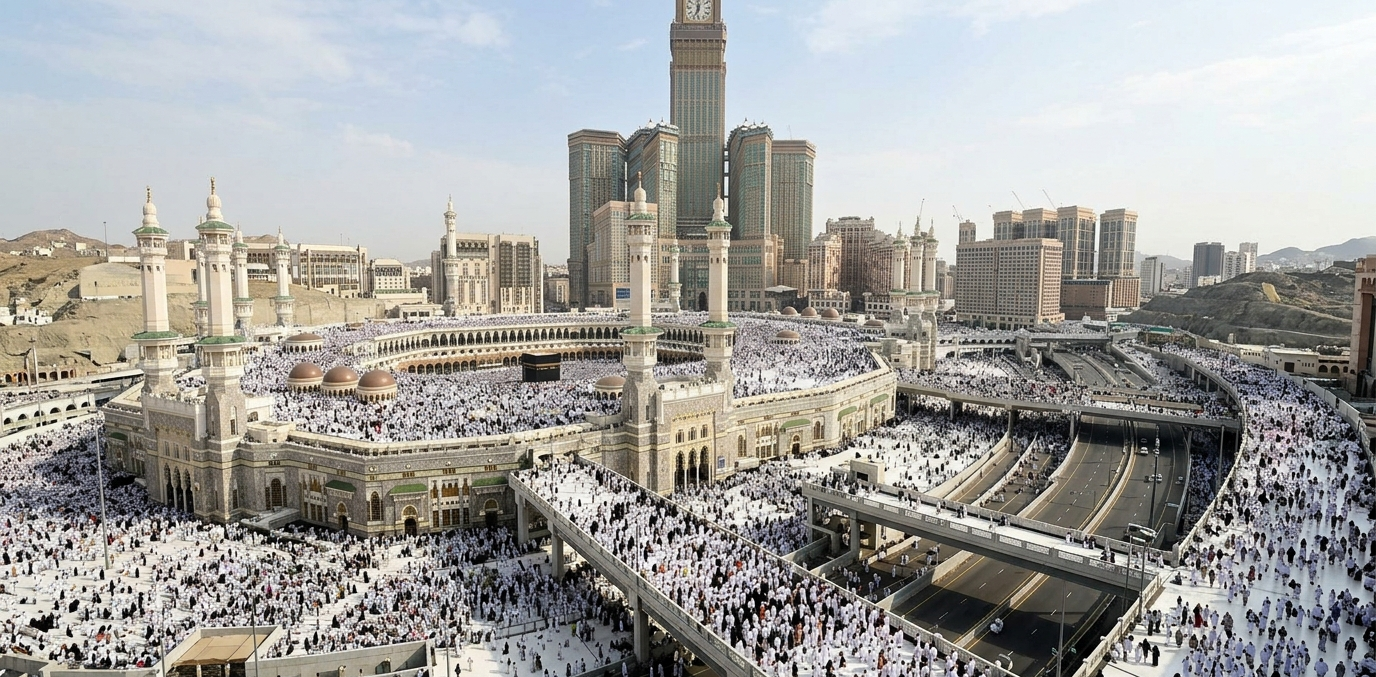
As more than 1.5 million Muslim pilgrims gather in the holy city of Mecca for the annual Hajj pilgrimage, the relatively low turnout has ignited a fierce international debate. Critics and Islamic commentators are questioning why the number remains tightly restricted in an era defined by unprecedented advancements in crowd management sciences and multi-billion-pound infrastructure engineering.
For decades, the Hajj stood as one of the world’s largest human gatherings, frequently hosting over 2.5 million worshippers. However, the decision by Riyadh to maintain the current ceiling at roughly 1.5 million has drawn sharp criticism from various corners of the Muslim world, exposing deep-seated geopolitical and administrative tensions.
Quota Restrictions and Sovereignty Disputes
Every year, numerous Islamic communities and foreign governments quietly — and sometimes publicly — voice frustrations over the strict quota system enforced by the Saudi Ministry of Hajj and Umrah. Under the current framework, slots are allocated based on a formula of one pilgrim per thousand Muslims in any given country.
Critics argue that Saudi Arabia’s absolute monopoly over the administration of the holy sites prevents more efficient logistical models from being explored. Calls for an international, pan-Islamic committee to co-manage or oversee the pilgrimage have historically been rejected by Riyadh, which views its custodianship of Mecca and Medina as a matter of absolute national sovereignty and a cornerstone of its global prestige.
Infrastructure vs. Operational Safety
The persistent restriction on pilgrim numbers appears paradoxical to many observers, given the massive engineering feats undertaken by the Kingdom. From the multi-tier expansion of the Grand Mosque to the high-speed Haramain railway and sophisticated pedestrian cooling systems, the physical infrastructure is theoretically designed to withstand much higher capacities.
However, the shadow of past tragedies continues to loom large over the event. Recurring incidents of fatal heatstrokes, stampedes, and crowd collapses over the years have led independent analysts to suggest that the technological upgrades have not fully resolved fundamental operational flaws. To critics, these recurring fatalities are evidence of administrative failure, proving that despite vast financial investments, the state apparatus struggles to handle the logistical complexities of mass movement.
Geopolitical and Security Theories
Within regional political circles, several theories have emerged to explain Riyadh’s reluctance to return to pre-pandemic crowd levels:
- The Administrative Capability Argument: Some experts suggest that the restrictions are a tacit admission of logistical limitations, with authorities preferring to artificially suppress numbers rather than risk a catastrophic security or health failure.
- The Dilution of Collective Power: A more cynical political narrative suggests that the Saudi leadership deliberately curtails the size of the gathering to diminish the symbolic weight and collective “grandeur” of a massive, unified Muslim assembly, which could theoretically become a platform for anti-regime sentiment.
- Regime Security and Counter-Coups: From a hardline security perspective, certain regional analysts argue that the Saudi establishment views the Hajj primarily through a counter-terrorism and intelligence lens. According to this view, the concentration of millions of foreign nationals represents an inherent threat to domestic stability, fostering fears of infiltration, political agitation, or potential coups against the ruling Al Saud dynasty.
As the rituals draw to a close under intense scrutiny and rising seasonal temperatures, the debate over who should control the Hajj — and how many believers should be allowed to fulfil their religious duty — remains one of the most sensitive and unresolved fault lines in the modern Islamic world.