
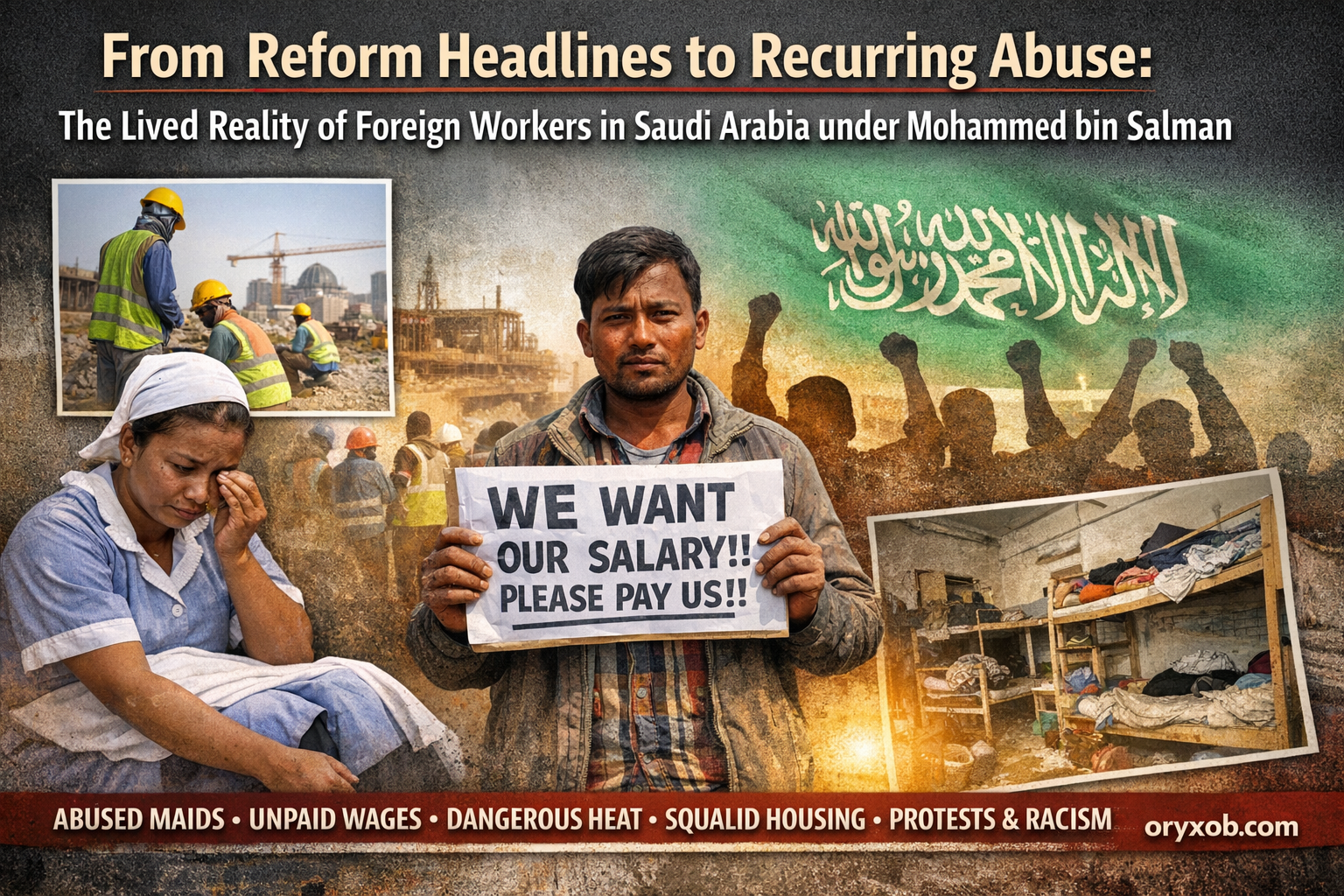
Since Mohammed bin Salman consolidated power in 2017, Saudi Arabia has promoted sweeping labour reforms as proof of modernisation under Vision 2030. Yet behind the rhetoric of transformation, documented cases from 2017 to 2025 reveal a labour system that continues to enable exploitation, shield abusive employers, and deny justice to migrant workers on whom the kingdom’s economic ambitions depend.
The evidence does not point to isolated failures. It points to structural impunity.
Domestic workers: excluded, isolated, abused
The clearest example lies in the treatment of domestic workers — housemaids, nannies and drivers — who remain excluded from the core Saudi Labour Law and are governed by weaker, separate regulations.
The case of Bangladeshi domestic worker Abiron Begum, who died in Riyadh after severe abuse, briefly exposed the brutality that can occur behind closed doors. Her employer was convicted — an outcome so rare that it became international news. Rights groups have long argued that such prosecutions are the exception, not the rule. Most allegations of confinement, beatings, starvation, sexual assault and unpaid wages never reach court.
Investigations into the treatment of Kenyan domestic workers have documented women working up to 16 hours a day without rest, having passports confiscated, wages withheld for months, and being locked inside homes. Some reported racial insults and degrading treatment. With no meaningful inspection of private households and limited independent complaint mechanisms, domestic workers remain effectively at the mercy of their employers.
Exclusion from labour law is not a technical oversight. It is a policy choice — and it sustains vulnerability.
Wage theft on flagship projects
Saudi Arabia’s global image is built on megaprojects. Yet wage theft has repeatedly surfaced on precisely these high-profile developments.
In 2025, Human Rights Watch reported that hundreds of migrant construction workers linked to the Mecca Masar redevelopment project had gone unpaid for months. Workers reportedly resorted to work stoppages. Several were detained before being released. The episode directly challenged the credibility of Saudi Arabia’s Wage Protection System, which is meant to electronically detect salary delays.
A system that detects non-payment but fails to prevent months of unpaid labour is not functioning as advertised.
In another case, hundreds of Nepali workers employed by Sendan International were left without salaries or end-of-service benefits after the company’s collapse. Nepal’s embassy confirmed workers were stranded in labour camps, some with expired residency permits and no income. The burden of intervention once again fell on a foreign embassy rather than Saudi enforcement authorities.
Similarly, thousands of Filipino workers have pursued long-delayed wage claims stemming from earlier corporate collapses. Partial settlements have taken years. For many workers, justice has been slow, incomplete or financially ruinous.
Wage theft in Saudi Arabia is not sporadic. It is recurrent.
Extreme heat and preventable deaths
Saudi Arabia enforces a seasonal midday work ban during summer months. Yet documented cases show workers labouring in temperatures exceeding 45°C. Human rights organisations have reported cases of heat exhaustion, dehydration and collapse.
More alarming are fatal workplace incidents involving electrocution, falls and heavy machinery. In several documented cases, families of deceased workers said they received limited information about how their relatives died and faced prolonged delays in obtaining compensation.
One Bangladeshi worker’s family reportedly encountered pressure to accept burial in Saudi Arabia in exchange for compensation. The family insisted on repatriation and borrowed money to return the body home. Benefits were delayed.
The pattern is clear: even in death, migrant workers’ families face bureaucratic and financial obstacles.
Compensation delayed, justice deferred
Saudi law requires compensation for workplace injury and death. In practice, families in Bangladesh, Nepal, India and Kenya have reported waiting years — in some cases more than a decade — for payments through the social insurance system.
For grieving families abroad, pursuing claims inside Saudi Arabia is often impossible without embassy assistance. Diplomatic missions have become de facto labour rights intermediaries, negotiating unpaid wages, repatriations and settlements.
A system that depends on foreign embassies to function cannot credibly claim to protect workers’ rights.
Squalid housing and recruitment debt
Investigations into labour camps linked to major projects have described overcrowded rooms, insufficient sanitation and poor ventilation. Workers reported sharing cramped quarters with inadequate facilities and limited privacy.
Many migrants arrive already burdened by recruitment debt — despite regulations prohibiting such fees. Workers have documented paying thousands of dollars to agents before departure. When wages are withheld, that debt becomes a tool of coercion.
Debt, employer-controlled residency status, and restricted mobility combine to create conditions that rights groups and international trade unions have described as amounting to forced labour or modern slavery.
Racism and structural discrimination
Investigations involving African domestic workers have documented racist abuse and discriminatory treatment. Racial hierarchies within the labour market intensify vulnerability, particularly for women working inside private homes.
Discrimination is not incidental. It intersects with the sponsorship system, employer control and limited oversight to produce a hierarchy of rights in which some nationalities and job categories are far more exposed to abuse than others.
Protest is risky, silence is common
Workers who protest unpaid wages risk detention, deportation or blacklisting. In documented cases, labour stoppages have been followed by arrests.
The absence of independent unions and meaningful collective bargaining means that many grievances remain suppressed. When abuses surface, they often do so only because embassies, journalists or rights groups intervene.
Silence should not be mistaken for satisfaction.
Reform without accountability
Saudi authorities consistently point to the 2021 Labour Reform Initiative and digital monitoring systems as evidence of progress. Some mobility restrictions have eased for certain categories of workers. But domestic workers remain excluded from the main labour law, enforcement remains inconsistent, and documented cases continue to reveal unpaid wages, unsafe worksites and delayed compensation.
The problem is no longer a lack of awareness. It is a lack of systemic accountability.
Nearly nine years into Mohammed bin Salman’s leadership era, Saudi Arabia’s migrant labour system remains built on dependency and imbalance. The kingdom’s economic transformation relies heavily on foreign labour. Yet the workers who sustain its megaprojects, households and service economy continue to face exploitation with limited recourse.
Until enforcement becomes transparent, independent and consistent — and until all workers, including domestic workers, are fully protected under labour law — reform will remain a public relations narrative rather than a lived reality.