
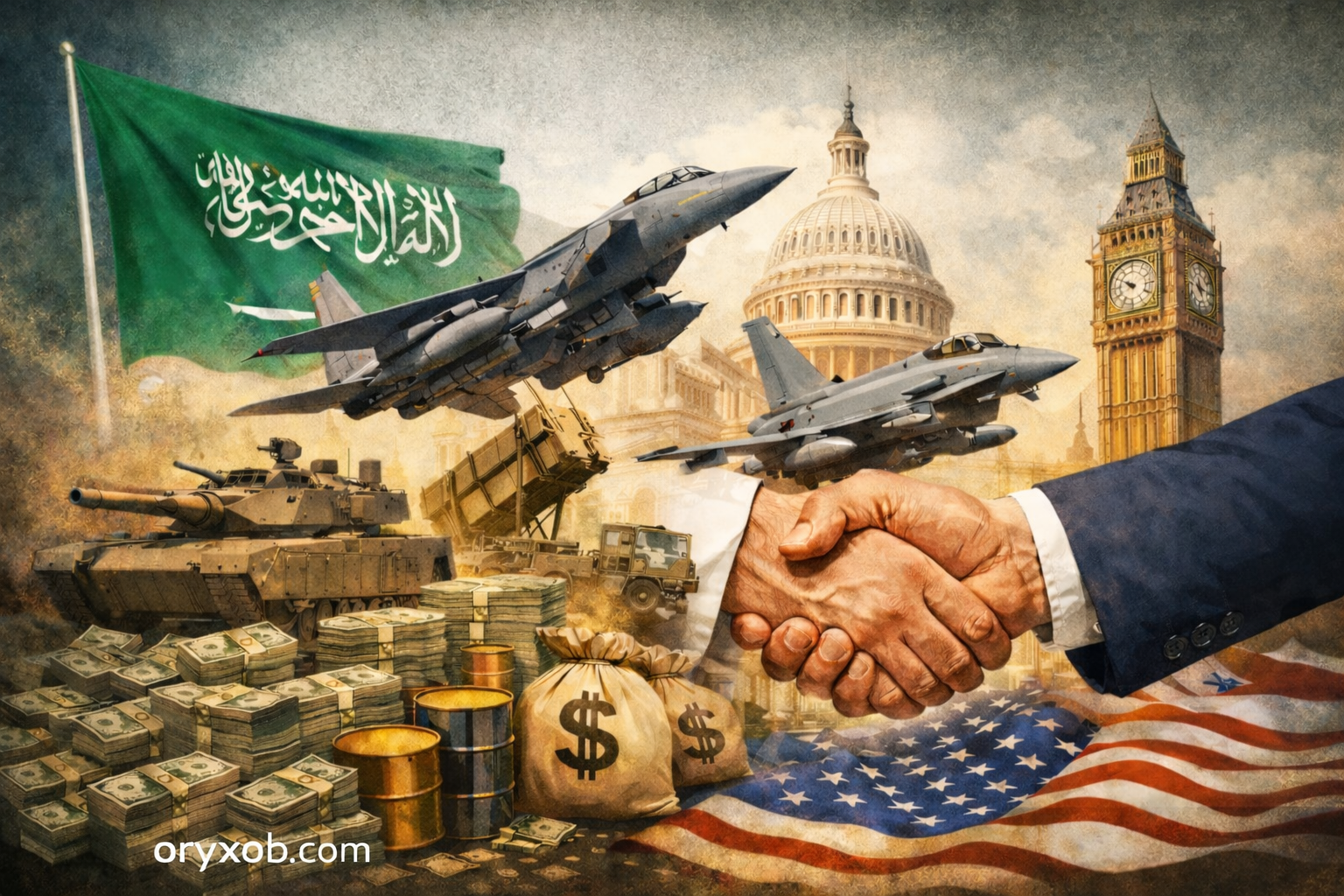
For decades, Saudi Arabia has ranked among the world’s largest military spenders. According to the Stockholm International Peace Research Institute (SIPRI), the kingdom consistently sits near the top of global defence expenditure tables, allocating tens of billions of dollars annually to weapons procurement, sustainment and military modernisation.
On paper, this should translate into overwhelming strategic advantage.
In practice, it has not.
The uncomfortable truth is that Saudi Arabia’s vast arms spending has too often failed to produce sovereign military capability. Instead, it has entrenched dependency, inflated costs and reinforced a procurement culture long shadowed by corruption allegations and political leverage.
The Al-Yamamah Shadow
Any serious discussion of Saudi arms procurement must begin with the Al-Yamamah programme brokered by BAE Systems.
Signed in the 1980s and expanded over decades, the deal became one of the largest arms agreements in history. It also became one of the most controversial. Allegations of secret commissions, offshore payments and extensive financial inducements surfaced repeatedly in British and international media.
In 2006, the UK’s Serious Fraud Office abruptly halted its investigation into the deal, citing national security concerns. The decision was widely criticised and became emblematic of how strategic alliances can override accountability.
No systemic reform followed.
The aircraft flew.
The contracts continued.
The message was unmistakable: geopolitics trumped scrutiny.
In 2010, BAE Systems agreed to major settlements with US and UK authorities over accounting and compliance failures linked to international defence contracts. While not framed as a Saudi conviction, the episode reinforced the broader perception that mega-arms agreements often operate within a permissive ecosystem where transparency is secondary.
A Pattern, Not an Incident
Al-Yamamah was not a historical anomaly. Over the years, investigative reporting by outlets such as The Guardian and the Financial Times has described opaque intermediaries, offshore arrangements and extraordinary executive-level access associated with Saudi-linked defence contracts.
Whether or not every allegation resulted in prosecution is not the central point. The pattern is.
Large, politically sensitive contracts negotiated at the highest levels, shielded from parliamentary oversight, and insulated by national security exemptions create environments in which accountability becomes optional.
That structural opacity carries consequences.
Political Insurance, Not Military Autonomy
Western governments routinely frame arms sales to Saudi Arabia as pillars of strategic partnership. Yet the architecture of these agreements reveals a deeper imbalance.
Saudi Arabia acquires advanced aircraft, precision munitions and missile defence systems. But core elements of real military sovereignty — source codes, software authority, electronic warfare libraries, deep system integration rights — remain tightly controlled by suppliers.
Export-control regimes, particularly in the United States, ensure strict end-use monitoring and technological limitations. Sustainment chains are contractor-heavy. Upgrades require political approval.
This is not full-spectrum sovereignty.
It is managed capability.
The financial flows, however, are indisputable — supporting defence industries and employment in supplier states while embedding long-term dependency within the Saudi force structure.
Yemen as a Stress Test
The Saudi-led intervention in Yemen exposed operational realities beneath procurement headlines. Despite operating some of the region’s most sophisticated aircraft, Saudi air operations relied extensively on foreign contractor maintenance and external logistical pipelines.
When political pressure mounted in supplier countries, export restrictions and review processes tightened. The vulnerability was not technological — it was structural.
Procurement dependent on political goodwill is not strategic independence.
It is conditional power.
Transparency and Governance Risk
Transparency International’s defence assessments have repeatedly categorised Saudi Arabia as facing elevated corruption risk within its defence sector, citing opaque budgeting and limited institutional oversight.
The issue is not proving bribery in every contract.
It is recognising systemic characteristics:
• Executive-driven mega-deals
• Limited legislative scrutiny
• National security justifications shielding financial terms
• Long-term sustainment obligations negotiated behind closed doors
In such environments, inefficiency thrives quietly — and reform becomes politically inconvenient.
The Illusion of Localisation
Under Vision 2030, Riyadh has pledged to localise defence production and expand domestic industry. Joint ventures and assembly lines are frequently announced.
But assembling components is not the same as owning intellectual property.
True military autonomy lies in software control, systems integration authority, electronic warfare customisation and independent upgrade capability. Without substantive transfer of those elements, localisation risks becoming optical rather than operational.
A Marketplace of Leverage
Saudi arms procurement has historically functioned as diplomatic currency. Purchasing Western weapons has reinforced alliances, secured access and signalled alignment.
But when procurement doubles as geopolitical insurance, strategic coherence suffers.
Supplier states gain industrial revenue and political leverage.
The buyer receives advanced hardware — but not unfettered control.
The imbalance is embedded by design.
A Strategic Reckoning
Saudi Arabia can continue signing ever larger contracts. It can expand fleets, announce partnerships and publicise localisation milestones.
But the core question persists:
Is the kingdom acquiring genuine sovereign capability — or financing a geopolitical marketplace that profits from perpetual dependency?
Until transparency becomes institutionalised, oversight strengthened and technology transfer genuinely negotiated rather than rhetorically promised, Saudi military expenditure will remain a paradox:
Among the world’s highest.
Yet structurally constrained.
And that constraint is not technological.
It is political.

