
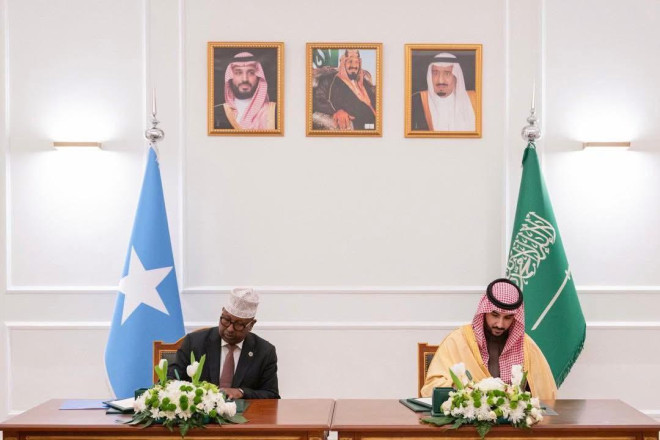
Saudi Arabia and Somalia have signed a military cooperation agreement aimed at strengthening security coordination and counterterrorism efforts, marking a significant development in Mogadishu’s external security partnerships and signalling a broader recalibration of Gulf influence in the Horn of Africa.
The agreement was signed in Riyadh by Somalia’s Minister of Defence, Ahmed Moallim Fiqi, and Saudi Arabia’s Minister of Defence, Prince Khalid bin Salman. Both sides framed the deal as part of efforts to enhance bilateral cooperation in defence and security at a time of persistent instability in the Red Sea and Horn regions.
Publicly available information indicates that the agreement focuses on areas such as military coordination, training, security cooperation and counterterrorism support. However, the full text of the agreement has not been published, and neither government has disclosed detailed operational mechanisms, timelines or financial commitments.
This lack of transparency renders the pact politically significant but operationally ambiguous. In the Horn of Africa, defence agreements often function as flexible frameworks that combine training, intelligence-sharing and long-term strategic positioning, allowing both parties room to expand cooperation without binding public commitments.
Gulf rivalry and the Horn of Africa
The Saudi–Somali agreement must be viewed within the broader context of intensifying rivalry between Saudi Arabia and the United Arab Emirates across the Red Sea basin and the Horn of Africa. While the two Gulf states have long cooperated on regional security, recent years have seen growing divergence, competition and, at times, open rivalry, particularly in Yemen and in strategically sensitive maritime corridors.
The Horn of Africa has emerged as a critical arena in this contest due to its proximity to the Bab al-Mandab strait, its role in Red Sea security, and its fragmented political landscape, which allows external powers to exert influence through both central governments and regional authorities. Somalia, with its long coastline and persistent internal divisions, occupies a central position in this strategic competition.
Somali–Emirati tensions and the Zubaidi episode
Mogadishu’s decision to deepen defence ties with Saudi Arabia follows a sharp deterioration in relations between Somalia and the United Arab Emirates. That rupture was triggered by controversy surrounding the entry of Aidarus al-Zubaidi, the leader of Yemen’s Southern Transitional Council, into Somaliland without coordination with Somalia’s federal authorities.
Somali officials viewed the incident as a direct challenge to national sovereignty and as further evidence of Emirati engagement with regional administrations outside the authority of Mogadishu. The episode was described by Somali authorities as the final breaking point after years of tension over Emirati involvement in ports, security arrangements and political affairs within Somalia.
The fallout led Somalia to cancel its agreements with the UAE, significantly altering its Gulf relationships and creating an opening for other regional actors, particularly Saudi Arabia, to step in.
Can Saudi Arabia replace the UAE?
Against this backdrop, Riyadh appears to be positioning itself as an alternative Gulf security partner for Somalia, especially at the federal level. By engaging directly with Mogadishu, Saudi Arabia offers political recognition, financial leverage and security cooperation framed around respect for state sovereignty rather than sub-state alliances.
Yet replacing the UAE in Somalia — and across the Horn more broadly — will not be easy. Emirati influence has been built over more than a decade through a dense network of port investments, logistics infrastructure, security cooperation and political ties with regional authorities such as Somaliland and Puntland. This embedded commercial-security ecosystem gives the UAE a level of influence that is difficult to dismantle quickly, even when relations with central governments deteriorate.
Saudi Arabia’s approach has traditionally been more state-centric and less commercially entrenched in the Horn. While Riyadh can mobilise diplomatic influence and financial resources rapidly, matching the UAE’s on-the-ground networks would require sustained engagement, long-term investment and careful navigation of Somalia’s internal political divisions.
Strategic implications
For Somalia, the agreement with Saudi Arabia reflects an effort to diversify external partners, reduce dependence on a single Gulf actor and reassert federal authority in foreign and security policy. For Saudi Arabia, the deal represents an opportunity to expand influence along the Red Sea corridor, counter Emirati dominance in parts of the Horn of Africa, and project itself as a stabilising power that respects formal state sovereignty.
Whether the agreement evolves into substantive military cooperation or remains largely symbolic will depend on follow-up actions, including training programmes, advisory missions, intelligence coordination and financial commitments. It will also depend on how Somalia’s internal federal–regional tensions shape the implementation of any external security partnership.
What is clear is that the Saudi–Somali military pact is not solely about counterterrorism. It is a geopolitical signal reflecting shifting balances of power among Gulf states in one of the world’s most strategically contested regions.
