
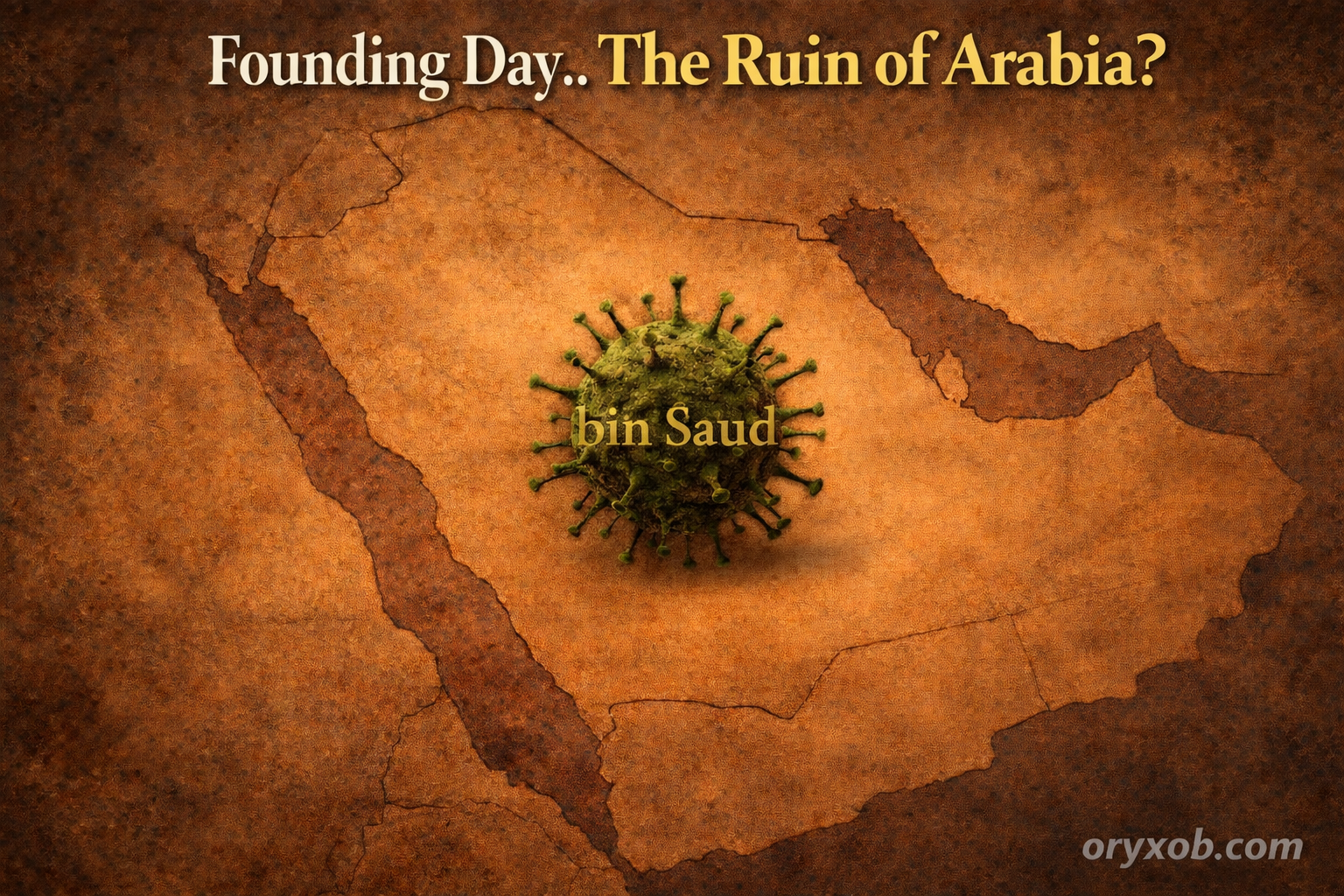
Most Founding Day events held across Saudi Arabia were marked by strikingly low public attendance. While events in Riyadh — the stronghold of the Alsaud family — recorded comparatively higher, albeit still limited, turnout, other regions across the country saw extremely sparse participation, in some instances reportedly fewer than ten attendees.
In January 2022, King Salman designated 22 February each year as Founding Day and declared it an official public holiday, urging citizens to commemorate the establishment of the First Saudi State by Mohammed bin Saud.
Despite extensive media mobilisation in support of the anniversary, public reluctance to attend the events was evident. Observers suggest that the government of Mohammed bin Salman anticipated the sharp shortfall in attendance, citing several measures introduced in the days preceding the occasion.
These included incorporating Founding Day branding into already scheduled events — such as flower festivals, cooking exhibitions and shopping activities — which had not originally been organised to mark the anniversary.
Government employees were reportedly instructed to attend officially announced events in their respective regions. However, in the absence of a formal mechanism to monitor attendance and absence, many employees appear to have preferred to make use of the public holiday rather than participate in the celebrations.
Commercial establishments were required to affix posters and banners to their premises encouraging citizens to attend the events. In addition, the religious police issued a mandatory directive calling on their members to participate in Founding Day activities, publishing the order across their social media platforms.
What Explains the Reluctance of Saudi Citizens to Mark Founding Day?
Saudi Arabia is composed of multiple peoples and minority communities with no single unifying historical narrative. Each group, according to this perspective, has its own reasons for refusing to recognise or celebrate the occasion.
The Wahhabi Minority
Members of the Wahhabi minority argue that marginalising the role of Mohammed bin Abdulwahhab constitutes historical falsification and a grave distortion of the past. They maintain that the First Saudi State was founded jointly by Mohammed bin Saud and Mohammed bin Abdulwahhab, not by bin Saud alone.
They contend that prior to Mohammed bin Salman’s rise to power, the name of bin Abdul Wahhab was consistently mentioned alongside that of Mohammed bin Saud in discussions of the founding of the First Saudi State. The perceived removal of his role from official media narratives and accompanying events has, in their view, erased the contribution of their religious leader and founder. For this reason, they reject participation in an anniversary which, they argue, denies the role of Abdulwahhab.
The People of Hejaz
The people of Hejaz — the majority of whom are Sunni — regard the founding of the First Saudi State as the emergence of what they describe as an extremist movement originating in Najd, which later advanced westwards, seized control of Hejaz and carried out brutal massacres against its inhabitants.
From this standpoint, the anniversary represents a violent and traumatic episode in their history, making celebration both difficult and unacceptable.
The People of Ahsa and Qatif
In Ahsa and Qatif — where the overwhelming majority of the population is Shia — many view Founding Day as a reminder of what they describe as the occupation of their regions and the perpetration of massacres, including the killing of women and children, acts of mutilation, burning of bodies and public dragging of victims through the streets.
They argue that executions and killings continue to this day under different titles, framed as judicial death sentences. These, they say, include executions of minors, with international organisations having issued reports documenting such cases.
For many within this community, commemorating the establishment of a state founded by a figure they regard as responsible for crimes against them is inconceivable. As they put it, no one celebrates their own executioner.
The People of Jizan and Najran
In Jizan and Najran — where large segments of the population belong to Zaidi and Ismaili traditions — many believe their regions were historically part of Yemen before being subjected to what they describe as an illegitimate Saudi occupation.
They allege that grave massacres were committed against their populations and that their freedoms were confiscated. As a result, they consider celebration of Founding Day incompatible with their historical experience.
The People of Ha’il
Ha’il was once an independent state known as the Emirate of Jabal Shammar, or the Emirate of Ha’il. According to this account, it was subjected to a violent Saudi invasion, its ruler was killed, and the territory was incorporated into Saudi rule through bloodshed and coercion.
For this community, the anniversary is viewed as a reminder of a violent conquest rather than a moment of national pride, and therefore not an occasion for celebration.
Across these communities, divergent historical narratives continue to shape attitudes towards Founding Day. For many, it is not regarded as a unifying national milestone, but as a commemoration of events they associate with violence, occupation and repression.