
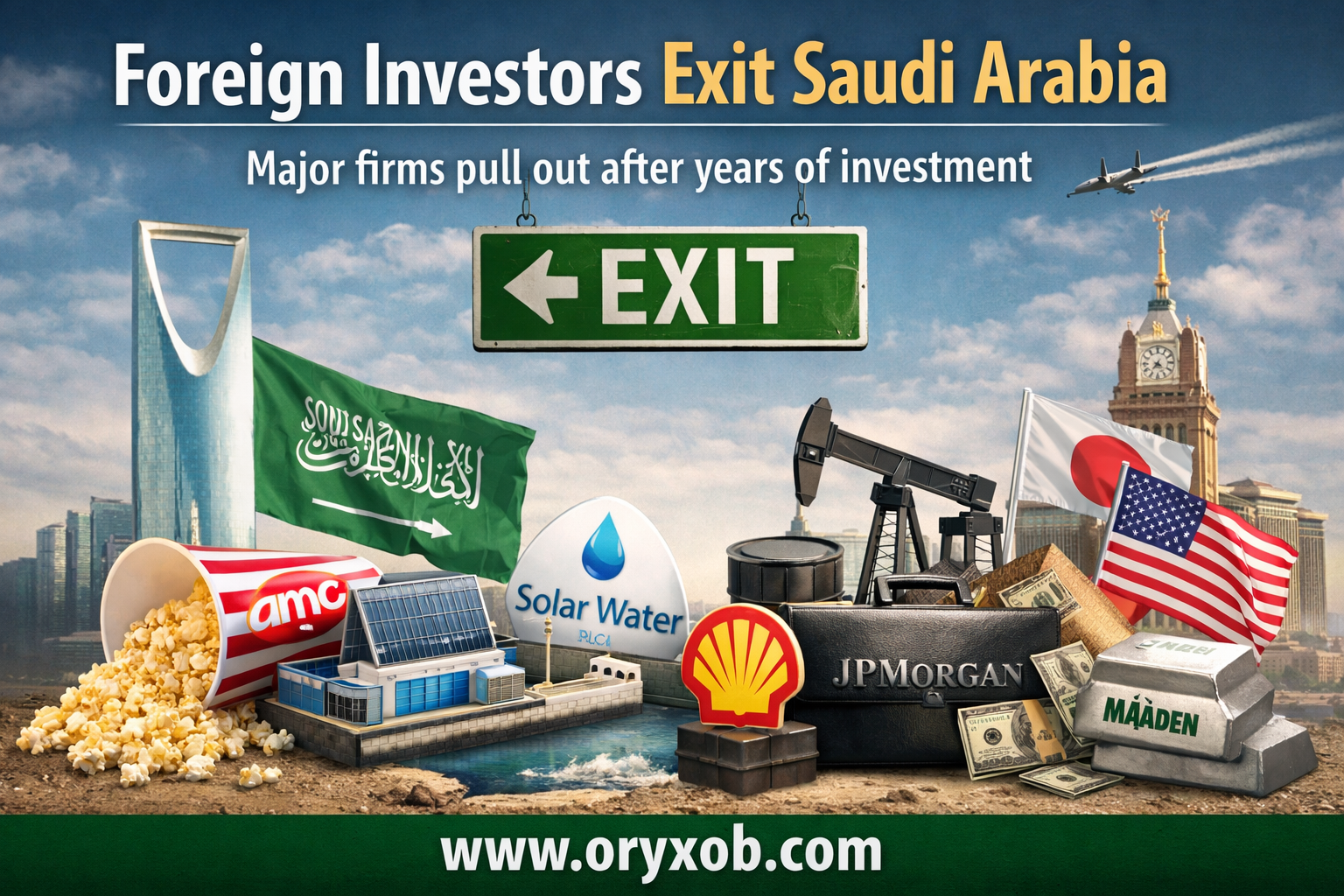
Saudi Arabia has spent the past ten years selling itself as a magnet for global capital: a newly liberalised entertainment sector, industrial joint ventures pitched as anchors for export growth, and state-backed megaprojects intended to pull in technology and expertise. Yet a number of foreign investors have also reduced exposure — not always as a dramatic “walkout”, but through negotiated buyouts, strategic disposals, or cancelled contracts.
Below are documented cases of foreign investors who exited or materially withdrew from Saudi investments between 2016 and 2025. The list is not exhaustive; many private exits are not disclosed publicly. But these examples illustrate the main forces behind investor pullbacks: shifting corporate priorities, project economics, and reputational risk.

AMC Entertainment (United States) — exit from equity, shift to licensing
Investor: AMC Entertainment Holdings
Investment: Saudi Cinema Company (SCC), the joint venture operating cinemas under the AMC brand
Entry: 18 April 2018 (AMC launched operations as commercial cinemas returned to the kingdom)
Withdrawal: 30–31 January 2023 (AMC agreed to sell its equity stake; the Saudi partner took full ownership while retaining the AMC brand under a licensing arrangement)
Reason: AMC said it was transitioning from a management-and-investment role to a “pure licensing” relationship, after establishing operations and training local teams. Reporting also cited the company’s heavy debt burden after Covid-19 and intensifying competition in the Saudi cinema market.
Shell (UK/Netherlands) — sold its SASREF stake to Saudi Aramco
Investor: Shell
Investment: 50% stake in SASREF, the refining joint venture in Jubail Industrial City
Entry: 1981 (SASREF established as a long-running partnership)
Withdrawal: 18 September 2019 (Saudi Aramco completed the acquisition of Shell’s 50% interest)
Reason: Saudi Aramco presented the deal as part of its downstream growth strategy, bringing the refinery fully under its control. Shell described the venture as a successful partnership and signalled it would continue exploring other business opportunities, consistent with a broader portfolio “high-grading” approach rather than a single-country retreat.
JPMorgan International Finance (United States) — sold a legacy banking stake
Investor: JPMorgan International Finance (a JPMorgan Chase subsidiary)
Investment: Minority shareholding in The Saudi Investment Bank
Entry: 1976 (a long-held legacy stake)
Withdrawal: 27 September 2018 (completion of the bank’s buyback of JPMorgan’s stake)
Reason: The sale was described publicly as the disposal of a non-core holding, while JPMorgan maintained that it remained committed to Saudi Arabia through its wider banking and securities business.
Lukoil (Russia) — withdrew from the LUKSAR gas venture
Investor: Lukoil (via LUKSAR, a joint venture with Saudi Aramco)
Investment: Contract Area A gas exploration and development venture
Entry: 7 March 2004 (upstream agreement signed; the joint venture structure was established that month)
Withdrawal: 22 June 2016 (Lukoil’s leadership said it was quitting the Saudi project)
Reason: The company attributed the decision to financial pressure and weakened project economics, in the context of the wider downturn in oil markets and reduced appetite for high-cost or low-return gas exploration.
The Mosaic Company (United States) — exited the Wa’ad Al Shamal phosphate joint venture
Investor: The Mosaic Company
Investment: 25% stake in Ma’aden Wa’ad Al Shamal Phosphate Company (MWSPC)
Entry: 5 August 2013 (entry into the joint venture framework for the integrated phosphate complex)
Withdrawal: 24 December 2024 (transaction closing date for the exchange of Mosaic’s MWSPC stake for Ma’aden shares)
Reason: Mosaic had previously signalled it was deprioritising further investment in the joint venture as it focused on balance-sheet goals and capital allocation, amid weaker fertiliser market conditions and pressure on margins.
Alcoa (United States) — sold its entire stake in the Ma’aden aluminium joint venture
Investor: Alcoa
Investment: 25.1% ownership interest in the Ma’aden joint venture (integrated aluminium and mining assets)
Entry: 2009 (joint venture established)
Withdrawal: 1 July 2025 (closing of Alcoa’s sale of its full 25.1% interest to Ma’aden)
Reason: Alcoa said the sale simplified its portfolio and improved financial flexibility, while making the value of its Saudi investment more transparent through publicly listed consideration.
Sumitomo Chemical (Japan) — partial withdrawal from Petro Rabigh
Investor: Sumitomo Chemical
Investment: Petro Rabigh (Rabigh Refining & Petrochemical Company), a joint venture with Saudi Aramco
Entry: 2005 (joint venture established)
Withdrawal: 8 October 2025 (completion of the sale of a 22.5% stake to Saudi Aramco, reducing Sumitomo’s holding)
Reason: The deal was presented by the companies as part of a broader turnaround plan for a loss-making venture. Saudi Aramco increased control and assumed wider marketing rights, while Sumitomo linked the transaction to restructuring priorities and a sharper focus on higher-value specialty chemicals.
Solar Water (United Kingdom) — cancelled a NEOM-linked contract
Investor: Solar Water (UK), led by founder Malcolm Aw
Investment: A reported contract to deploy solar-powered desalination technology for NEOM
Entry: 2019–29 January 2020 (the company said the deal was signed in 2019; the agreement was publicly announced in January 2020)
Withdrawal: 2022 (contract cancelled, according to the founder)
Reason: Aw said he withdrew on ethical grounds after becoming alarmed by reports of forced evictions and alleged abuses linked to land clearances for NEOM. The company framed the decision as incompatible with its values and brand.
What the exits reveal
These cases point to a market where foreign capital is welcome — but not guaranteed to stay. In several instances, the “exit” took the form of Saudi partners buying out foreign minority stakes as the state consolidated control in strategic assets. In others, withdrawals tracked corporate realities: post-pandemic debt, shifting capital discipline, or a reassessment of the risk-adjusted returns of large industrial projects.
A smaller set of cases highlight a different pressure: reputational risk. Where a project becomes entangled in allegations of rights abuses, some foreign principals conclude the commercial upside is outweighed by the ethical and brand cost — and the exit becomes, in effect, a statement.