
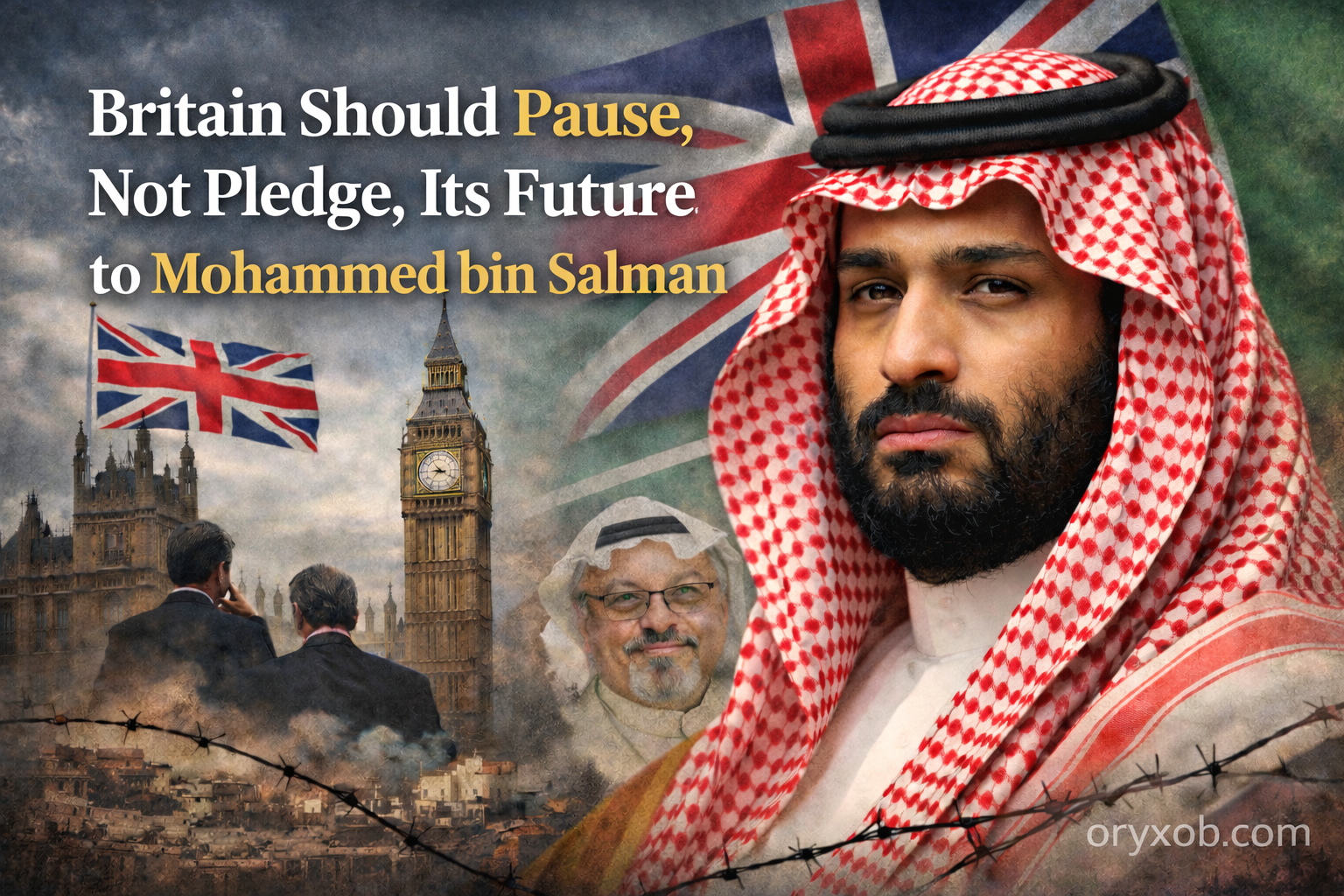
There is a long British tradition of mistaking access for influence, and expediency for strategy. Nowhere is this more evident than in London’s current posture towards Saudi Arabia’s Crown Prince, Mohammed bin Salman. The relationship is presented as pragmatic, necessary, even inevitable. Yet it is none of these things. In truth, Britain has little to gain—and much to lose—by tethering its interests to a man whose future on the Saudi throne is far from assured.
Since his appointment as Crown Prince on 21 June 2017, Mohammed bin Salman has been marketed to Western capitals as the embodiment of Saudi modernity: the reformer, the disruptor, the man who will drag an ossified kingdom into the twenty-first century. British governments of varying stripes have been eager consumers of this narrative. Arms contracts have flowed, red carpets have been rolled out, and moral qualms have been quietly shelved.
But politics, unlike public relations, has a habit of catching up with reality.
The defining moment came on 2 October 2018, inside the Saudi consulate in Istanbul, where Jamal Khashoggi—a Saudi journalist and legal resident of the United States—was murdered and dismembered. Turkish investigators established that the operation was conducted by a team of Saudi officials flown in from Riyadh. Western intelligence services, including Britain’s closest allies, concluded that such an operation could not plausibly have occurred without the knowledge, and likely the authorisation, of the Crown Prince himself.
That episode alone should have imposed lasting caution on Britain’s approach. Instead, outrage was gradually replaced by accommodation. The logic was familiar: Saudi Arabia is too important, Mohammed bin Salman too powerful, and British interests too pressing to allow principles to interfere.
Yet even if one were prepared to suspend moral judgement—a dubious proposition—the strategic case for betting on Mohammed bin Salman is remarkably weak.
His domestic rule has been defined not by institutional reform, but by personal consolidation of power. In November 2017, dozens of princes, senior officials, and businessmen were detained in what was officially described as an anti-corruption campaign, many held without due process in Riyadh’s Ritz-Carlton hotel. Some were released only after surrendering vast portions of their wealth. Whatever the merits of tackling corruption, the message was unmistakable: power would henceforth flow through one man alone.
Such a system may project strength, but it breeds fragility. Saudi Arabia is not a republic with a single line of succession; it is a royal family state, governed by consensus, patronage, and balance. By marginalising rivals and sidelining senior princes, Mohammed bin Salman has disrupted that equilibrium. History suggests that such disruption rarely passes without consequence.
Nor has his foreign policy inspired confidence. The military intervention in Yemen, launched in March 2015 when he was Defence Minister, rapidly became one of the world’s worst humanitarian disasters. Civilian casualties mounted, strategic objectives remained elusive, and Saudi Arabia’s international standing suffered severe damage. Meanwhile, the blockade imposed on Qatar in June 2017 collapsed in failure, lifting in January 2021 without achieving its stated aims.
Even the much-vaunted economic transformation, branded as Vision 2030, remains deeply uncertain. While social liberalisation has been real, foreign investment has proven skittish, unnerved by arbitrary detentions, opaque governance, and sudden policy shifts. Grand projects and glossy conferences cannot substitute for legal certainty and institutional trust.
For Britain, the implications are stark. To bind our foreign policy to Mohammed bin Salman is to assume not only his permanence, but his eventual success. Both assumptions are questionable. King Salman is elderly, and succession in Saudi Arabia has rarely been as straightforward as official decrees suggest. A future in which Mohammed bin Salman ascends the throne uncontested is possible—but far from guaranteed.
British diplomacy has always prided itself on patience. It understands that regimes endure longer than rulers, and that today’s strongman may be tomorrow’s liability. The United Kingdom has navigated similar moments before in the Middle East, backing leaders who appeared indispensable until they suddenly were not.
The wiser course now is restraint. Engagement with Saudi Arabia need not cease, but it should be recalibrated. Britain should deal with the Saudi state, not mortgage its credibility to one polarising individual. It should wait, observe, and prepare for multiple futures, rather than placing an uncritical wager on a single, controversial figure.
In politics, as in life, timing matters. This is not the moment for Britain to double down. It is the moment to pause.