
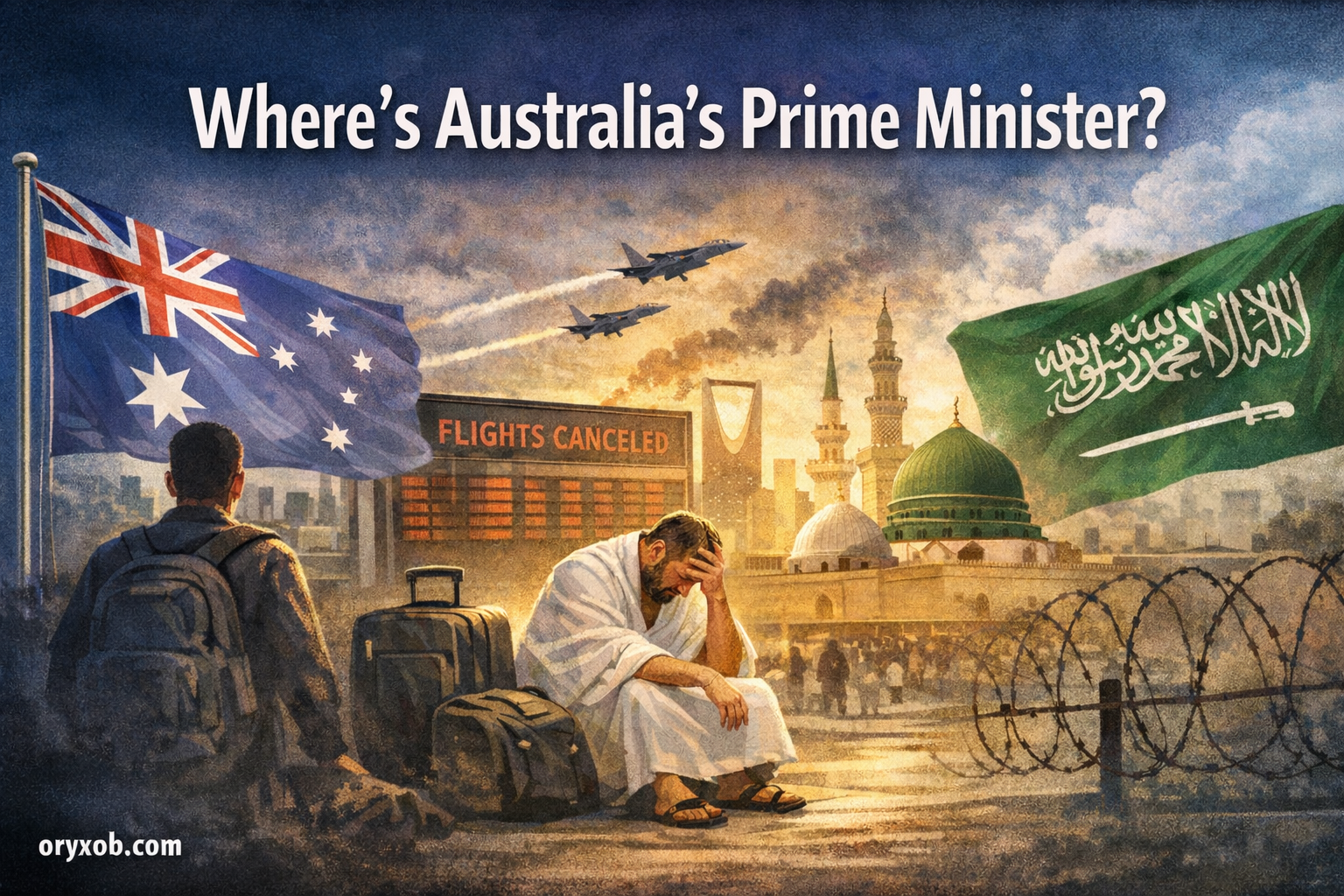
There is something obscene about watching a government wrap itself in the language of “values” and “rights” while its own citizens are told, in effect, to sit quietly and absorb the cost of a crisis they did not create.
In Medina this week, an Australian man, Adam Zanaty, described what “support” has looked like since the region was engulfed by war: skyrocketing airfares, accommodation that is “close to impossible” to secure in Mecca and Medina during Ramadan, and a deafening silence from Canberra. He had booked to leave on 1 March, only to find airspace closing and flights collapsing. After days of scrambling, he secured a ticket home via Kuala Lumpur costing about US$2,000 — and even then he was not sure it would actually depart. His fear was not only for himself, but for anyone without a family safety net or the cash to pay a crisis premium: “they’ll be stuck here because no one’s helping.” That is not a travel inconvenience; it is abandonment.
Australia’s leaders will insist they are doing what they can. They will point to helplines, to updates, to the limits imposed by closed airspace and a fast-moving conflict. They will remind us that there are around 115,000 Australians in the region — as though the size of the challenge absolves them of responsibility. They will cite “contingencies” and “commercial options” and the idea that the market will eventually produce a seat for sale, if you can afford it.
But this is precisely where the hypocrisy becomes unbearable.
Australia does not hesitate to step onto the world stage to speak about the “rules-based order”, human rights, and the obligations states owe to individuals. Our foreign minister has spoken, in soaring language, about Australia’s reputation for defending the international system and the Universal Declaration of Human Rights. Ministers issue statements about values, law, and the protection of civilians abroad. Australia even brands parts of its foreign policy around rights-based agendas and moral purpose.
And yet, when Australians are stranded — not in some obscure corner of the world, but in one of the most geopolitically central regions on earth — too many are left with the same blunt message: stay where you are, and pay whatever it takes.
Yes, a first flight from Dubai carried about 200 Australians back to Sydney, and crisis teams have been flagged. But the moral test is not whether government can help a few hundred when the optics demand it; it is whether it treats stranded citizens as people with rights, not as problems to be managed. Australians stuck in Saudi Arabia, including pilgrims in the holy cities, are not an afterthought. They are citizens. Their government’s job is not to outsource their safety to airline algorithms and surge pricing.
If Australia can organise itself to speak loudly on human rights abroad, it can organise itself to communicate clearly, coordinate with partners, and provide practical support for Australians trapped by war: negotiated landing slots, charter capacity where feasible, emergency accommodation arrangements, and transparent triage that does not quietly privilege the “easier” locations. At the very least, it can speak directly to Australians stranded in places like Saudi Arabia and tell them — honestly — what is being done, and what is not. Silence is not neutrality; it is neglect.
But Saudi Arabia, too, deserves scrutiny — not as a passive backdrop, but as an active participant in the region’s deadly arithmetic.
The kingdom markets itself as a sanctuary for worshippers, the custodian of holy places, and a pillar of stability. Yet stability is not a slogan; it is a set of choices. And Saudi choices have long been tied to Washington’s military architecture. Reuters reported a visible build-up of US military support aircraft at Prince Sultan Air Base — including refuelling tankers and airborne surveillance aircraft — even as Saudi officials publicly insisted their territory would not be used for military action against Iran. You cannot credibly posture as a reluctant bystander while hosting the enabling machinery that makes an air war sustainable. Tankers and surveillance platforms are not decorative; they are the lungs and eyes of modern combat.
This war has already spilled across borders and into airspace, shutting down airports and turning civilian travel into chaos. Iranian drones have reportedly struck the US embassy compound in Riyadh, a grim reminder that “managed escalation” is a fantasy once missiles start flying. And every state that offers logistical depth — whether through basing, overflight permissions, intelligence-sharing, or quiet coordination — helps widen the blast radius.
If Saudi Arabia truly wants to keep the region from burning, it should stop acting as a convenient platform for a war that will not produce security, only retaliation and radicalisation. Opening doors to the machinery of war while claiming the language of restraint is not diplomacy; it is plausible deniability.
So here we are: Australia preaching about citizens’ rights while leaving citizens to fend for themselves; Saudi Arabia proclaiming stability while enabling the infrastructure of a conflict that endangers civilians, pilgrims, and its own cities. Both want the moral credit of principle without paying the political price of acting on it.
The answer is not complicated. Canberra should stop the performative lecturing and do the basic work of statehood: protect its people, communicate clearly, and stop treating stranded citizens as a footnote to geopolitics. Riyadh should stop pretending it can host and assist the engines of war while remaining untouched by the consequences. And both should have the courage to say what this moment demands: a reckless war against Iran will not deliver peace — it will only multiply the stranded, the bereaved, and the betrayed.