
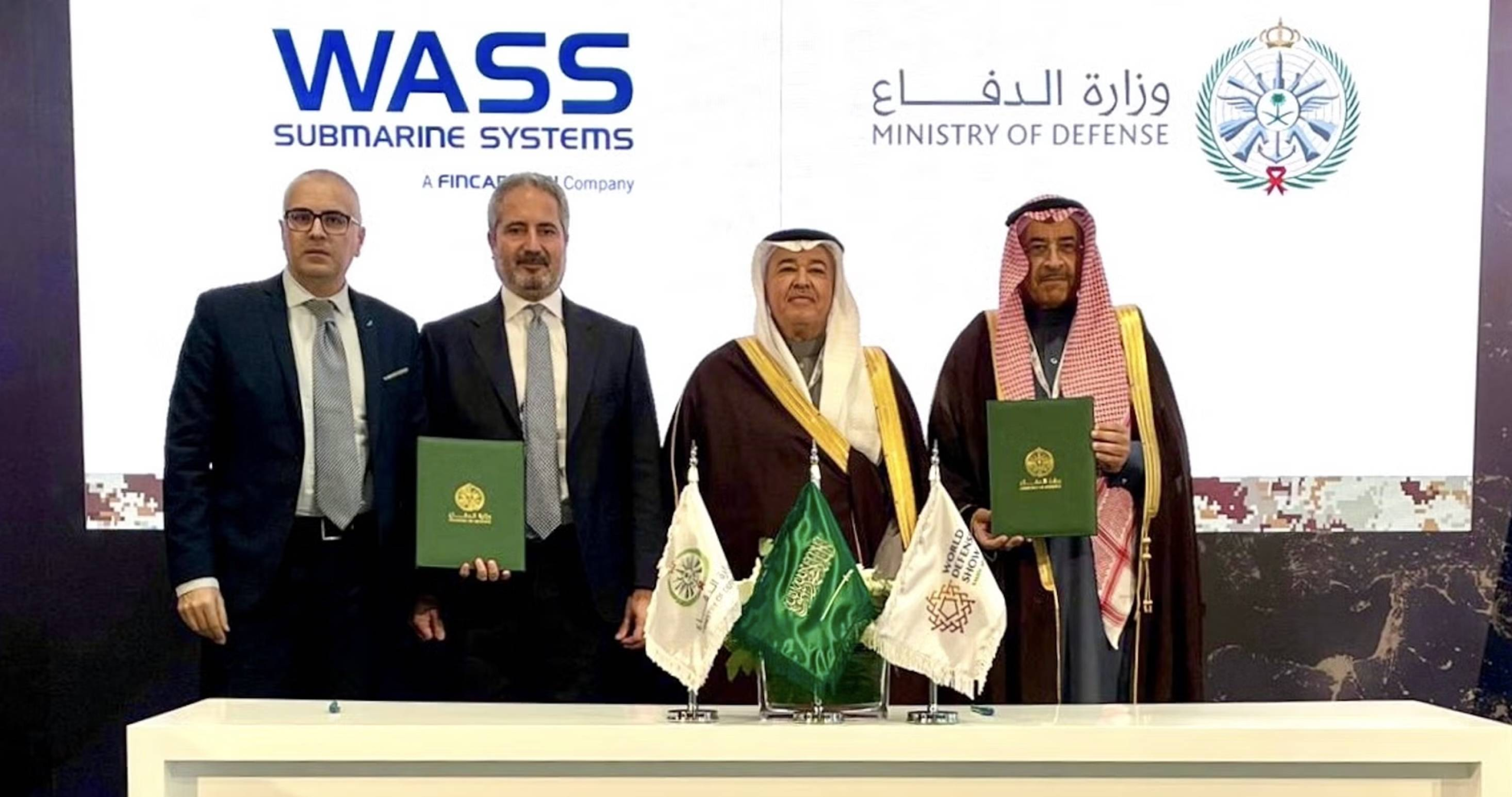
On 10 February 2026, Italian shipbuilding group Fincantieri, through its subsidiary WASS Submarine Systems, announced that it had secured an order from the Saudi Ministry of Defence to supply MU90 lightweight anti-submarine torpedoes to the Royal Saudi Naval Force. The announcement was made during the World Defence Show 2026 in Riyadh, where the deal was presented publicly with senior Saudi procurement officials and WASS leadership in attendance. WASS has indicated that the programme will be managed from its facility in Livorno, Italy, with deliveries expected between 2029 and 2030, and with logistics support included alongside the munitions package.
The stated value of the contract has been reported as above €200 million, and elsewhere as €237 million. Either way, it is described as WASS’s largest contract to date and its first direct agreement with the Saudi Ministry of Defence. That framing matters: the transaction is not merely commercial, but a signal of deepening ties between a European defence supplier and a government that has repeatedly tested the international community’s tolerance for authoritarianism and impunity.
The mechanics of the deal are revealing. Rather than being anchored in transparent public oversight or a substantive debate about national security doctrine, the contract was effectively unveiled as part of a defence exhibition. Arms expos are built for deal-making, marketing, and status projection — and the Saudi state has mastered the use of such platforms to rebrand itself. Procurement becomes theatre: a carefully lit stage where authoritarian power is repackaged as “modernisation”, and where the presence of foreign executives functions as a form of external validation.
Saudi Arabia will argue that MU90 torpedoes are defensive, a rational investment amid regional tensions and maritime threats. The MU90 is marketed as a modern lightweight torpedo designed for anti-submarine warfare, deployable from surface ships and aircraft, intended to strengthen the protection of naval task groups, sea lines of communication, and offshore infrastructure. Yet in assessing any new capability, the decisive factor is not the brochure, but the political culture controlling it. A state’s weapons are only as “defensive” as its record of restraint and accountability.
That is where this deal becomes politically charged. Saudi Arabia remains one of the world’s biggest military spenders; by some estimates it spent about $80.3 billion in 2024, making it the largest spender in the Middle East and among the top globally. This scale of investment is not an accident of geography. It is a governing choice — and it sits uncomfortably alongside a domestic system that suppresses civic freedoms and punishes dissent.
Human rights reporting over recent years has documented continuing crackdowns on peaceful expression and the use of counterterrorism institutions against non-violent speech. Alongside this, human rights organisations have warned about a sharp rise in executions. One assessment states that Saudi authorities carried out at least 356 executions in 2025, a record level, while other reporting highlights escalating use of the death penalty including in drug-related cases and affecting foreign nationals, under procedures widely criticised as unfair. These are not marginal issues. They are central to how the regime governs.
Against that backdrop, arms deals cannot be treated as neutral transactions. They are a form of political endorsement, especially when they are celebrated publicly with senior state officials and framed as “milestones”. The inclusion of logistics support and the long delivery timeline — expected between 2029 and 2030 — deepen this reality. Such arrangements are not simply about procurement; they create ongoing relationships through training, maintenance, supply chains, and technical dependency, making future scrutiny and political pressure harder to sustain.
The regional context further darkens the picture. Saudi Arabia’s war in Yemen generated years of international concern about civilian harm and humanitarian catastrophe, and the conflict remains a defining reference point for how Saudi power has been exercised. Even where a specific weapons system differs, the underlying question persists: what does it mean to strengthen the military reach of a state whose recent history includes large-scale intervention with devastating civilian consequences? That question cannot be answered by pointing to maritime threat narratives alone.
There is also a broader issue of impunity. The Saudi state has sought to normalise its international standing while maintaining a governing posture in which coercion is not an aberration but a method. The lesson that Riyadh learns from high-profile defence contracts is simple: commercial partnerships will endure, and human rights consequences will be absorbed. Deals like this therefore function not only as capability upgrades, but as impunity insurance — proof that the regime can continue to purchase high-end weaponry without purchasing accountability.
Ultimately, the public beneficiaries are clear. For the supplier, this is a “largest ever” contract and a route to deeper market entrenchment. For the regime, the deal is a symbol of international acceptance and a tool for projecting strength. The losers are less visible but more important: ordinary Saudis, asked to accept that national prestige is better measured in weapons contracts than in the rule of law, due process, or meaningful public accountability; a region that absorbs another increment in militarisation; and international norms weakened each time arms exports proceed as if repression is merely background noise.
This torpedo deal should therefore be read as more than a procurement story. It is a case study in how the Saudi regime converts wealth into military capability and diplomatic legitimacy, while sustaining a domestic order defined by punishment and control, and while leaving unresolved the legacy of destructive regional policies. The staging in Riyadh, the celebratory tone, and the multi-year support relationship point to the same conclusion: it is not only about underwater warfare. It is about underwriting a political system that still treats accountability as optional.
