
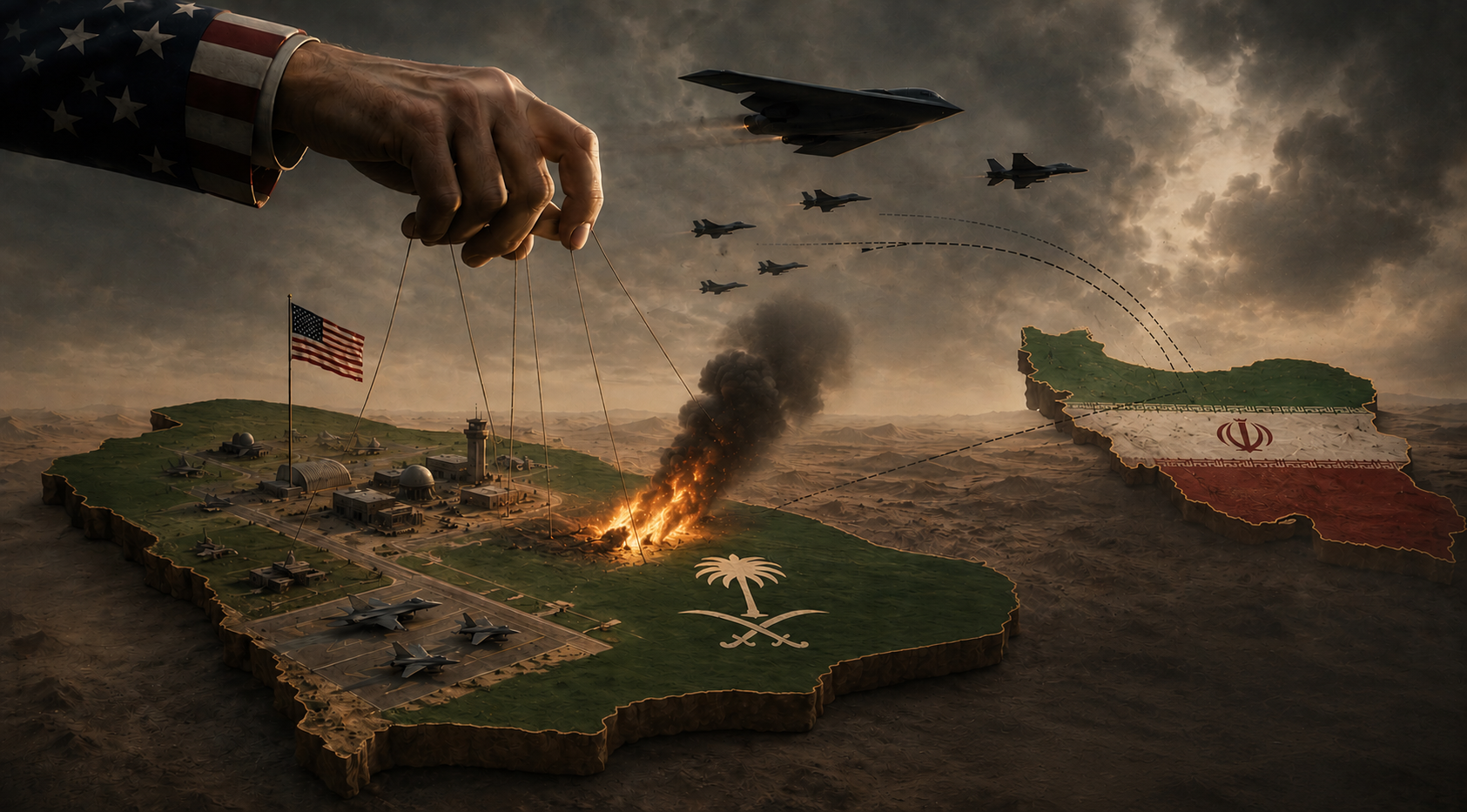
The presence of American forces in Saudi Arabia has long been presented as a strategic bargain: the Kingdom provides facilities, access and political cover, while Washington provides security. Yet the experience of the American war with Iran has exposed a harsher reality. The arrangement has not protected Saudi Arabia so much as it has turned Saudi territory, airspace and resources into instruments of American and Israeli priorities.
The central question is simple: if American forces are stationed in Saudi Arabia to defend the Kingdom, why did their presence fail to spare Saudi Arabia from danger when the United States escalated against Iran? The answer is that these forces are not primarily designed to protect Saudi sovereignty. They are positioned to serve the wider American military architecture in the region — an architecture whose first political beneficiary is Israel.
This is the contradiction at the heart of the issue. If the Saudi government says it did not authorise American military action against Iran, then the presence of US forces becomes an even greater sovereignty problem. Either Riyadh had control and allowed the infrastructure of war to remain available, or it did not have full control over what foreign troops could do from or around its territory. Neither possibility is reassuring.
The logic of foreign bases is often disguised by the language of defence. In practice, however, bases create dependency. They place the host country inside another state’s military timetable. They expose it to retaliation for wars it may not have chosen. They make its airspace negotiable, its territory strategic real estate, and its political decisions subject to pressure from a foreign power.
For Saudi Arabia, the cost is not only strategic but financial. The Kingdom spends enormous resources on defence, purchases American weapons, hosts American forces and absorbs the political consequences of US regional policy. Yet when war comes, the calculation is rarely made in Riyadh. It is made in Washington, and often with Israel’s security at the centre of the argument.
This is the real imbalance. Saudi Arabia pays in money, risk and sovereignty, while the United States retains freedom of action. The Kingdom’s land and skies become part of a military network whose objectives are not necessarily Saudi objectives. The claim that these forces exist to protect Saudi Arabia collapses when their presence increases the possibility of Saudi Arabia being dragged into confrontation.
A sovereign state must control its territory completely. It must know what foreign forces are doing, where they are operating, and for what purpose. It must be able to say no — not symbolically, but effectively. If American forces can operate in ways that serve a war Saudi Arabia claims it did not approve, then sovereignty has already been compromised.
The lesson of the American confrontation with Iran is therefore stark. Foreign troops do not automatically bring security. Sometimes they import another country’s wars. Sometimes they protect someone else’s priorities. And sometimes the host nation discovers too late that what was called protection was in fact a costly loss of control.
Saudi Arabia does not need a security arrangement that turns it into a platform for American power and Israeli protection. It needs a defence policy rooted in its own sovereignty, its own interests and its own regional stability. Anything less means the Kingdom continues to pay three times: with its money, with its security, and with its independence.