
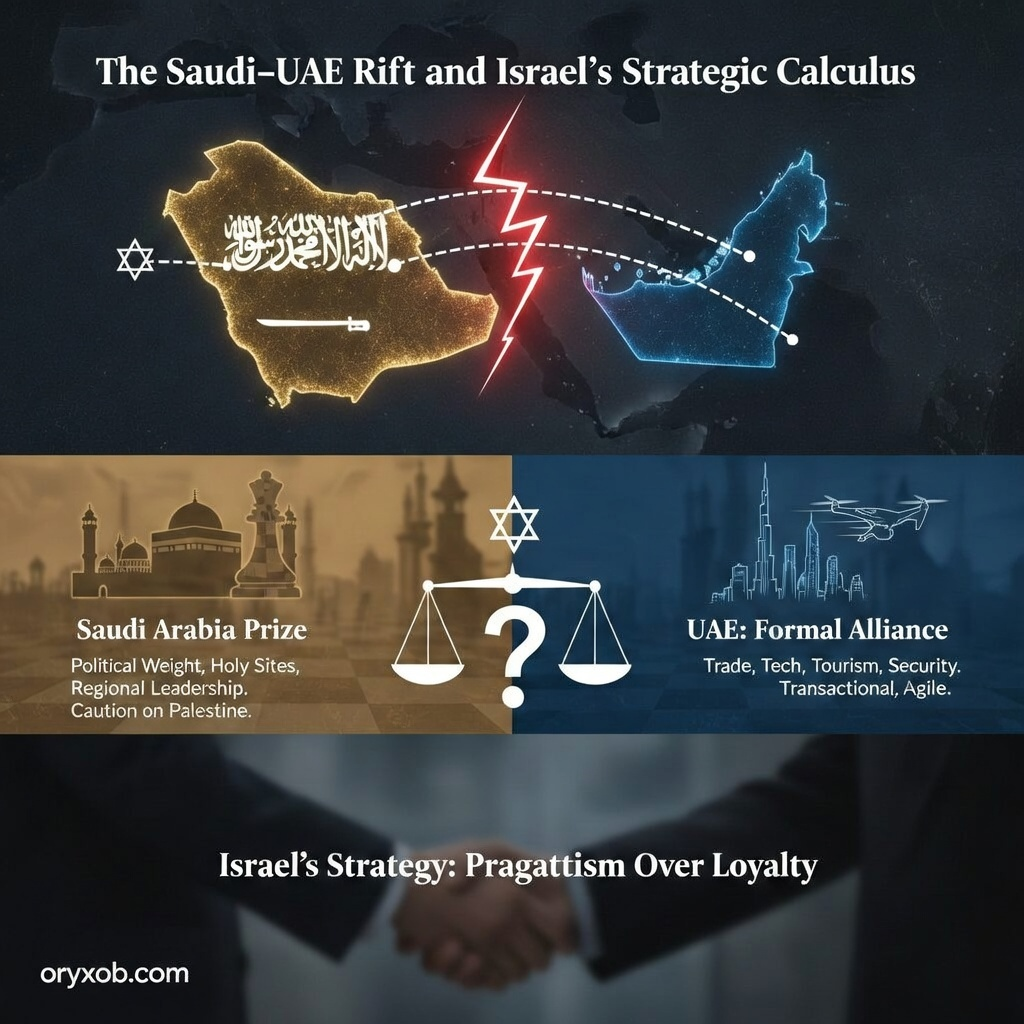
For much of the past decade, Saudi Arabia and the United Arab Emirates were portrayed as the twin pillars of a unified Gulf strategy. From Yemen to counter-political Islam and regional realignment, Riyadh and Abu Dhabi appeared to move in lockstep. Yet this image of cohesion has increasingly given way to a quieter but more consequential reality: a growing strategic rift between the two most influential Gulf monarchies.
This divergence is no longer confined to closed diplomatic channels. It has begun to surface in media narratives, economic competition, and differing regional priorities. As this rift deepens, it inevitably raises a critical question for Israel, a state whose regional strategy increasingly depends on managed alliances in the Gulf: where does Israel stand, and who does it prioritise?
From Tactical Alliance to Strategic Competition
The Saudi-UAE relationship has shifted from cooperation to competition across several domains. In Yemen, Abu Dhabi scaled back its direct military involvement earlier than Riyadh and pursued its own network of local allies, at times working at cross-purposes with Saudi objectives. Economically, the two states are now competitors rather than complementary partners: Saudi Arabia’s push to reposition Riyadh as a regional business hub has directly challenged Dubai’s long-standing dominance.
Politically, their regional visions diverge. The UAE has embraced a model of aggressive normalisation, open economic integration, and a transactional foreign policy that prioritises speed and visibility. Saudi Arabia, by contrast, has adopted a more cautious and calibrated approach, especially on issues carrying symbolic or religious weight.
This divergence has reduced the space for automatic alignment. While neither side seeks open confrontation, the relationship now resembles a managed rivalry rather than a strategic partnership.
Israel and the UAE: A Formal but Limited Alliance
Israel’s relationship with the UAE is formal, visible, and operational. Since normalisation in 2020, cooperation has expanded rapidly in trade, technology, tourism, and security. For Israel, the UAE has proven to be a reliable and low-friction partner, capable of delivering tangible gains without the political complexities associated with larger Arab states.
However, this relationship has clear limits. The UAE, despite its influence, cannot offer Israel the strategic, symbolic, or religious legitimacy that Saudi Arabia represents. Abu Dhabi’s value to Israel is practical rather than transformational. It enhances Israel’s regional integration, but it does not redefine it.
Israel is therefore careful not to over-invest politically in the UAE at the expense of broader Gulf flexibility. Publicly siding with Abu Dhabi in a dispute with Riyadh would risk narrowing Israel’s strategic options.
Israel and Saudi Arabia: The Strategic Prize
Saudi Arabia occupies a fundamentally different position in Israel’s calculations. Any form of normalisation with Riyadh would carry regional and global significance far beyond that of existing agreements. Saudi Arabia’s political weight, custodianship of Islam’s holiest sites, and leadership role in the Arab and Muslim worlds make it uniquely important.
Yet Saudi-Israeli relations remain informal and conditional. Riyadh continues to frame any future normalisation within the context of progress on the Palestinian issue, anchored in the Arab Peace Initiative. Even when back-channel cooperation exists, it is deliberately kept discreet.
From Israel’s perspective, Saudi Arabia represents potential rather than certainty. This makes Israeli policy towards Riyadh cautious and deferential, avoiding actions that could be interpreted as pressure or interference in Saudi regional disputes.
Will Israel Choose Sides?
The short answer is no — at least not openly.
Israel’s strategy is best described as hedging rather than aligning. It seeks to preserve strong relations with the UAE while keeping the door open to Saudi Arabia. This requires deliberate neutrality in Saudi-UAE tensions.
Choosing the UAE outright would risk alienating Riyadh and undermining the long-term objective of Saudi normalisation. Choosing Saudi Arabia at the expense of the UAE would be equally counterproductive, potentially damaging an existing and functioning alliance for a hypothetical future gain.
Instead, Israel benefits most from maintaining parallel tracks: deepening technical and economic cooperation with the UAE, while signalling respect for Saudi conditions and sensitivities.
Public Opinion and the Reality of Power
In both Saudi Arabia and the UAE, public sentiment remains overwhelmingly opposed to normalisation with Israel in the absence of a just resolution to the Palestinian question. This opposition is evident across social media, cultural discourse, and informal polling where available.
However, neither state is democratic. Foreign policy decisions are not subject to electoral accountability or parliamentary constraint. In both systems, the final decision on normalisation rests with a narrow ruling elite — in practice, with a single decision-maker at the apex of power.
This reality explains how normalisation can proceed in one state and stall in another despite broadly similar public attitudes. It also means that Israeli calculations are shaped far more by elite politics than by popular opinion in the Gulf.
Conclusion: Pragmatism Over Loyalty
Israel is not facing a binary choice between Saudi Arabia and the UAE. Rather, it is navigating a fragmented Gulf landscape in which alliances are fluid, conditional, and transactional.
The Saudi-UAE rift complicates Israel’s regional strategy, but it does not force an immediate decision. Israel’s priority is to maximise strategic flexibility, not to demonstrate loyalty to one partner at the expense of another.
In this sense, Israel will not “stand with” either Saudi Arabia or the UAE in their rivalry. It will stand with its own interests — maintaining existing alliances, pursuing future opportunities, and avoiding entanglement in intra-Gulf disputes that could close more doors than they open.