
When a Crown Prince retreats beneath the ground, others above ground start calculating what they can extract.
There are moments in a war when the rhetoric evaporates and the real structure of power is exposed. Saudi Arabia is living through one of those moments now. And what is being exposed is not strength, strategy, or sovereignty. It is insecurity — and a Crown Prince trying to purchase reassurance with Saudi Arabia’s most precious asset: oil.
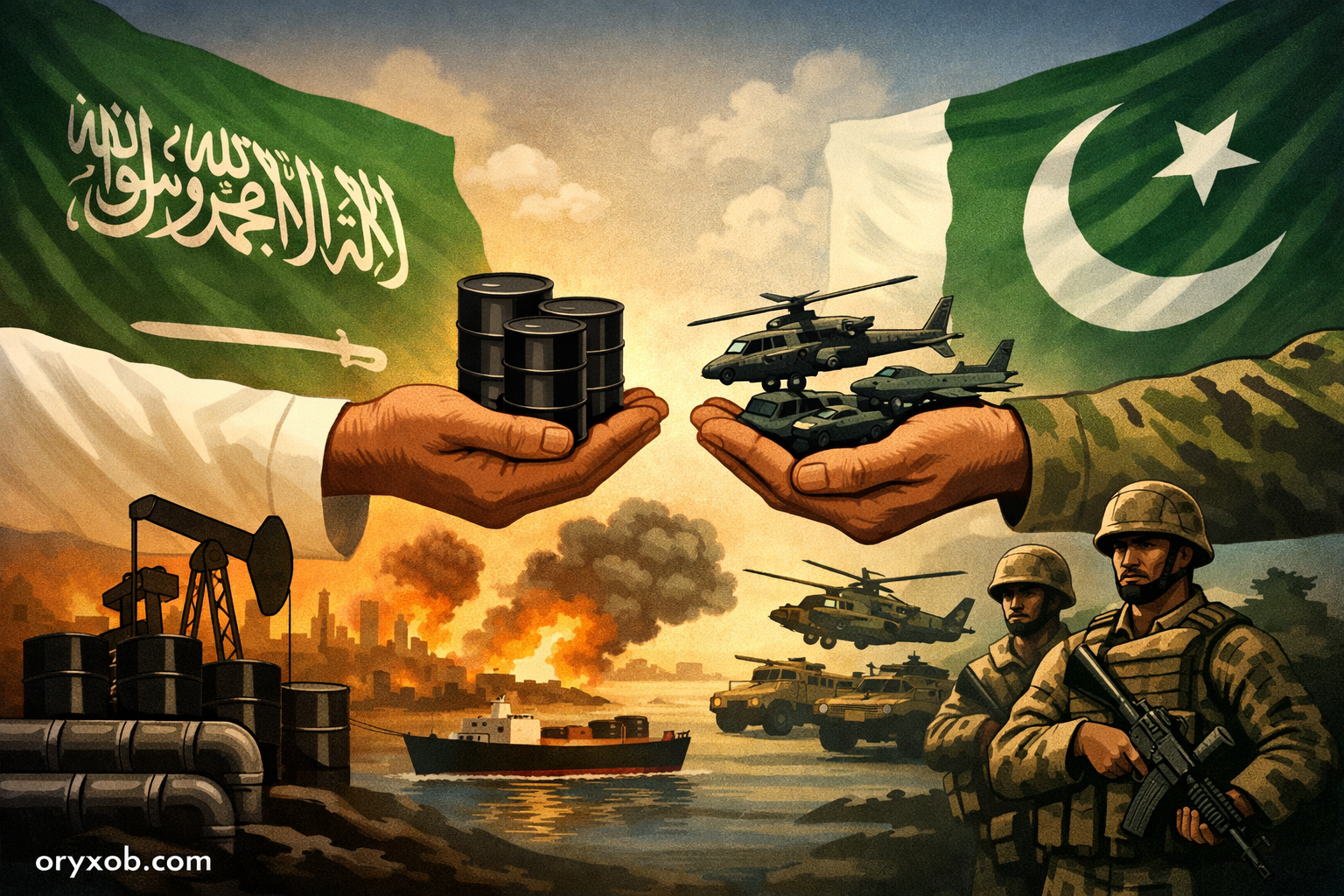
Pakistan’s sudden push for privileged Saudi oil arrangements did not arrive in a vacuum. It arrived at a very specific time: shortly after Riyadh, rattled by Iranian strikes that hit US facilities on Saudi soil, reached out to Islamabad in search of protection and deterrence. In my view, Pakistan read the situation correctly: Saudi Arabia is nervous, overstretched, and politically trapped by its own choices. So Pakistan did what states do when they smell leverage — it squeezed.
Let’s call this what it is: oil for protection.
Pakistan’s leaders have been careful to dress their demand in the language of “energy security”, “disrupted shipping routes”, and the dangers of regional escalation. That language is convenient and, to a point, true. But timing is not a coincidence in geopolitics; it is a signal. Pakistan’s appetite for Saudi concessions grew loud precisely when Saudi Arabia’s need for Pakistani cover became urgent. It is not hard to see the bargain being shaped in real time: Islamabad offers reassurance, strategic messaging, and the implied weight of its military; Riyadh offers crude, routes, and terms generous enough to be sold as “brotherhood” rather than what they really are — payment.
This is not Pakistan being uniquely cynical. It is Pakistan being rational. The scandal is on the Saudi side: a leadership that has made Saudi Arabia negotiable.
We are asked to believe that Saudi Arabia is a confident regional power, steering West Asia with a steady hand. Yet the reality is that Saudi Arabia has been dragged into a reckless confrontation that it neither controls nor can credibly absorb. And the clearest symbol of that fear is not a speech or a statement; it is the way the state has been operating since the war began.
I will put this bluntly: since the outbreak of hostilities, Mohammed bin Salman has been governing from a fortified underground shelter, and he has chaired a Cabinet session via video link from inside it. That is not the posture of a leader calm in his own security architecture. It is the posture of a man who knows the region is on fire and that Saudi Arabia is not insulated from the flames.
When a Crown Prince retreats beneath the ground, others above ground start calculating what they can extract.

Pakistan understands — as others do — that MbS lacks the experience and the strategic judgement to anticipate second- and third-order consequences. He is impulsive, image-driven, and overly dependent on a narrow circle that confuses public relations with statecraft. That is why foreign capitals increasingly treat him less like a seasoned negotiator and more like an opportunity.
The most damaging proof of this inexperience is the catastrophic decision to open Saudi land and airspace to American warplanes pursuing an absurd, open-ended campaign against Iran. This is not a defensive, limited mission designed to protect civilians or stabilise the region. It is a futile escalation, driven by ideology and vengeance, that cannot deliver a clean victory and can easily ignite a wider inferno. Anyone with a basic grasp of regional dynamics knows where such a road leads: retaliation, sabotage, disrupted trade lanes, and the slow bleeding of investor confidence.
And yet MbS either does not understand this — or understands it and cannot say no.
Either way, Saudi Arabia pays. Not the Crown Prince personally. The people.
Every time Riyadh lends its airspace, its bases, its logistics, and its political cover to a foreign war, it turns itself into a target. Every time it does so without a clear national mandate, it erodes the legitimacy it claims to defend. Every time it tries to patch the resulting insecurity by calling in outside protectors, it invites more demands — and more “special arrangements” paid for with Saudi resources.
This is where Pakistan’s move becomes instructive. Islamabad is under pressure at home. It needs energy, foreign exchange, and favourable financing. It also has something Saudi Arabia currently craves: the optics of an additional security partner, and the implied deterrent of a capable military. Put those together, and the transaction almost writes itself.
A confident Saudi leadership would resist this kind of extraction. It would separate national security from personal security. It would refuse to become a staging ground for a war that invites blowback. It would build credible regional de-escalation channels rather than gambling on American firepower. It would treat oil as a strategic national resource, not as a coupon book for buying temporary calm.
But that is not what MbS has built. He has built a system that turns crises into auctions.
Worse, the world knows it. Regional players, global powers, and “friends” of Saudi Arabia have learned that the Crown Prince can be pressured, flattered, and manoeuvred into costly decisions. They know he is politically invested in appearing decisive, even when decisiveness is the wrong tool. They know he fears looking weak, so they offer him symbolic victories in exchange for real concessions. And they know that when he feels cornered, he reaches for chequebook solutions.
That is how a state is looted in daylight: not only by enemies, but by partners who understand that the ruler is insecure and the national treasury is his easiest shield.
Some will argue that this is simply how alliances work: one side provides security, the other provides resources. Fine — in theory. But what makes this moment dangerous is that it is not a balanced alliance emerging from a coherent Saudi strategy. It is a scramble, triggered by MbS’s reckless entanglement in a war he did not design and cannot control.
Saudi Arabia is being pulled into the region’s worst instincts while being sold the illusion of protection. Pakistan is merely the latest actor to present the bill.
And that is the final indignity: a country that should be shaping regional outcomes is instead bargaining for basic security — paying in oil, paying in prestige, and paying in the long-term erosion of sovereignty. When leadership is inexperienced, others do not merely take advantage. They organise themselves around the expectation of advantage.
If MbS continues to treat Saudi Arabia as a personal project — a stage for grand gestures and dangerous alignments — then he should not be surprised when states line up to harvest the consequences. In war, weakness is not only punished by foes. It is monetised by friends.