
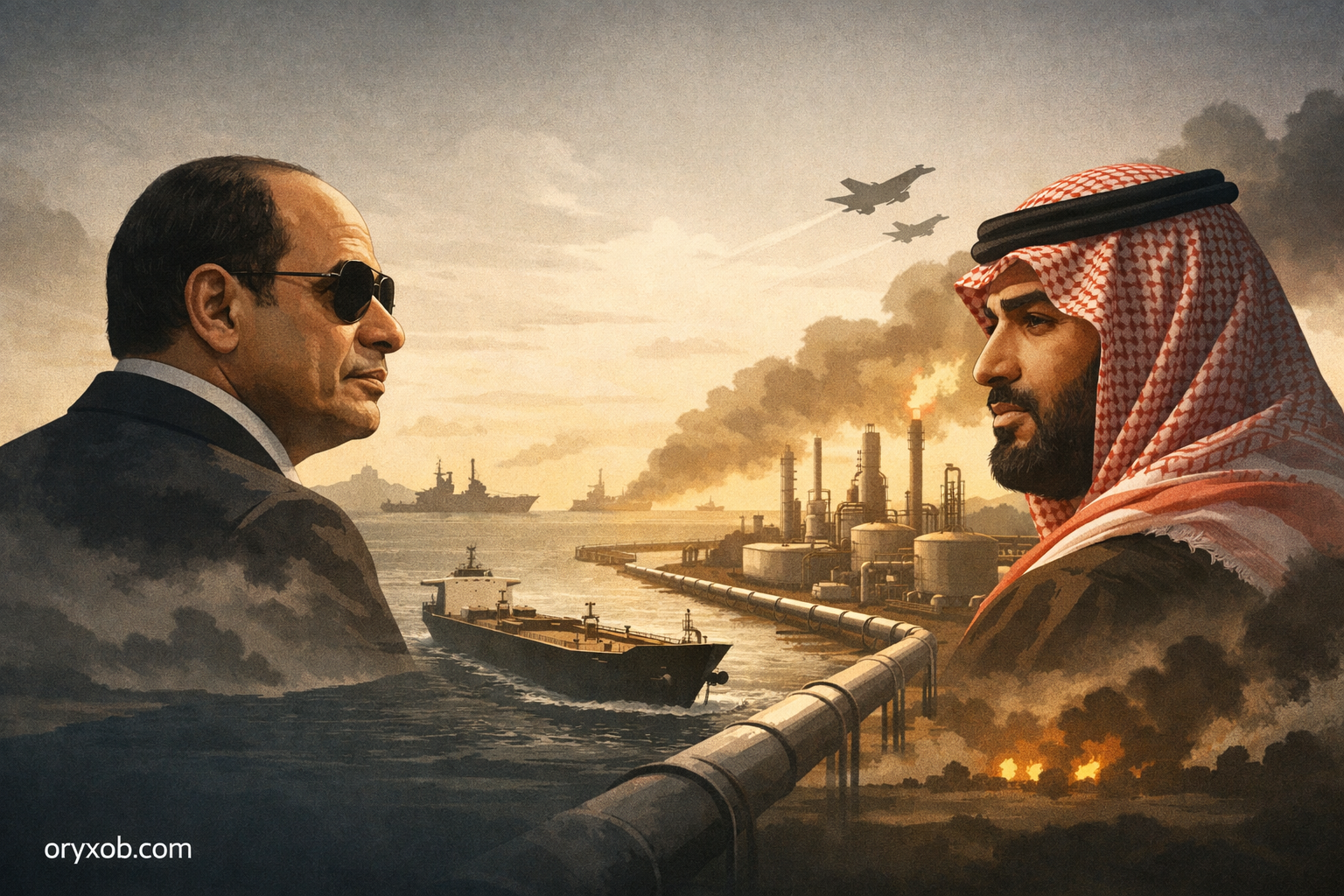
War has a way of revealing who is guided by principle, and who is guided by appetite. In the middle of a region-wide emergency — with shipping disrupted, markets rattled, and ordinary people bracing for yet another round of price shocks — Abdel Fattah al-Sisi is doing what he does best: turning catastrophe into a sales pitch, and turning allies into ATMs.
Egypt’s offer to move Saudi crude via the SUMED pipeline is being dressed up as regional “co-operation”. Let’s call it what it is: a transactional shakedown, timed perfectly to a moment of panic. With traffic through the Strait of Hormuz effectively choked by the war and insurance premiums soaring, Riyadh needs alternatives. Cairo knows it. And Sisi, ever the crisis trader, has rushed to the front of the queue, waving a “solution” that comes with an unspoken invoice.
To be clear, the logistics are real. Saudi cargoes can be routed from Yanbu across the Red Sea to Ain Sokhna, then pumped through SUMED to the Mediterranean — a practical bypass when the Gulf is a battlefield. But Sisi is not offering this because he suddenly discovered the virtues of Arab solidarity. He is offering it because he smells leverage.
This is the same man whose contempt for Gulf money was caught, years ago, in an infamous leaked recording: Gulf rulers, he scoffed, “have money like rice.” In that same episode, the conversation was not about partnership or shared security — it was about how to extract more. Even allowing for disputes about authenticity, the leak captured something unmistakably consistent with Sisi’s behaviour ever since: a sense of entitlement to other people’s wealth, and a willingness to use fear as a crowbar.

His method is simple and brutal. When the region is calm, he markets “stability”. When the region is burning, he markets “necessity”. Either way, the pitch ends in the same place: deposits, bailouts, emergency packages, and “investments” designed less to build Egypt’s productive economy than to keep afloat a debt-heavy model that Sisi’s own mismanagement helped entrench. Every crisis becomes a new justification for why Gulf treasuries should underwrite Cairo’s failures — and why questions about governance, waste, and accountability should be postponed indefinitely.
And here is where Mohammed bin Salman deserves his share of the criticism — not as a victim, but as a willing mark.
For years, MBS has behaved as though grand projects and grand gestures can substitute for strategic judgment. He has spent lavishly to project power, to buy influence, to accelerate a transformation he insists is irreversible. Yet war does not respect branding. Missiles do not care about investor conferences. And markets do not reward impulsive decisions dressed up as “bold leadership”.
Saudi Arabia has publicly signalled it would not allow its airspace or territory to be used for military action against Iran — a sensible stance, and one that acknowledges a basic reality: to facilitate a reckless war is to invite retaliation, economic blowback, and political isolation. But even if Riyadh tries to keep formal distance, the Kingdom is already being pulled into the consequences of Washington’s campaign: disrupted air routes, shaken confidence, and direct threats to the energy infrastructure that underpins Saudi state power.
This is precisely why Sisi’s manoeuvre is so cynical. He is not merely “helping” Saudi Arabia move oil; he is exploiting Saudi vulnerability at a moment when MBS cannot afford to look weak. He knows the Crown Prince’s instincts: pay now, manage the optics, worry later. He knows that MBS—still learning what seasoned statecraft looks like—often confuses spending with strategy.
But what does Riyadh get in return for feeding Cairo’s appetite? An emboldened Sisi, for one — a man who has learned that there is no penalty for squeezing the Gulf, only rewards. And a deeper trap, for another: once Saudi Arabia is seen to bankroll Egypt again under wartime pressure, it normalises the idea that every regional shock is a bill the Kingdom must pick up.
Worse still, MBS risks sleepwalking into decisions whose economic and political costs will outlive the war itself. If Saudi territory, skies, or infrastructure are perceived — fairly or not — as enabling the assault on Iran, the consequences could be severe: retaliatory strikes, sustained insecurity for shipping and aviation, capital flight, and a long-term premium on doing business in a country that Vision 2030 desperately needs the world to view as predictable. The Gulf’s great promise has always been stability. War turns that promise into a question mark.
There is an uncomfortable truth here that both men would rather avoid. Sisi’s regime is not a strategic asset to the Gulf; it is a recurring liability. And MBS’s inexperience is not a harmless personal flaw; it is a national risk factor when decisions can trigger regional escalation and global economic shock.
The region does not need Sisi’s extortionate politics of permanent emergency. It does not need a President who treats crises as harvest seasons and allies as milking cows. But neither does it need a Saudi leadership that keeps mistaking cheques for competence — or that underestimates how quickly a “limited” war can become an open-ended catastrophe.
If MBS wants to prove he is more than a spender with a throne, he should stop funding Sisi’s crisis hustle and start demanding measurable returns, transparency, and limits. And if Sisi wants to be treated as a partner rather than a parasite, he could begin by respecting the very donors he once mocked — and by building an economy that survives without turning every regional fire into a fundraising tour.
Until then, expect more of the same: Sisi circling every disaster like a vulture, and MBS learning — the hard way — that the price of naïveté is rarely paid in cash alone.