
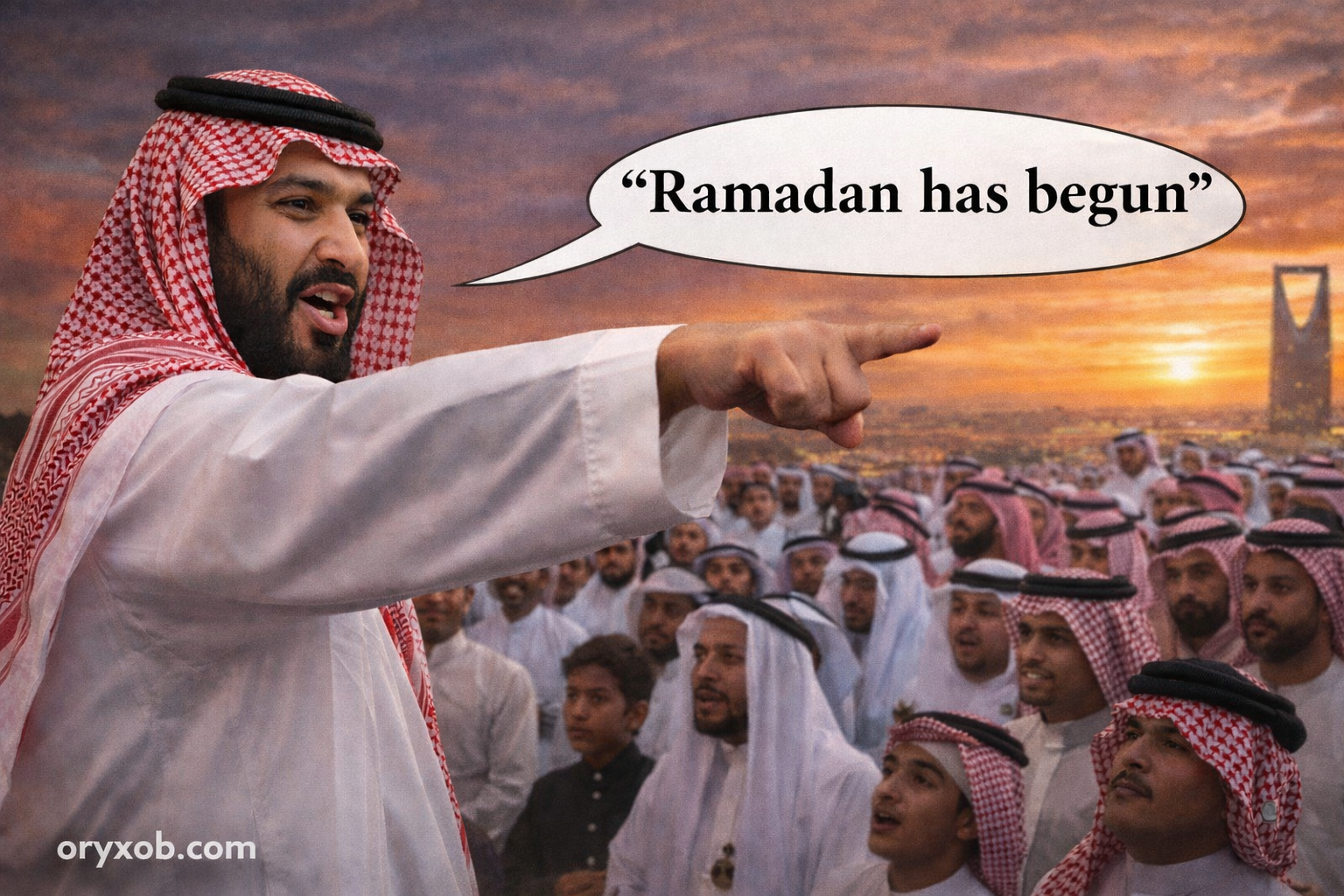
The Saudi Royal Court announced, citing the Supreme Court, on Tuesday evening, 17 February 2026, that Wednesday, 18 February would be one of the days of the month of Ramadan, the ninth month in the Islamic calendar during which Muslims fast every year.
Within this announcement there are several fundamental observations:
First: The Supreme Court is an official state religious authority. Why, then, did it not announce the beginning of the fasting month directly to citizens itself? Why is it not permitted to do so, and instead the announcement must be issued by the Royal Court on its behalf, as though the Royal Court were merely a media platform rather than a political authority that governs the country?
Second: The Supreme Court represents the Wahhabi minority in Saudi Arabia. For those who do not know, Saudi society is composed of Islamic minorities; there is no single dominant religious majority. Wahhabism is among the smallest of these minorities. However, it derives its strength and authority over all other minorities from the fact that the ruling family adheres to this doctrine.
Third: In Islam, the decision regarding the beginning of Ramadan depends on the sighting of the crescent moon in the sky before sunset. Any individual or group can observe the sky and verify the sighting independently. This is what happens in Saudi Arabia among all communities: Shia Muslims in Al-Ahsa and Qatif, Sunnis in the Hijaz, Zaydi and Ismaili communities in Jizan and Najran. All looked to the sky and confirmed that they did not see the crescent on Tuesday evening.
But who saw it?
Only one Wahhabi individual, whose identity was not publicly known, claimed to have seen it in the Sudair region near Riyadh. He then went to the Supreme Court to give his testimony, and because he was Wahhabi, his testimony was accepted. This method is not fictional; it is the reality Saudi Arabia experiences every year.

The Story of the Sudair Region:
For decades, this Wahhabi region has been associated with what amounts to an exclusive privilege in determining the beginning and the end of Ramadan. A group of Wahhabis travel to the desert of this region before sunset in an attempt to sight the crescent. If one of them sees it, then Ramadan has begun — or ended.
On more than one occasion, scandals have emerged in connection with this practice. It has later been established, the following day or days afterwards, that what that Wahhabi individual saw was not the crescent, but another planet — or even the International Space Station.
Reports about such incidents have been published in local Saudi media, yet the flawed practice continues.
Third: Respect for minorities:
Religious minorities in Saudi Arabia state that they should be respected in the decision regarding the beginning or the end of Ramadan. It is unreasonable that the Wahhabi minority — which constitutes, according to unofficial estimates, less than 10 per cent of the various Islamic minorities — should determine the fate of all the other minorities. Since the announcement of Ramadan’s beginning or end is issued through the Royal Court, the matter becomes even worse for those minorities, because the state should represent all citizens in all their diversity, not represent a single minority among them.
Fourth: Other countries — how do they determine Ramadan?
Muslim countries are divided on the issue of crescent sighting into two types:
Countries not subject to Saudi religious influence: In these countries, religious institutions determine the beginning of Ramadan rather than political institutions. In the present case, many of these countries announced that Ramadan would begin on Thursday rather than Wednesday. Among them are: the Sultanate of Oman, Jordan, Egypt, Iraq, Turkey, Iran, Pakistan, Algeria, Morocco, Malaysia and Syria.
Countries subject to Saudi influence, or which avoid contradicting the Saudi religious decision for social, customary or political reasons: These countries announce the beginning or end of Ramadan based on the Saudi announcement rather than their own independent sighting of the crescent. Among them are: the United Arab Emirates, Qatar, Bahrain and Kuwait.
Conclusion:
This article does not seek to say that the correct date of Ramadan is Wednesday or Thursday. Not at all. This article seeks to say that the method by which the beginning of Ramadan is announced and decided in Saudi Arabia is a bad method, a flawed method, an arbitrary method. At its core, it is a method through which Wahhabism seeks to break the will of other Muslims.
