
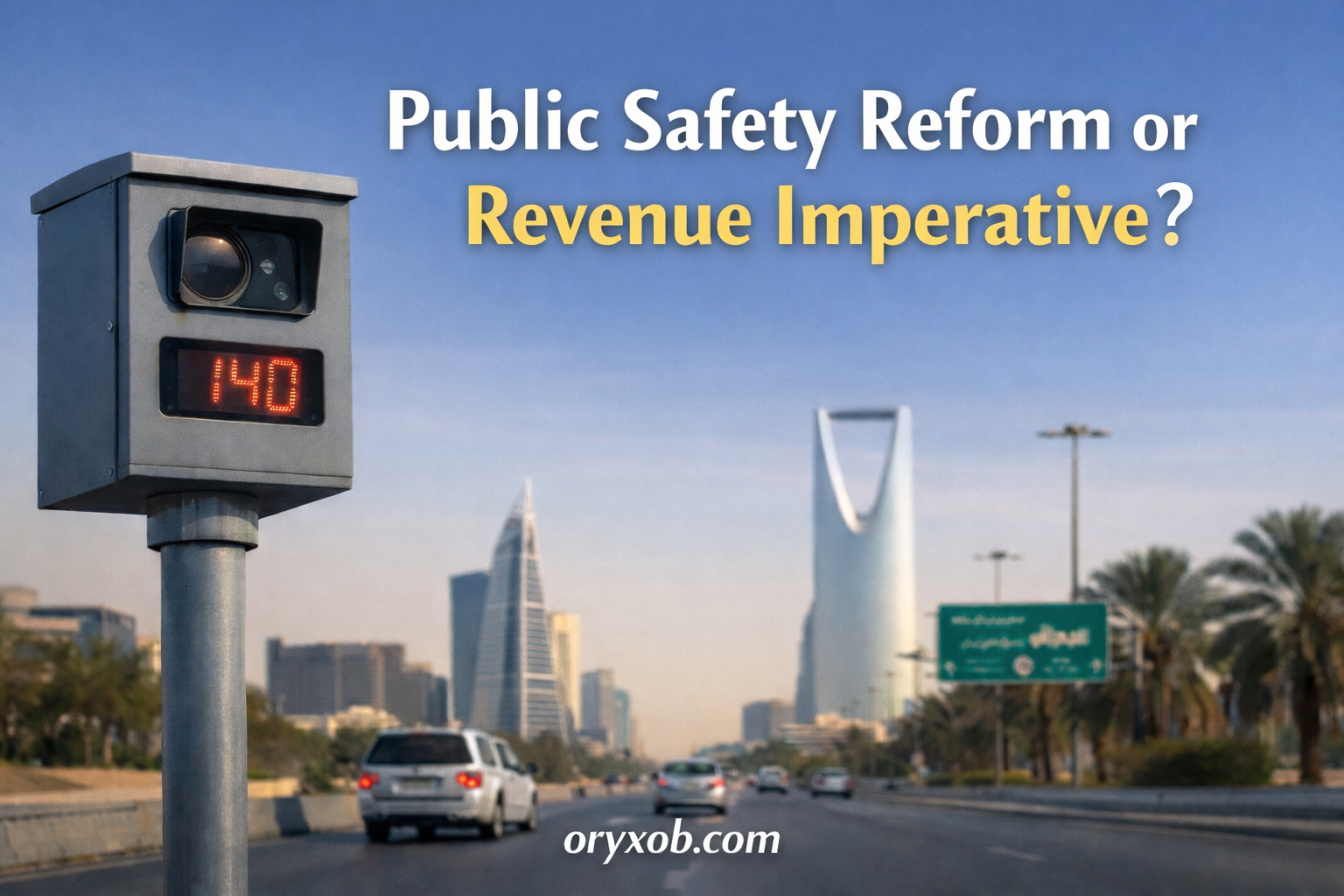
Saudi Arabia’s Saher Traffic Enforcement System: Public Safety Reform or Revenue Imperative?
Saudi Arabia’s automated traffic enforcement network, known as the Saher system, was introduced with a clear public mandate: to reduce road fatalities, enforce traffic laws consistently and modernise traffic management across the Kingdom. More than a decade after its rollout, however, the system remains a subject of persistent public debate. While officials credit it with improving compliance and curbing dangerous driving, many citizens question whether its primary function has shifted from protecting lives to generating revenue.
What is the Saher system?
Launched in 2010 under the supervision of the General Directorate of Traffic, Saher is an automated monitoring network that uses digital cameras, radar technology and number-plate recognition systems to detect traffic violations. These include speeding, red-light offences and, in more recent phases, mobile phone use while driving and failure to wear seatbelts.
The system operates continuously and transmits violations electronically to a central database, after which fines are issued to registered vehicle owners via digital government platforms. Authorities have consistently framed Saher as a cornerstone of wider road safety reforms, particularly in a country that historically recorded high rates of traffic accidents and fatalities.
Officials argue that automation eliminates selective enforcement, reduces human error and ensures that traffic laws are applied uniformly. Government statements over the years have linked the system to measurable declines in certain categories of traffic violations and accidents, although comprehensive public data remains limited.
Citizen complaints and recurring concerns
Despite its stated objectives, Saher has faced sustained criticism from segments of the public. Among the most frequently voiced complaints are allegations of arbitrary or inaccurate violation recordings. Some drivers report receiving fines in circumstances they believe did not constitute clear breaches of traffic law, raising questions about calibration, technical errors or contextual misinterpretation by automated systems.
A second recurring concern relates to transparency in the appeals process. While formal channels exist for contesting fines through digital platforms, critics argue that the process can lack clarity, particularly regarding the evidentiary standards applied. Drivers have reported difficulties obtaining detailed visual proof or contextual explanation of the alleged offence before adjudication.
Another source of frustration concerns the absence of discretionary judgement in exceptional circumstances. For example, motorists have cited instances in which they crossed a red light to make way for an ambulance positioned behind them, only to receive an automatic penalty. Others point to situations involving sudden obstacles, emergency manoeuvres or unclear road markings, arguing that automated enforcement cannot adequately account for real-time context.
Some citizens also question the placement of certain cameras, alleging that they are positioned in areas where speed limits change abruptly or where road signage may be insufficiently visible. In such cases, critics contend that enforcement appears punitive rather than preventative.
Additionally, the cumulative financial burden of fines has become a topic of public debate. For lower-income drivers, repeated penalties can escalate quickly, leading to concerns that enforcement disproportionately affects those least able to absorb the costs. This has fuelled the perception among some that the system functions, at least in part, as a fiscal instrument.
In several Saudi cities, frustration has at times spilled over into acts of vandalism targeting Saher cameras installed along major roads. Authorities have reported incidents in which devices were damaged or destroyed, treating such actions as criminal offences against public property. Individuals convicted of attacking traffic enforcement equipment have received prison sentences and financial penalties, underscoring the state’s zero-tolerance approach to interference with the system. These incidents, while not widespread, illustrate the intensity of feeling surrounding the debate and the extent to which opposition to Saher has, in some cases, moved beyond digital complaint into direct confrontation.
Safety gains versus public trust
The core question remains whether Saher has achieved its central aim of safeguarding lives. Road safety experts generally acknowledge that automated enforcement can reduce speeding and dangerous driving when implemented transparently and accompanied by clear public communication. International experience suggests that visible, predictable enforcement is more effective than perceived entrapment.
In Saudi Arabia’s case, the government maintains that Saher has contributed to a cultural shift in driving behaviour. However, the durability of such reforms depends not only on enforcement but also on public trust. Where citizens perceive a system as opaque or revenue-driven, compliance may become reluctant rather than cooperative.
The broader policy challenge lies in balancing deterrence with fairness. Ensuring that speed limits are rational, signage is unambiguous and appeals mechanisms are accessible and independent could strengthen confidence in the system. Greater publication of aggregate data on accident trends, fine revenues and appeal outcomes would also contribute to transparency.
An evolving debate
For many citizens, the principle of traffic enforcement is not in dispute. The contention lies in implementation: accuracy, proportionality and accountability. In that sense, the debate over Saher reflects a wider conversation about governance in the digital age — where automation promises efficiency, but legitimacy still rests on trust.
The question, therefore, is not whether traffic laws should be enforced, but whether enforcement can be both firm and fair.