
Executive summary
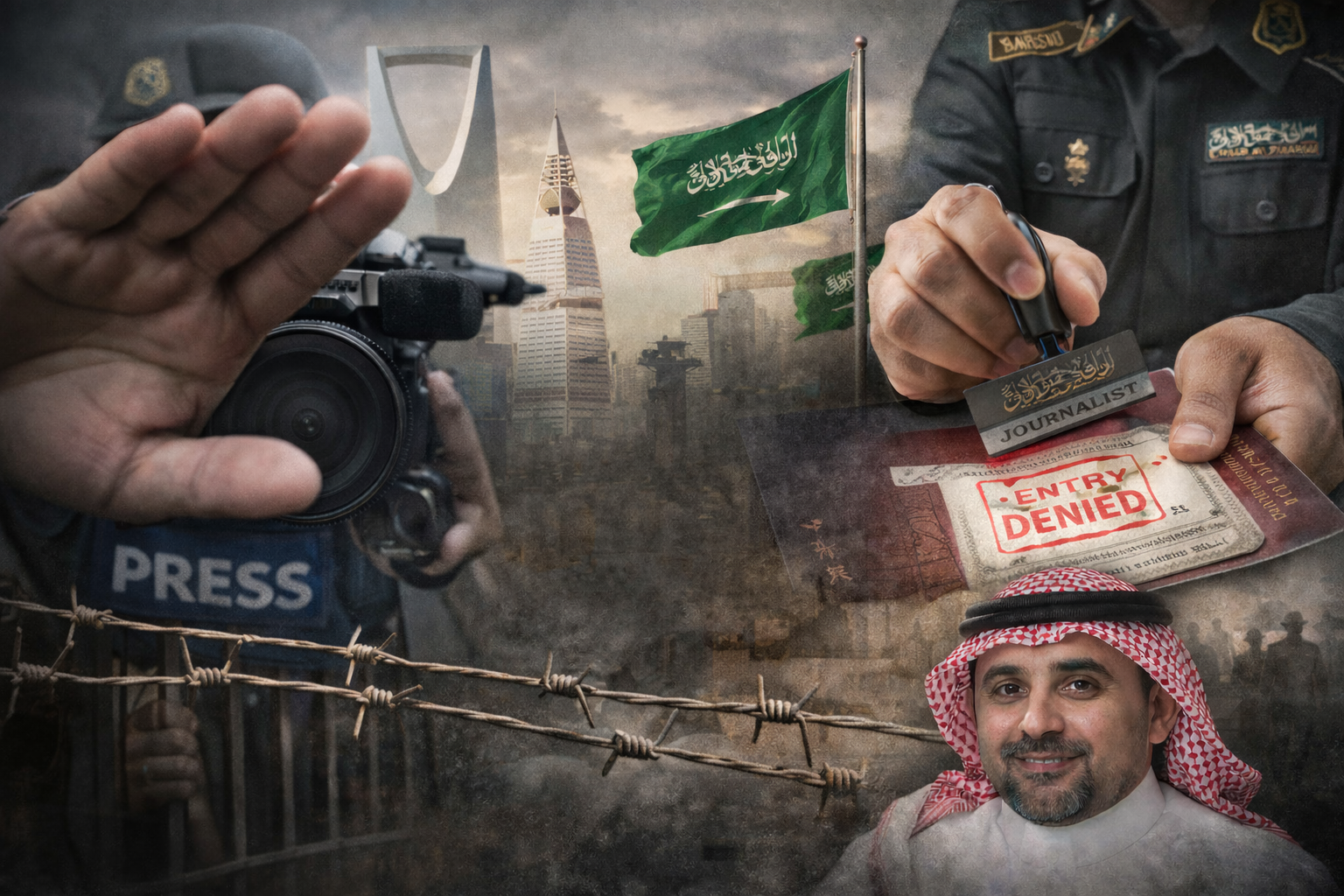
Saudi Arabia permits foreign correspondents to report from within the Kingdom, but it does so through a licence-and-accreditation model that keeps reporting inside political, legal and cultural boundaries.
The core framework is straightforward: foreign media activity is regulated as a licensed practice, correspondents and bureaux operate only with written approval, and accreditation can be withdrawn or not renewed. Implementing rules make clear that accredited correspondents must hold a valid press card, and that reporting without it is not considered lawful.
In practice, foreign correspondents’ independence is constrained by four structural factors:
- Discretionary access: licensing, accreditation and visas are administrative permissions that can be granted, delayed, limited or withdrawn.
- Broad speech and security offences: laws and enforcement practices allow critical coverage to be treated as public-order, cyber or national-security violations.
- A coercive enforcement environment: authorities have used visa denials, accreditation withdrawals, bureau closures, blocking, detention and expulsions to shape coverage.
- A domestic media market under state dominance: independent local media are widely assessed as effectively absent, narrowing the pool of safe local partners and sources.
The overall picture is not “no foreign correspondence”, but foreign correspondence by permission—vulnerable to sudden administrative action and shaped by predictable red lines around senior leadership, religion, national security and foreign policy.
What the law and regulations provide
A licensing principle for print and news media
Saudi Arabia’s press regime is built on a licensing premise: publication and media activity are permitted, but only within limits defined by law and official approvals. The Law on Printed Materials and Publication (Royal Decree No. M/32) explicitly brings “offices of foreign information media and their reporters” under the Ministry’s licensing jurisdiction. It also sets broad prohibitions, including content deemed to conflict with Sharia, harm public security or policy, serve “foreign interests” against the national interest, or stir discord.
Implementing rules: offices, correspondents, press cards
The implementing regulations (as published by the Ministry of Media) define a foreign media office as a fixed local headquarters representing a foreign outlet in the Kingdom, overseen by a director approved by the Ministry. They define a correspondent as an accredited journalist (including photo and arts journalists) nominated by the outlet through official channels.
The regulations make accreditation more than a formality. They provide for press cards issued by the Ministry for set periods (with renewal procedures), and they state—directly—that a correspondent’s work is not considered lawful without a valid press card. The rules also restrict certain kinds of activity, including commercial or advertising work tied to journalistic status.
Audiovisual content controls and pre-release approval powers
For audiovisual reporting and production, the Law of Audiovisual Media (Royal Decree No. M/33) requires a licence for audiovisual media activity and imposes detailed content controls. These include prohibitions on offending the King or Crown Prince, undermining relations with friendly countries, and content framed as incitement to terrorism or threats to national security. The law also allows regulators to demand access to recordings and—under specified conditions—to require content not yet released to be submitted for approval before broadcast.
Enforcement often relies on broader “anti-state” and cyber provisions
Beyond media-specific laws, enforcement against journalists and commentators has frequently relied on broader security, counterterrorism and cybercrime provisions. International assessments—including US State Department human-rights reporting—describe licensing requirements and restrictions that leave foreign media offices present but unable to operate freely, alongside legal tools used to penalise expression and commentary.
How access works in practice
Permission is renewable—and therefore fragile
The formal model (licence first, accreditation second) produces an operational reality in which foreign reporting depends not only on editorial decisions but on continued administrative permission. A bureau’s legal standing, a correspondent’s press card, filming permissions and entry conditions can all become pressure points.
This fragility shapes behaviour. Research on foreign correspondence in restrictive environments has long described how the risk of losing hard-won credentials incentivises self-censorship—particularly where access is scarce and can be withdrawn quickly.
Visas and purpose-specific permissions
Saudi authorities have demonstrated that they treat entry conditions and reporting permissions as purpose-specific and enforceable through immigration controls. In one widely reported case (May 2024), Saudi officials said a foreign state-media crew had entered on visas that allowed pilgrimage but not journalistic work, and the group was detained and expelled. The broader implication is practical: even where a correspondent can physically enter the Kingdom, reporting and filming may still be restricted by the terms of entry and by additional permissions required on the ground.
A record of restrictions: selected documented cases
Saudi controls over foreign reporting are not merely theoretical. Public reporting and watchdog documentation show the state has used visa denials, accreditation withdrawals, bureau closures, detention and expulsion to influence foreign coverage.
Accreditation withdrawal and expulsion: Reuters (2011)
In March 2011, Reuters reported that Saudi authorities withdrew the accreditation of its Riyadh-based correspondent Ulf Laessing, obliging him to leave the country after officials complained a report on a protest was inaccurate. Reuters stood by its reporting.
High-visibility event access: Al Jazeera and the Hajj (2003–2005)
Press-freedom reporting documented repeated refusals to allow Al Jazeera to cover the pilgrimage in Mecca, including statements that requests for accreditation were refused over multiple years.
Bureau closure and licence revocation: Al Jazeera (2017)
During the 2017 Gulf diplomatic rupture, CPJ reported that Saudi Arabia revoked Al Jazeera’s licence to operate in the Kingdom and ordered its office to close, citing official Saudi reporting at the time.
Detention and expulsion over alleged visa misuse: Iranian state-media crew (2024)
In May 2024, AP reported that Saudi Arabia detained and expelled six members of an Iranian state-media crew. Saudi officials said they were working in violation of their visa terms.
Short-term detention of a visiting journalist: Turkish journalist (2024)
In July 2024, Reuters reported that a Turkish journalist, in the Kingdom to cover a youth football team, was detained in Taif over alleged remarks concerning the killing of Jamal Khashoggi. Reuters said details were unclear; subsequent reporting indicated the journalist was released following diplomatic engagement.
These cases vary in severity and context, but they share a common feature: foreign reporting can be curtailed through administrative decisions (accreditation, licensing, access permissions) and, at times, coercive measures (detention, expulsion).
The wider climate: what foreign correspondents are operating inside
Foreign correspondents do not work in a vacuum. The risks they face are linked to the broader environment for journalism and expression in Saudi Arabia, where independent domestic media are widely assessed as effectively absent and where journalists and commentators have faced detention and harsh sentences.
The execution of journalist Turki al-Jasser (June 2025)
On 14 June 2025, Saudi authorities executed journalist Turki al-Jasser. The Saudi Interior Ministry announced the execution and described the case in terrorism- and treason-related terms. International organisations including UNESCO and CPJ condemned the execution. Whatever the disputed details surrounding online attribution and trial transparency, the case signalled—in the starkest way—that certain forms of speech and journalism can be treated as capital offences.
For foreign correspondents, such cases matter because they shape the risk calculus for sources, fixers and local partners. In environments where domestic expression is heavily policed, the ability of foreign reporters to build a diverse set of corroborated voices is structurally reduced.
What this means for foreign reporting
Foreign reporting from Saudi Arabia is best understood as a managed-access system:
- Structural self-censorship: when accreditation can be withdrawn or not renewed, correspondents have incentives to avoid topics likely to trigger administrative retaliation.
- Dependence on official access: when dissenting voices face high risk, reporting skews towards official narratives and controlled access.
- Event-driven tightening: pilgrimages, diplomatic crises and security incidents can bring rapid restrictions for specific outlets or individuals.
- Risk transfer to locals: the greatest danger is often borne not by visiting reporters but by local sources, fixers and contributors.
Saudi Arabia allows foreign correspondents. But the conditions attached to access—licensing, accreditation, visa enforcement and broad legal prohibitions—mean correspondents can operate legally, while remaining operationally dependent on the state’s permission structure. Independence, in the sense of reporting without fear of administrative or criminal reprisal, is materially limited.