
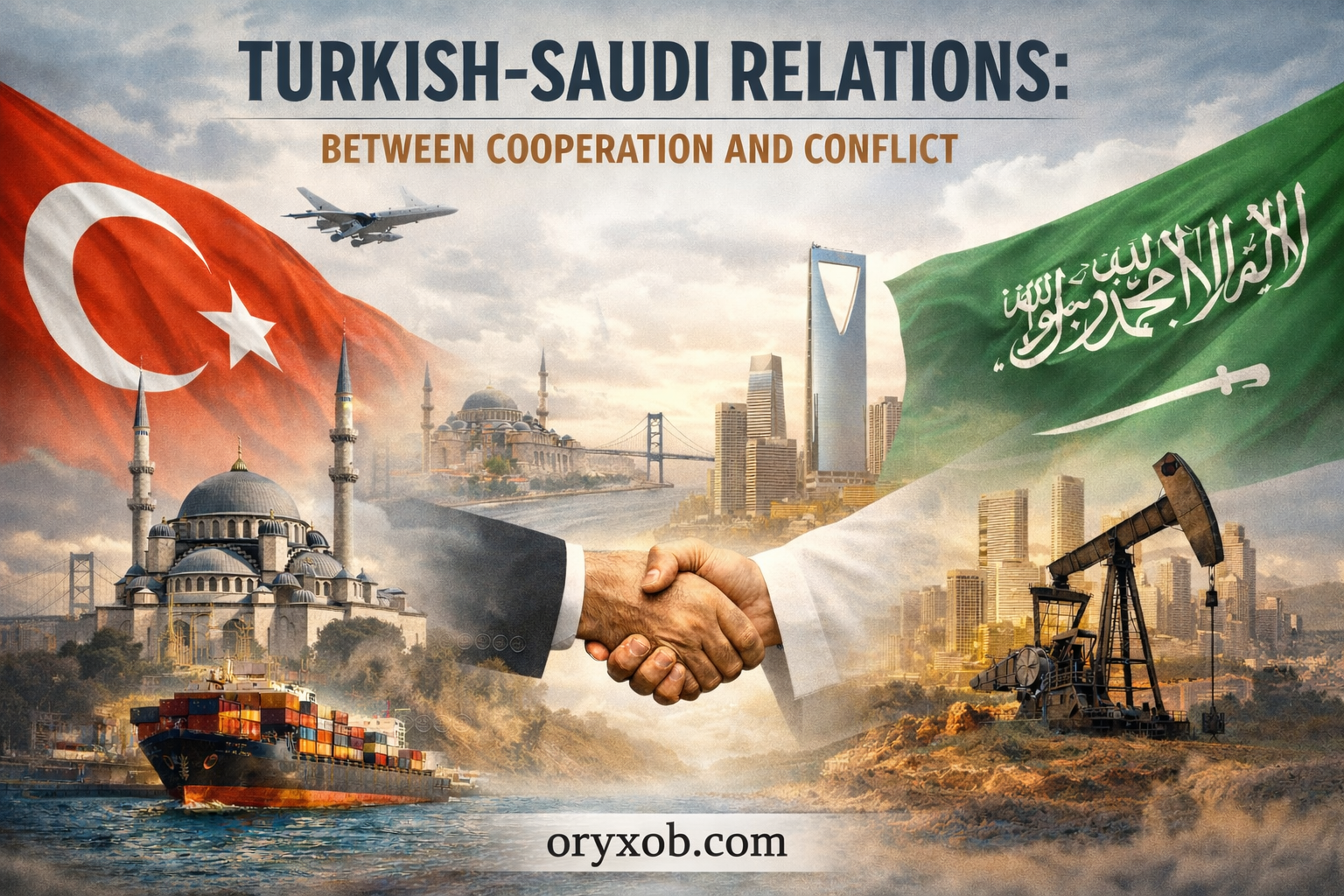
Turkey and Saudi Arabia did not “reset” their relationship so much as execute a sequence of hard pivots: ideological competition after the Arab uprisings, confrontation after Jamal Khashoggi’s murder, and then an interest-driven re-engagement that has become steadily more institutionalised.
The current phase is best captured by the joint statement issued after President Recep Tayyip Erdoğan’s visit to Riyadh on 3 February 2026, where he met Crown Prince Mohammed bin Salman. Its breadth is striking: trade and investment; defence industries and cyber; energy interconnection, hydrogen and critical minerals; and a wide sweep of regional files from Gaza to Syria, Yemen, Sudan, Somalia and the Russia–Ukraine war. The document reads like a relationship trying to become “normal” through administrative density—councils, forums, feasibility studies—after years when politics routinely overrode commerce.
That density matters. It signals a shift from episodic bargains to a more repeatable operating model. But it does not erase the relationship’s underlying fragility. Several drivers of friction have not disappeared; they have been managed. The partnership is now resilient enough to do deals, yet still vulnerable to shocks that revive prestige politics, ideological suspicion or leadership-level mistrust.
Timeline: the pivots that changed the operating model
- June 2017: The Qatar crisis exposes divergence; Turkey rejects demands associated with the Saudi-led bloc, including those linked to Ankara’s military presence in Qatar.
- October 2018: The killing of Jamal Khashoggi in the Saudi consulate in Istanbul becomes the central rupture point.
- October 2020: An informal boycott dynamic—officially denied by Riyadh but widely reported—turns trade into a political instrument.
- April 2022: A Turkish court halts the Istanbul trial of Saudi suspects and transfers the case to Saudi Arabia, widely read as clearing a political obstacle to re-engagement.
- June 2022: Mohammed bin Salman visits Ankara as both sides signal normalisation after years of acrimony.
- March 2023: Saudi Arabia places a $5bn deposit at Turkey’s central bank—a visible marker of improved ties.
- July 2023: Erdoğan visits Jeddah; Saudi Arabia signs a landmark drone agreement with Baykar that Turkey described as its biggest defence/aviation export contract to date.
- July 2024: Turkey’s central bank terminates (by mutual agreement) the $5bn deposit transaction as part of reducing external liabilities—an indicator that “bailout diplomacy” is no longer the only glue.
- December 2024: Syria enters a post-Assad phase after rebels seize Damascus and Bashar al-Assad flees.
- November 2025: Türkiye is confirmed as COP31 host for Antalya, November 2026, in a compromise that gives Australia a lead role in negotiations.
- February 2026: Erdoğan’s Riyadh visit produces a wide joint statement and an intergovernmental renewable-energy agreement to develop up to 5,000 MW of solar projects in Turkey.
Convergence without sameness
The joint statement is explicit about new common ground: both sides commit to expanding trade and investment, activating defence cooperation, cooperating on cybersecurity and counter-terror finance, and deepening energy collaboration (petrochemicals, electricity interconnection, renewables, hydrogen and supply chains). It also places regional coordination in unusually detailed language—particularly on Yemen, Somalia and Syria.
But convergence is not sameness. The relationship now works because it has found a pragmatic division of labour. Turkey brings defence technology, contracting capacity and operational experience across regional theatres. Saudi Arabia brings capital, convening power and, in some arenas, diplomatic centrality. That division shows up in the pattern of deliverables: drones and industrial localisation on one side; deposits, project pipelines and energy investment on the other.
The new transactional core: trade, finance, defence and energy
Trade: collapse, then recovery
The 2020–2021 boycott episode demonstrated how quickly economic ties can be weaponised. Yet the recovery that followed is just as telling. UN-Comtrade-based figures cited by Gulf Research Center show Saudi imports from Turkey dropping sharply in 2021 and then rebounding by 2023–2024. Methodologies vary (mirror statistics, re-exports and reporting differences), but the direction of travel is clear: trade has returned as a pillar of the relationship, not merely an outcome of it.
Finance: “bailout diplomacy”, then an orderly unwind
The $5bn deposit in 2023 functioned as stabilisation finance and strategic messaging. It was framed in directive language—closer to geopolitical signalling than routine central-bank practice. The July 2024 termination, by mutual agreement, is therefore as important as the deposit itself. It suggests a maturing relationship: a reversible, rules-framed financial instrument rather than open-ended patronage. For Saudi Arabia, it avoids becoming Turkey’s permanent backstop. For Turkey, it signals a shift from emergency dependence towards credibility.
Defence industrial cooperation: drones and localisation
The July 2023 drone deal matters because it moves the relationship into a strategic domain that both leaderships value: operational capability paired with industrial policy. Subsequent localisation arrangements point towards a model in which procurement is linked to technology transfer, joint production and domestic capacity-building—an approach aligned with Saudi industrial ambitions and Turkey’s defence export strategy.
Energy and climate: from MoUs to concrete assets
Early 2026 introduced unusually concrete energy cooperation. Under an intergovernmental agreement announced during Erdoğan’s 3 February visit, solar power projects in Turkey are planned up to 5,000 MW, implemented in phases (with the first 2,000 MW in Sivas and Karaman). The structure—long-term electricity purchase by a Turkish state entity, investment size and localisation language—signals a move from political symbolism to asset-level cooperation.
Climate diplomacy has also become an arena for signalling alignment. Saudi Arabia explicitly welcomed Turkey’s COP31 hosting and presidency for 9–20 November 2026 in Antalya. That is not a minor footnote: it ties bilateral messaging to a global summit where prestige and policy intersect.
Regional theatres: what now shapes the bargain
If one structural change has defined the relationship since 2024, it is this: Turkey–Saudi ties are no longer primarily shaped by what the two capitals think of each other, but by what they fear could happen around them—state failure, spillover conflict, sanctions regimes, insurgent governance and the militarisation of shipping lanes.
Syria: the clearest test case
Post-Assad Syria has created shared incentives: sanctions relief, reconstruction, counter-terrorism, refugee return management and preventing renewed fragmentation. The 2026 joint statement endorses Syrian territorial integrity, supports sanctions relief, and backs a ceasefire and integration agreement announced at the end of January 2026. That is the language of shared risk management.
Yet priorities still differ. Turkey’s Syria lens remains security-heavy, shaped by border governance and Kurdish-linked armed structures. Saudi Arabia appears more comfortable operating through diplomatic re-entry and economic leverage while avoiding deep operational entanglement. The question is whether the two can coordinate without sliding back into proxy logic.
Yemen and the Red Sea: alignment on paper, complexity in practice
On Yemen, the joint statement backs the internationally recognised government and explicitly supports Saudi efforts to end the crisis. The convergence is real—but it should not be overstated. Turkey has rarely been a decisive actor on the ground, and its Yemen posture has often tracked broader Gulf ties. The destabilising variable may be intra-Gulf dynamics and Red Sea escalation, which can complicate any Ankara–Riyadh coordination that touches maritime security.
Libya: latent rather than active
Libya remains the most plausible re-divergence theatre. The previous decade placed Turkey and Saudi Arabia on different sides of Libya’s conflict ecosystem, with ideological subtexts and competing regional alignments. Even if the bilateral track is warmer now, Libya’s propensity for sudden militia conflict—and its linkages to Mediterranean energy and maritime disputes—keeps it in the “latent risk” category.
Horn of Africa: a new overlap with sharper language
The joint statement contains unusually direct language rejecting Israel’s mutual recognition declaration with Somaliland, framing it as a violation of Somalia’s territorial integrity. This positions Turkey and Saudi Arabia on the same side of a sensitive issue that sits at the intersection of territorial norms and maritime chokepoint security.
Where they converge—and where they can still diverge
| Dimension | What converges now | What can still re-diverge |
|---|---|---|
| Diplomacy | Frequent high-level engagement and a push to institutionalise ties through councils and forums | Residual mistrust from 2018–2021 can resurface through extraterritorial cases, media campaigns or dissident-linked controversies |
| Defence & security | Drone procurement, localisation, cyber cooperation, counter-terror finance language | Turkey’s NATO commitments and threat hierarchy differ from Saudi de-escalation priorities with certain rivals |
| Economics & finance | Trade recovery, investment signalling, support for a GCC–Turkey FTA track | The boycott episode shows how quickly economics can be weaponised; capital deployment remains selective and political |
| Energy & climate | Concrete renewables projects, talk of interconnection, hydrogen and supply chains; COP31 alignment | Different energy narratives (hydrocarbon centrality vs hub ambition) can produce reputational friction in climate diplomacy |
| Regional policy | Shared risk management language on Syria, Yemen, Somalia; coordination across crises | Proxy dynamics can re-emerge in theatres like Libya; Syria’s settlement could fracture along security lines |
| Soft power & media | Cultural normalisation tends to follow political thaw | Competitive leadership narratives remain: “modernisation” branding versus “civilisational leadership” storytelling |
Outlook: institutionalisation, Syria, and the prestige paradox
The baseline expectation is continued transactional cooperation with periodic turbulence—a relationship that can absorb medium shocks but not profound ones.
Three watchpoints are decisive.
First, institutionalisation is accelerating—and that is the point. The 2026 joint statement does not merely announce projects; it instructs bureaucracies to activate signed agreements across energy, defence, trade and coordination mechanisms. This is how two states try to prevent future crises from instantly collapsing working-level ties.
Second, Syria will test whether the rapprochement is structural. Post-Assad stabilisation creates shared incentives, but also hard questions about armed integration, governance and autonomy arrangements. If Ankara and Riyadh can coordinate in Syria without reverting to proxy logic, it will be the strongest evidence that the relationship has moved beyond a marriage of convenience.
Third, security alignment will remain hedged rather than bloc-like. Both capitals value optionality. Cooperation will likely deepen through projects, procurement and intelligence coordination rather than through formal alliance structures that force one side to inherit the other’s adversaries.
The paradox is that success itself can generate future friction. The more the relationship delivers economically and militarily, the more it creates potential rivalry over prestige and leadership. For now, discipline holds: both sides foreground stability, investment and managed outcomes, not ideological crusades. History suggests that discipline is easiest when the region is on fire—and hardest when it cools.