
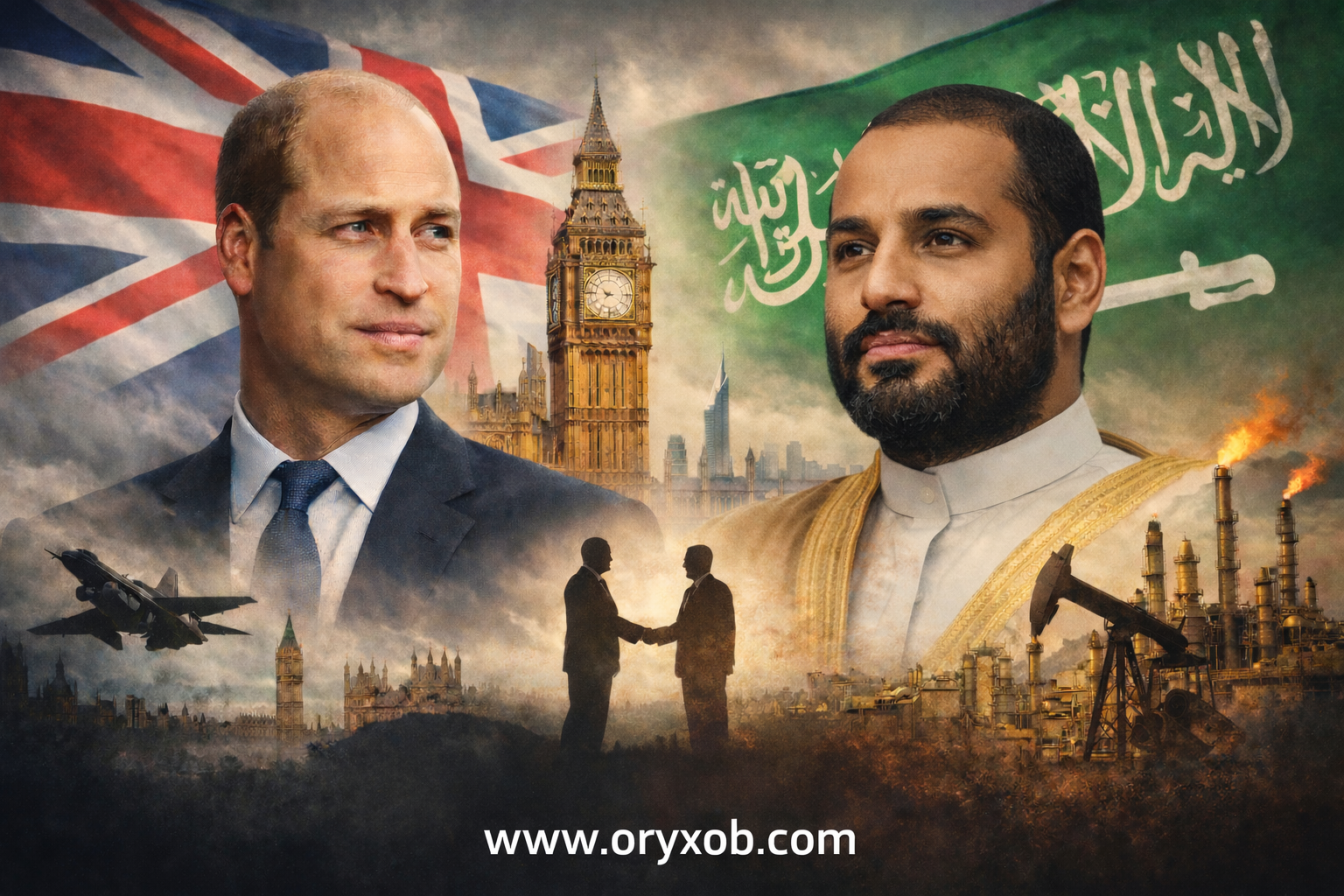
A Prince’s Visit and Saudi Hopes
Prince William’s visit to Saudi Arabia arrived wrapped in ceremony and good manners, but it also opened a more awkward file: what, exactly, does Riyadh think it is buying when it cultivates a relationship with the future King of the United Kingdom?
The Saudi leadership’s enthusiasm for the Prince of Wales is not difficult to decode. In a political culture shaped by palace authority and personal rule, the notion of “the future king” carries a meaning that is almost literal: a man who will one day sit at the apex of the state and, by virtue of that position, deliver outcomes. The trouble is that Britain’s monarchy is not Saudi Arabia’s monarchy. The two crowns sit on entirely different constitutional planets. If Saudi decision-makers are courting Prince William as a future political asset, they may be chasing an illusion.
Britain is a constitutional monarchy. The sovereign reigns but does not rule. The King’s remaining formal powers are, in practice, exercised on ministerial advice. The monarch does not make foreign policy. The monarch does not sign trade agreements as a personal decision. The monarch does not decide whether to sell weapons, impose sanctions, recognise a government, or shift the country’s strategic posture. Those decisions are made by elected politicians, debated in Parliament, contested in the courts, tested by the press, and ultimately judged by the public. The Crown’s influence is largely symbolic, cultural and diplomatic: soft power, not hard power.
This is not a semantic distinction; it is the spine of the British constitutional settlement. A British monarch is constrained not only by law but by convention and by the survival instinct of the institution itself. Any attempt to act as a political actor would provoke public backlash and constitutional crisis. The modern monarchy’s legitimacy rests on restraint. The monarch is expected to be above party politics, not inside it.
Now place that beside the reality of Saudi Arabia under Mohammed bin Salman. The kingdom is an absolute monarchy in which power is concentrated with astonishing intensity. While King Salman remains the formal head of state, the Crown Prince is widely understood to be the de facto ruler and the central decision-maker. Political life is not organised around elections, representative institutions, or a free contest of ideas. It is organised around loyalty, security services, and the calculus of palace power. When Saudi Arabia wants something, it is not unusual for officials to assume that “the leader” can deliver it, because in their system the leader can.
This is the core of the misunderstanding. Riyadh is used to a ruler who can decide, overnight, that a critic becomes an enemy; that a project must be built; that an industry must be created; that a rival must be neutralised; that a policy must change direction without debate. The West is often too polite to name what this is: one-man rule, with few meaningful checks. The concentration of authority in a single figure is not a mere governance style. It determines how society breathes.
Consider the human cost. The climate for free expression is harsh. Political dissent is routinely treated as a security threat. Prominent cases have involved severe sentences for speech, including online speech. The death penalty is used extensively, and mass executions have been carried out in the modern era. This is the texture of absolute power: a state that can punish words with decades, and sometimes life itself, because the system is built to protect the ruler, not the citizen.
Saudi Arabia’s political structure also contains a symbolic cruelty that is hiding in plain sight: the country is named after the ruling family. “Saudi” is not just a nationality; it is a label derived from the House of Saud. It is difficult to imagine a more explicit statement of ownership. It suggests a nation whose identity has been fused to a dynasty, as though an entire people were a branch of a family brand. You do not have to be a radical to see why this would feel like a form of political servitude: a population made to carry the ruler’s name as its own.
This is why the Saudi leadership may misunderstand Prince William. In Riyadh, a king is power. In London, a king is continuity. If Mohammed bin Salman, or those around him, believe they can invest in Prince William today and receive political returns tomorrow, they are projecting their own system onto Britain’s. That projection is not only wrong; it exposes the Saudi regime’s deeper habit of confusing personal relationships with political institutions.
It would not be the first time. The history of UK–Saudi relations is littered with episodes in which personal influence, hospitality, and the promise of strategic partnership have collided with Britain’s messy democratic constraints. The most notorious example remains the long-running controversy around major arms deals between British industry and Saudi Arabia, and the allegations of bribery and “sweeteners” involving Saudi intermediaries. The scandal’s most revealing feature was not only the allegation itself, but the way pressure was reportedly applied to make investigations go away. When a foreign government can credibly be accused of leaning on British authorities to halt scrutiny, it underlines two truths at once: first, that Riyadh historically expects special treatment; and second, that Britain’s system, precisely because it is not absolute, can become a battleground between rule-of-law principles and political expediency.
Saudi Arabia’s own “anti-corruption” theatre in 2017 offered another lesson in how power operates there. The dramatic detention of princes and tycoons at the Ritz-Carlton in Riyadh was marketed as a clean-up operation and was accompanied by claims of vast sums recovered for the state. But the episode also looked, to many observers, like a consolidation of Mohammed bin Salman’s authority: a moment when rivals were forced into submission and wealth was extracted through coercive bargaining, without transparent due process. That is what anti-corruption looks like in an autocracy: selective, centralised, and ultimately useful to the ruler.
Against this backdrop, the charm of royal diplomacy becomes both understandable and suspect. Saudi Arabia wants legitimacy and comfort in the company of Western prestige. A visit by a senior British royal offers precisely that: photographs, symbolism, a sense of acceptance. It also feeds a domestic narrative that the leadership is respected internationally, whatever the headlines about repression, surveillance, and the killing of dissidents. Soft power works both ways, and Riyadh understands it.
Britain, too, has reasons to engage. Saudi Arabia remains a major energy actor, a security partner for some in Whitehall thinking, and a market for trade. British governments of different stripes have pursued pragmatic relations, sometimes while insisting that values and interests can be balanced. But the risk of royal visits is that symbolism can slide into sanitisation. The public sees pageantry; the regime sees endorsement. And the people who live under absolute power see their rulers welcomed while their own voices remain trapped at home.
None of this means Prince William is irrelevant. Far from it. The British monarchy possesses cultural capital and global reach. It can open doors, frame narratives, and help Britain project a certain image. A royal can sometimes say what ministers cannot, or at least create a moment in which uncomfortable topics must be acknowledged, even if privately. But there is a line between influence and authority, and Saudi Arabia’s system is built to blur that line deliberately. In a one-man state, almost every relationship becomes transactional, and almost every prestige encounter becomes a tool.
So the question should be put plainly: does Mohammed bin Salman believe that the future King of Britain can provide political services? If he does, he will be disappointed. A British king cannot deliver policy favours in the way an absolute ruler can. He cannot silence Parliament. He cannot neutralise media scrutiny. He cannot make investigations disappear. He cannot, in any legitimate sense, serve as an agent of Saudi interests inside the British state.
The more interesting question, however, is why Riyadh would want to believe it. The answer lies in the psychology of absolutism. When one man can decide nearly everything, it becomes natural to assume that other systems operate similarly, merely with different costumes. It also becomes tempting to seek validation abroad, because domestic legitimacy is fragile when it depends on fear and the suppression of dissent. International photographs become substitutes for internal consent.
For Saudis living under this system, the spectacle is bitter. They know what it means to have no meaningful say in who governs them. They know what it means for speech to be policed and for punishment to be disproportionate. They know what it means to watch their nationality tied linguistically to a dynasty. They watch their rulers cultivate friendships with foreign princes while their own civil society is curtailed. The contrast is not merely political. It is existential.
If Saudi Arabia genuinely seeks a modern relationship with Britain, it would do better to invest in institutions rather than in individuals. It would do better to reduce repression rather than to manage optics. And it would do better to understand that Britain’s monarchy is not a lever of state power, but a symbol in a constitutional machine that cannot simply be “bought” through charm or ceremonial intimacy.
Prince William’s visit, then, should be seen for what it is: a diplomatic gesture with limited practical consequences. For Britain, it is soft power in service of government objectives. For Saudi Arabia, it is prestige and the appearance of normality. But if Mohammed bin Salman is quietly wagering that today’s prince becomes tomorrow’s political instrument, he is misreading both Britain and the very lesson that keeps the British monarchy alive: the crown endures precisely because it does not govern.
And for Saudis, the deeper tragedy remains unchanged. A country named after its rulers, governed by one man’s will, cannot buy its way into legitimacy abroad while denying dignity at home. The world may applaud the choreography, but the people still live the reality.