
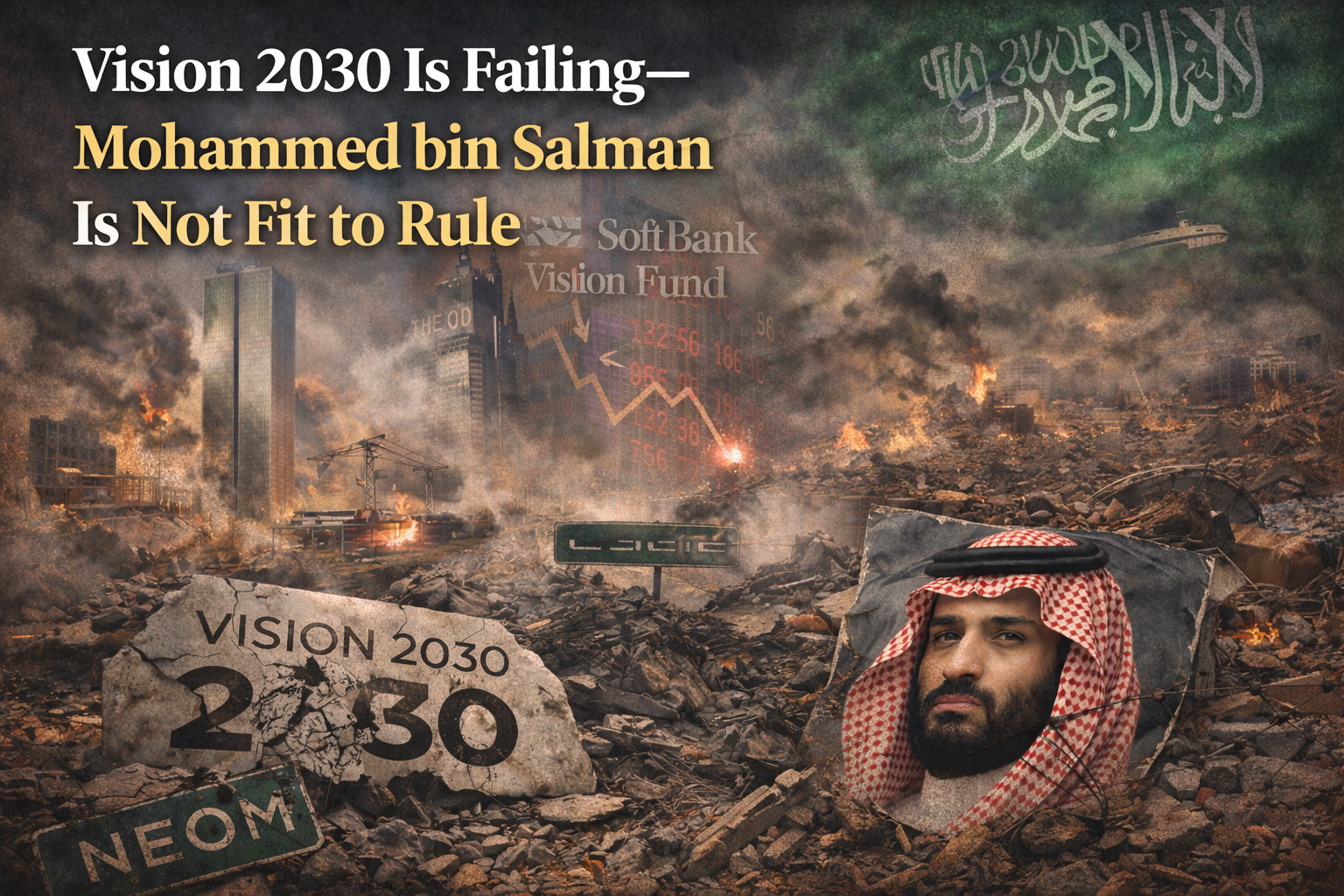
When Saudi Arabia’s Crown Prince Mohammed bin Salman unveiled Vision 2030 in April 2016, it was presented as nothing less than a national rebirth. The plan promised to wean the kingdom off oil dependency, build futuristic cities, attract foreign investment, create millions of jobs, and reposition Saudi Arabia as a global economic powerhouse.
Nearly a decade later, the reality is far less flattering. What was sold as a carefully engineered transformation now resembles a catalogue of delays, cost overruns, abandoned ambitions, and investor scepticism. At the centre of this failure sits Mohammed bin Salman himself: an inexperienced, impulsive leader who substituted spectacle for planning and intimidation for governance.
NEOM: the $500 Billion Fantasy
No project better symbolises the failure of Vision 2030 than NEOM, the $500 billion mega-city announced in 2017. Marketed as a high-tech utopia spanning 26,500 square kilometres, NEOM was supposed to house advanced industries, renewable energy hubs, and a population of millions.
The reality is starkly different.
According to internal planning documents leaked in 2023, the original target of housing 1.5 million residents by 2030 has been quietly revised down to fewer than 300,000. The flagship component, The Line—a 170-kilometre mirrored city—has been drastically scaled back. Instead of completing the full structure, current plans focus on a fragment of just 2.4 kilometres, at a projected cost exceeding $100 billion.
Senior executives have come and gone at alarming speed. Nadhmi al-Nasr, NEOM’s long-serving chief executive, struggled to impose any coherent governance structure, while global consultants repeatedly warned that timelines were “unachievable”. Foreign contractors complained privately of erratic decision-making and last-minute design changes dictated directly by the Crown Prince.
Meanwhile, the human cost has been ignored. Members of the Huwaitat tribe were forcibly displaced to clear land for NEOM, with documented cases of arrests and lethal force against those who resisted. Vision 2030, it seems, was never meant to include consent.
The Line, Oxagon, Trojena: ambition without arithmetic
Beyond NEOM itself, its sub-projects illustrate the same pattern.
- Oxagon, the floating industrial city, was advertised as the world’s largest floating structure. Construction timelines have slipped repeatedly, and industrial tenants have failed to materialise at scale.
- Trojena, the proposed mountain ski resort, was announced despite average winter temperatures well above freezing. Artificial snow production alone would require vast energy and water inputs, undermining the project’s own sustainability claims.
Each announcement generated headlines and glossy videos. Each delivery phase ran into engineering, financial, or environmental realities that had clearly not been fully considered at the outset.
The Red Sea Project and tourism overreach
Tourism was meant to be a cornerstone of diversification. The Red Sea Project, launched in 2017 by Red Sea Global, promised 50 luxury resorts across pristine islands.
By 2024, only a handful of hotels had opened. Costs ballooned far beyond initial projections, while international hotel operators demanded guarantees and concessions to offset reputational and regulatory risks. The original target of attracting one million visitors annually by 2030 now appears increasingly unrealistic given regional instability and limited global appetite for ultra-luxury tourism in a tightly controlled state.
Lucid Motors and the illusion of industrialisation
Vision 2030 also aimed to build domestic manufacturing. The Crown Prince personally championed Lucid Motors, committing more than $1 billion through the Public Investment Fund (PIF) and promising to turn Saudi Arabia into an electric vehicle hub.
Yet Lucid has struggled badly. In 2022 and 2023, the company posted losses exceeding $2.8 billion, repeatedly cut production targets, and laid off staff. Its Saudi factory operates far below capacity, assembling vehicles at costs that far exceed market logic. What was meant to showcase industrial competence instead exposed how state-backed prestige projects ignore basic commercial viability.
SoftBank, the Vision Fund, and investor flight
Mohammed bin Salman also sought legitimacy through global finance. In 2016, he personally spearheaded Saudi Arabia’s $45 billion investment into SoftBank’s Vision Fund, the largest tech investment fund in history.
The results were disastrous. High-profile failures such as WeWork, Katerra, and Oyo wiped out tens of billions in value. By 2022, SoftBank posted its largest-ever annual loss, forcing the fund into retreat. Far from attracting confidence, the Saudi-backed fund became a warning sign about governance-free capital flooding into unsound ideas.
Youth unemployment and fiscal reality
Despite constant rhetoric about job creation, Saudi youth unemployment remains stubbornly high, hovering around 15–16% in recent official figures. Much of the employment growth touted under Vision 2030 has come from temporary public-sector hiring or low-wage service roles tied to state spending, not sustainable private-sector expansion.
At the same time, the kingdom has quietly returned to austerity measures: cutting subsidies, raising VAT to 15%, and trimming public-sector benefits—hardly the signs of a confident economic transformation.
Centralised power, absent expertise
These failures are not accidental. They are the product of a governance model in which all major decisions flow through one man, and dissent is treated as disloyalty.
Mohammed bin Salman has no background in economics, engineering, urban planning, or public administration. Yet he overrides specialists, reshuffles leadership at will, and governs through fear rather than competence. Ministers, consultants, and executives know that challenging unrealistic targets can end careers—or worse.
Vision 2030 was never subjected to democratic scrutiny, parliamentary oversight, or independent auditing. It exists as a personal project of an absolutist ruler who mistakes scale for seriousness and spectacle for strategy.
An unfit ruler, not just a failed plan
The collapse of Vision 2030’s credibility leads to an unavoidable conclusion. This is not merely a flawed policy agenda; it is a reflection of the man behind it.
A leader who launches half-trillion-dollar projects without feasibility, silences critics instead of correcting course, and treats national wealth as a personal venture capital fund is not fit to rule a modern state. Mohammed bin Salman’s recklessness, immaturity, and lack of experience have turned Saudi Arabia’s future into a high-stakes gamble—with the population bearing the risk.
Vision 2030 was supposed to be Saudi Arabia’s leap into the future. Instead, it stands as a cautionary tale: of what happens when absolute power meets unchecked ambition, and when governance is replaced by vanity.
The tragedy is not only that Vision 2030 is failing—but that an entire country is being forced to fail along with it.
