
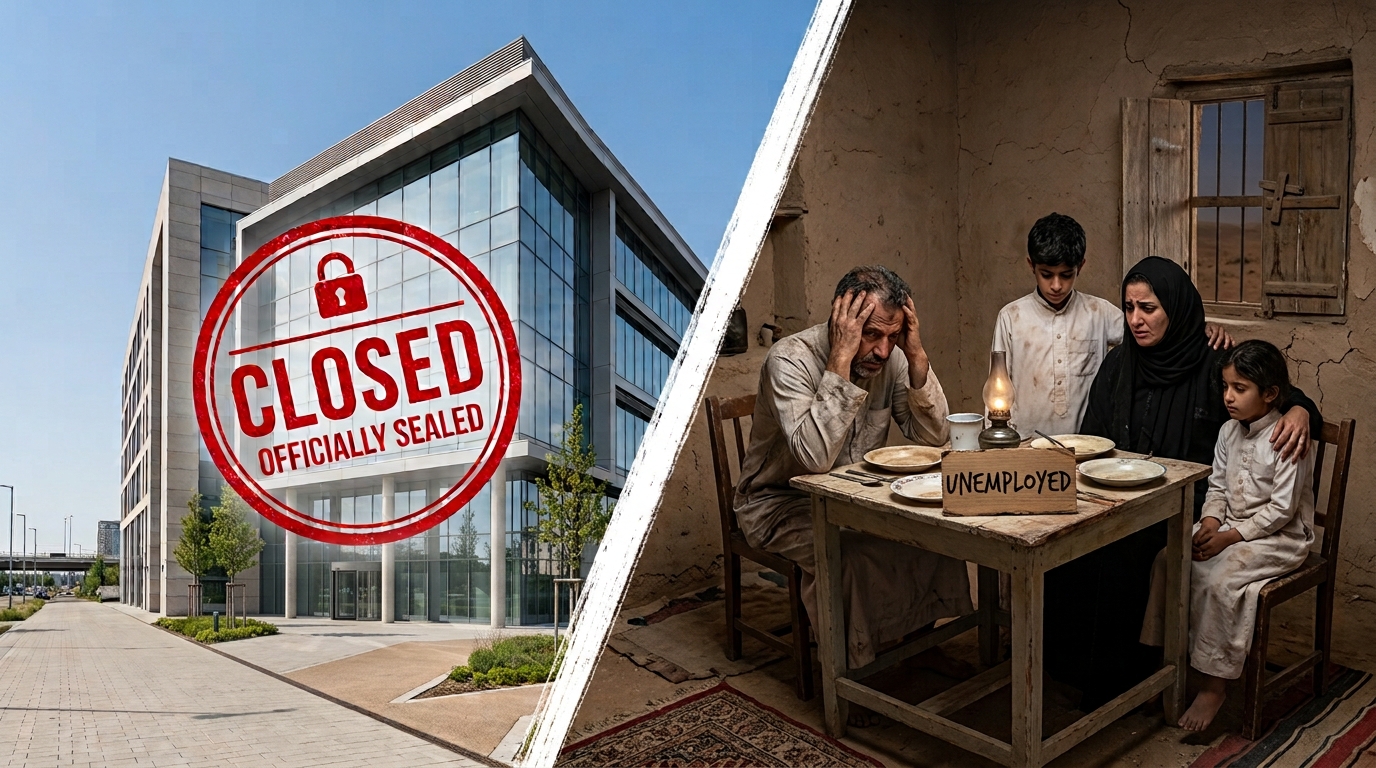
There is a particular kind of ruin that never makes the evening news. It does not arrive with a palace intrigue or a missile strike. It arrives as a locked clinic in Jeddah, a contractor’s yard gone quiet in Dammam, a restaurant in Riyadh that no longer opens its doors. It arrives as a father who cannot explain to his children why the company that bore the family name is now a line in a court ledger. In the Kingdom of Saudi Arabia, that ruin has become a monthly ritual.
Between January and the end of August 2026, some 489 Saudi firms entered bankruptcy or opened formal insolvency proceedings. The monthly tally is not a freak spike. It is a drumbeat: 72 in January, 48 in February, 55 in March, 55 in April, 63 in May, 64 in June, 62 in July, and 70 in August. Seventy companies in a single month, recorded before the courts of Riyadh, Dammam, Jeddah, Medina, Mecca, Abha and Buraidah. One does not need a ministry briefing to recognise the shape of a private sector under strain. One needs only the patience to read the names.
They are not, for the most part, the glittering vehicles of Vision 2030. They are the ordinary anatomy of a commercial society. In healthcare: Hadeer Al-Madain Medical Complex in Jeddah, Awan Medical Complex in Riyadh, Rawad Angel Medical, Bohouth Medical, Farm Medical, Rahima Al-Ahli Clinic in Dammam. In contracting: Droob Al-Sharqiyah, Burooj Al-Tatawur, Al-Ramla Contracting, Al-Faiha Construction, and the long-titled house of Abu Bakr Salem Bawazir & Partners. In technology: Al-Suraa Al-Majhoola for Information Technology, Rawad Al-Manazil IT, Ana Ibdaa for Communications. In food and hospitality: Areeka Al-Deera Restaurants, Ittijah Al-Ghitha, Sereen Restaurants, Fateerati, and the rather hopeful-sounding True Business for Meal Provision. In retail and apparel: Fifi Modern Ready-Made Clothes, Al-Arabiya for Garments, Mukhtarat Al-Jawarib. In property: Asas wa Arbah Real Estate Development, Aknan for Investment and Real Estate Marketing.
Read those names slowly. They are not abstractions. They are clinics that once employed nurses, kitchens that once paid waiters, sites that once hired labourers, offices that once sent a young graduate home with a first salary. When such firms fail, a household does not merely “restructure”. A household is gutted. In Arabic one speaks of kharab buyut — the wrecking of homes — and the phrase is not poetry. It means school fees unpaid, rents falling into arrears, marriages postponed, dignity quietly pawned. Multiply that by the staff of hundreds of companies and you have not a statistic but a social wound.
The official line, when it is offered at all, is a masterpiece of administrative gentility. Opening insolvency proceedings, we are told, does not necessarily mean a firm has left the market. There is preventive settlement. There is financial reorganisation. There is, in short, a legal architecture designed to sound modern. Quite so. Modern bankruptcy law is a civilised instrument. It is also, when the caseload swells month after month, a thermometer. A government that boasts of transformation cannot treat a rising fever as a triumph of diagnostic equipment.
What, then, is the cause? The courtier’s answer will always be global headwinds, sectoral correction, the natural churn of enterprise. There is a sliver of truth in every alibi. Construction everywhere is cyclical. Restaurants everywhere die young. Credit everywhere tightens. But a serious country does not outsource responsibility for its own commercial weather to the gods of the market while its Crown Prince claims authorship of the climate. Mohammed bin Salman has spent a decade presenting himself as the sole architect of the new Saudi economy: the man who would wean the Kingdom off oil, summon giga-projects from the desert, and turn a closed society into an investment prospectus. He has concentrated power to a degree that makes the old consensus of princes look almost parliamentary. He cannot, therefore, be permitted the luxury of being everywhere in the brochures and nowhere in the wreckage.
The failure is not merely one of taste in megaprojects, though the gap between neon renderings and unpaid invoices has become its own genre of dark comedy. It is a failure of political economy. An economy commanded from the top, greased by royal procurement and frightened into loyalty, does not produce a resilient private sector. It produces clients. Clients thrive while the spending lasts and fold when the tap is adjusted. They cannot lobby in public. They cannot form an independent association that says the unsayable: that priorities have been distorted, that liquidity has been hoarded at the summit, that the small and the medium have been treated as disposable scenery for a spectacle of national rebirth. In a system that punishes frank speech, the insolvency register becomes the only permitted form of protest — and even that protest is filed in the third person, by lawyers, in the dry language of the court.
This is the cruelty that the glossy interviews never mention. These companies cannot speak. Their founders cannot give a television interview about the contract that was delayed until it killed them, the payment that never came, the regulator that smiled and did nothing. Their wives cannot write to a newspaper. Their employees cannot picket a ministry. There will be no hearing for the grief of the men and women who built these firms, nor for the thousands who have lost their wages because the firm is gone. The silence is not accidental. It is the point. A politics that cannot tolerate complaint will always prefer a ruined shopkeeper to a talking one.
The consequences are already visible, even if they are not admitted. Trust is a form of capital. When clinics close and contractors vanish, suppliers stop extending credit. Banks become more timid. Young Saudis who were told that the private sector was their future learn a different lesson: that the safest living is still in the shadow of the state. The very “Saudisation” of enterprise, so loudly advertised, becomes a trap if the enterprises themselves are not allowed to live. Foreign investors, who read more than they let on, notice that the legal system can process failure with some efficiency and that the political system cannot process blame at all.
What comes next is not mysterious. If the present cadence holds, the Kingdom will finish the year with well over six hundred firms on this grim roster — not the collapse of the state, which is a fantasy of its enemies, but the hollowing of the commercial middle, which is a habit of its rulers. More households will be broken in private. More talent will emigrate in the polite disguise of study and second passports. The giga-projects will continue to announce themselves as the future, because announcement is the one industry that never files for bankruptcy.
A columnist in a free country would end by demanding a parliamentary inquiry, a change of minister, an election. Saudi Arabia affords none of these remedies. That is precisely why the argument must be made from outside, and made without the liquid courtesy that so often passes for analysis of the Gulf. Mohammed bin Salman asked to be judged as a moderniser. Very well. Judge him by the shops that have gone dark, by the clinics that no longer take patients, by the contractors who cannot pay their men, and by the enforced hush in which all of this is required to happen. A ruler who will not hear the grief of the ruined should not be surprised when history records the silence as his most eloquent policy.