
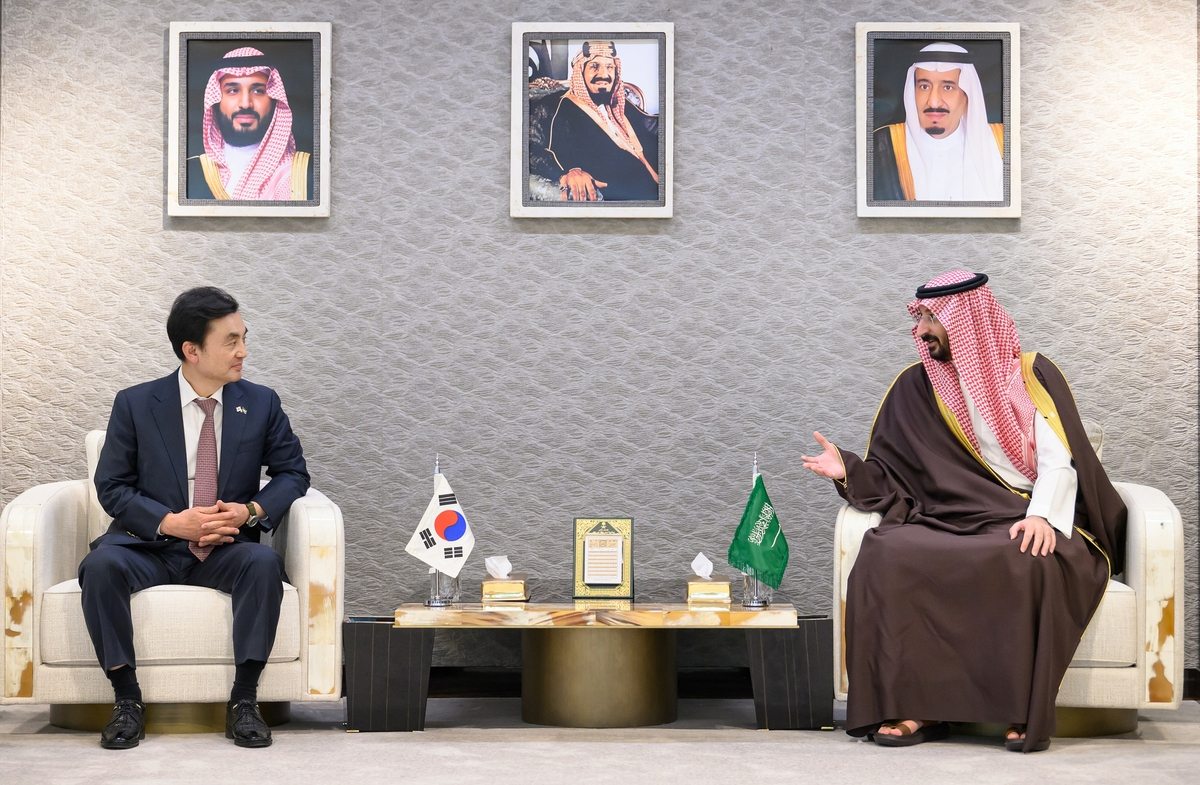
On Monday, 9 February 2026, defence cooperation between Saudi Arabia and South Korea was discussed during a high-level meeting in Riyadh between Prince Abdullah bin Bandar, Saudi Arabia’s Minister of the National Guard, and Ahn Gyu-back, South Korea’s Minister of National Defence. The talks took place on the sidelines of the World Defence Show 2026, a major international defence exhibition hosted by Saudi Arabia.
During the meeting, the two sides discussed ways to expand bilateral cooperation in the defence sector and oversaw the signing of a memorandum of understanding between their respective state defence research institutions. The agreement focuses on cooperation in defence research and development, providing a framework for joint research, technology development, and future defence systems. The move signals an intention to advance relations beyond traditional arms procurement towards longer-term technological and industrial collaboration.
This development aligns with Saudi Arabia’s broader efforts to modernise its security institutions, diversify defence partnerships, and strengthen domestic military-related industries. From Seoul’s perspective, the engagement reflects South Korea’s ambition to consolidate its position as a rising defence exporter and to deepen its presence in Middle Eastern security markets.
However, despite the political and symbolic significance of the Saudi–South Korean defence engagement, it would be misleading to interpret it as evidence of full Saudi autonomy in arms procurement. In strategic reality, Saudi decision-making in this field cannot ultimately exceed the boundaries set by American strategic will, for several structural reasons.
First, Saudi Arabia’s overall security architecture remains deeply embedded within a US-centred framework. Core elements of the Kingdom’s defence and security ecosystem—including air power, missile defence, command-and-control structures, logistics, training, and maintenance—are overwhelmingly dependent on American platforms, standards, and long-term support arrangements. Any substantial deviation from this ecosystem would carry significant operational and strategic risks.
Second, the United States retains decisive influence over access to the most advanced military technologies. High-end capabilities such as next-generation combat aircraft, integrated air and missile defence systems, advanced sensors, and precision-guided munitions remain subject to US political oversight and export controls. Even when procurement involves third-party suppliers, interoperability requirements and the presence of US-origin components often necessitate explicit or implicit American approval.
Third, political considerations continue to shape Saudi arms acquisition. Washington has repeatedly demonstrated its readiness to delay, condition, or restrict weapons transfers to Riyadh in response to regional developments or domestic political pressures within the United States. These constraints have encouraged Saudi Arabia to explore alternative suppliers, but they have not diminished the central role of the United States in defining the practical limits of Saudi arms procurement.
Seen in this context, cooperation with South Korea represents a managed diversification strategy rather than a strategic realignment. It enhances Saudi leverage, broadens technological exposure, and signals dissatisfaction with excessive reliance on a single supplier, while remaining firmly contained within the broader US–Saudi security relationship.
In conclusion, while Saudi–South Korean defence cooperation reflects Riyadh’s ambition to expand its options and deepen technological collaboration, the Kingdom’s arms procurement decisions remain structurally constrained by American strategic preferences. Any genuine move towards full autonomy in defence policy would require a fundamental reconfiguration of Saudi Arabia’s security relationship with the United States—an outcome that, for now, remains unlikely.
