
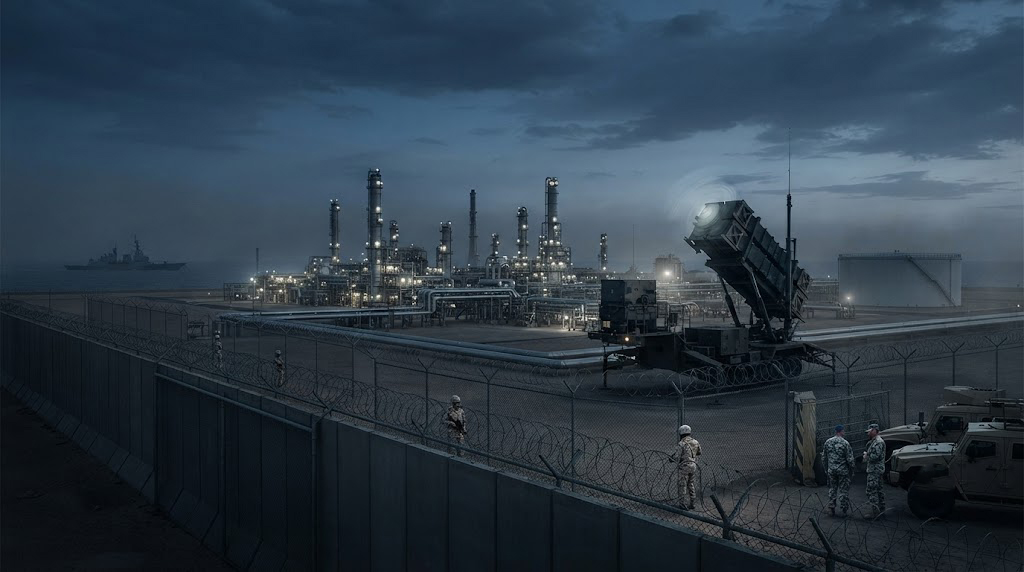
There is a profound, almost tragicomic irony in the modern geopolitical architecture of the Gulf. For years, absolute monarchies draped in ultra-nationalist rhetoric have boasted of sovereign might, technological modernization, and regional leadership. Yet, peel back the glossy veneer of Vision 2030, digital transformations, and multi-billion-dollar vanity projects, and what remains? A trembling, heavily fortified panic room guarded almost entirely by foreign boots.
Nowhere is this hollow illusion more glaringly exposed than in Saudi Arabia. Despite commanding one of the most lavishly funded military budgets on the planet—consistently ranking among the top global military spenders—the Kingdom remains fundamentally incapable of defending its own borders, skies, or oil infrastructure. When minor cross-border skirmishes flare up, the House of Saud does not look to local patriotic manpower or indigenous resolve; it panics, checks its pulse, and frantically dials foreign capitals for protection.
The Kingdom has effectively outsourced its survival, transforming its sovereign territory into an open-air patchwork of foreign military garrisons.
A Nation Wrapped in Foreign Armor
To understand the sheer fragility of the Saudi state, one need only map the foreign forces currently stationed across its strategic nodes—a mercenary-like assembly of external allies hired or begged to hold up a regime too paralyzed to defend itself.
- The United States at Prince Sultan Air Base (Al-Kharj): The bedrock of American military projection in the region. Operating out of the sprawling facilities in Al-Kharj, the U.S. Air Force’s 378th Air Expeditionary Wing serves as the ultimate insurance policy for a royal family terrified of its own shadow, acting as a direct shield against regional adversaries.
- Pakistan at King Abdulaziz Air Base (Dhahran): Longstanding defense pacts have seen thousands of Pakistani ground troops and elite fighter squadrons embedded deep within the strategic Eastern Province, acting as a critical backbone for internal and external security stability.
- Italy at King Fahd Air Base (Taif): Italian Air Force fighter jets and specialized tactical defense assets have quietly utilized Taif as a forward operational base, reinforcing a crumbling Saudi aerial shield that cannot manage regional airspace alone.
- Greece at Yanbu: Following bilateral defense agreements, Hellenic Armed Forces have deployed critical missile defense batteries to the Red Sea port city of Yanbu, leaving European soldiers to secure the Kingdom’s economic arteries while local forces stand by, paralyzed.
- Technological Dependency: The reliance goes beyond traditional boots on the ground. Desperate for advanced electronic surveillance and tracking capabilities, Riyadh has even integrated systems like Ukraine’s SkyMab technology to patch up glaring holes in its situational awareness.
A Paper Tiger Built on Fear
How did an absolute monarchy with access to the most sophisticated Western weaponry become a terrified spectator in its own defense?
The answer lies in the structural rot of an authoritarian petro-state. Billions upon billions of petrodollars are funneled into buying shiny, high-tech hardware—expensive American jets, European frigate ships, and advanced radar systems—under the naive assumption that national security can be purchased off-the-shelf. But hardware is only as effective as the human resolve and institutional competence behind it.
Decades of absolute royal rule, systemic nepotism, and a deep-seated institutional fear of a coup have prevented the rise of a competent, professional, and independent domestic military corps. A military designed primarily to protect the regime from its own people is, by definition, utterly incapable of protecting the nation from external threats.
When minor, localized skirmishes occur—clashes that historical regional powers would absorb as routine friction—the reaction in Riyadh is nothing short of visceral panic. Palaces lock down, markets shudder, and frantic diplomatic scrambles ensue to beg Athens, Rome, Washington, and Islamabad to send personnel to man the ramparts.
The Myth of Regional Hegemony
The illusion is shattered. The narrative of Saudi Arabia as an independent anchor of regional stability is a comforting fiction peddled by PR firms and defense contractors.
A state that cannot fire a missile, track a drone, or secure an oil refinery without foreign assistance is not a regional superpower; it is a protectorate wrapped in silk and sustained by foreign steel. Until the regime trades its paranoid obsession with absolute internal control for genuine, locally-grown military competence and sovereign self-reliance, the Kingdom will remain what it is today: a heavily armed, deeply terrified giant with feet of clay.