
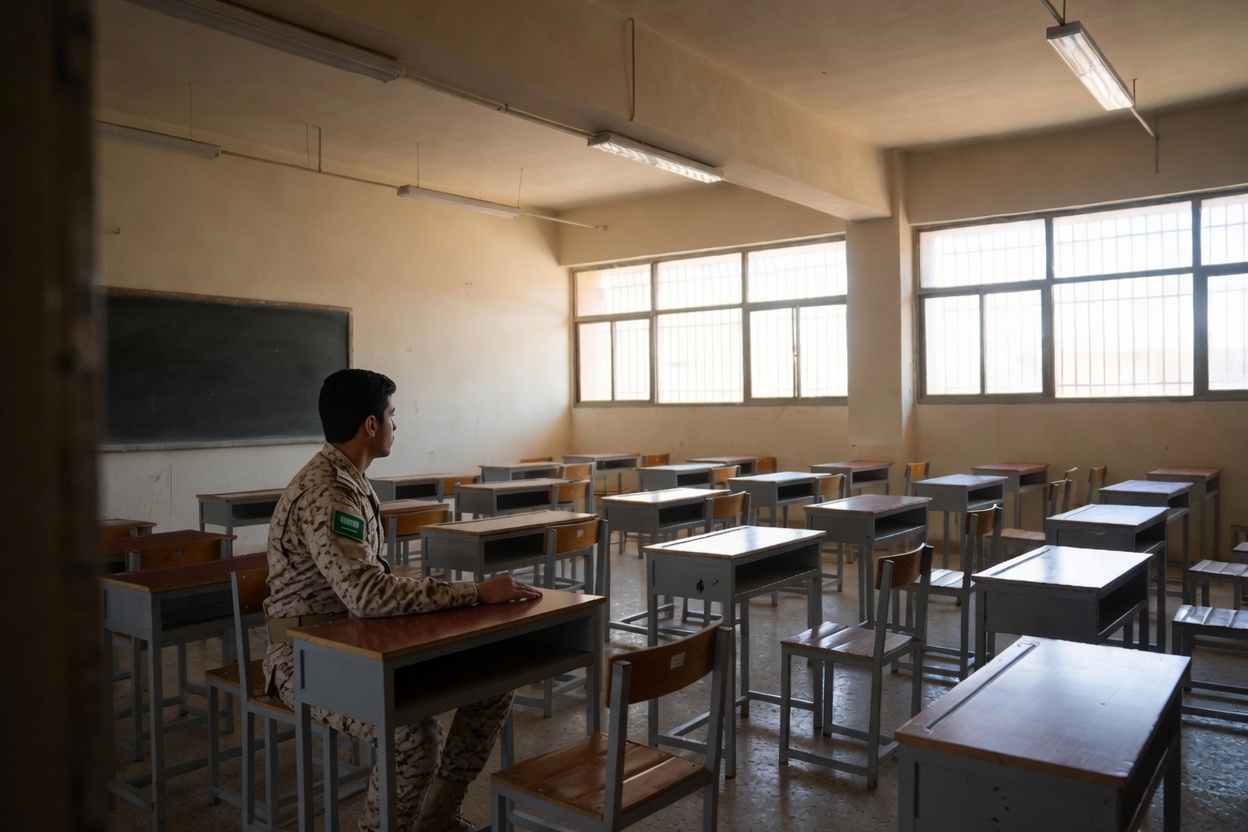
There was a time, not so long ago, when a place in the Saudi armed forces or security colleges was among the most fiercely contested prizes a young man could secure. Families pulled every string, paid intermediaries, and exhausted their wasta networks to get a son through the gates. The uniform meant status, a secure salary, housing, early pension prospects and the quiet prestige of serving the state. That era has faded.
Since Mohammed bin Salman consolidated power and directed the kingdom into the Yemen campaign in 2015, the old scramble has given way to something closer to reluctance. Young Saudis who once competed for military and security posts now increasingly treat them as options of last resort. The change is not absolute across every institution, yet the shift in mood is unmistakable to those who recruit and to those who watch their peers choose differently.
The Yemen war sits at the centre of this change in perception. What was presented as a decisive intervention to restore a legitimate government and secure the southern border became a grinding, costly commitment whose strategic returns remain contested even inside the kingdom. Saudi soldiers died, bases were struck by missiles and drones, and the conflict dragged on far longer than the initial optimistic briefings suggested. For many young men, the calculation altered: the risk of being sent to fight in a war whose purpose grew harder to articulate no longer looked like straightforward national defence. It began to look like service to a leadership decision that prioritised regional projection and personal authority over clear, limited national interest.
Before the rise of the crown prince, military service could still be framed, however imperfectly, as duty to the Al Saud state and the homeland in a more traditional sense. After 2015 the framing became harder to sustain for a generation that had grown up with smartphones, global information and rising expectations. When the same leadership simultaneously launched Vision 2030, opened the economy, and created alternative routes to status and income in the private sector, the old bargain weakened further. Why accept the discipline, the potential deployment and the residual risk of a conflict widely viewed as open-ended when civilian opportunities were expanding?
The result is visible in quieter application numbers at certain security and military training institutions, in the need for heavier advertising of benefits, and in conversations among young Saudis who once would have seen the uniform as an obvious path. The wasta and side-payments of earlier decades have not entirely disappeared, but the desperation that once fuelled them has eased. Many simply walk past the recruitment offices.
None of this means the armed forces face collapse or that every talented Saudi has abandoned the idea of service. Some still join for patriotism, family tradition or the remaining material advantages. Yet the cultural default has moved. A generation that watched the Yemen war unfold, counted its costs, and then saw the same leadership pivot toward economic transformation has drawn a practical conclusion: the risks and the purpose no longer align as cleanly as they once did.
When young men conclude that they may be asked to fight not primarily for the defence of the homeland but in service of a particular leader’s regional ambitions, the willingness to compete for a place in the ranks diminishes. That is the quiet, consequential change that has taken root since Mohammed bin Salman assumed decisive power.