
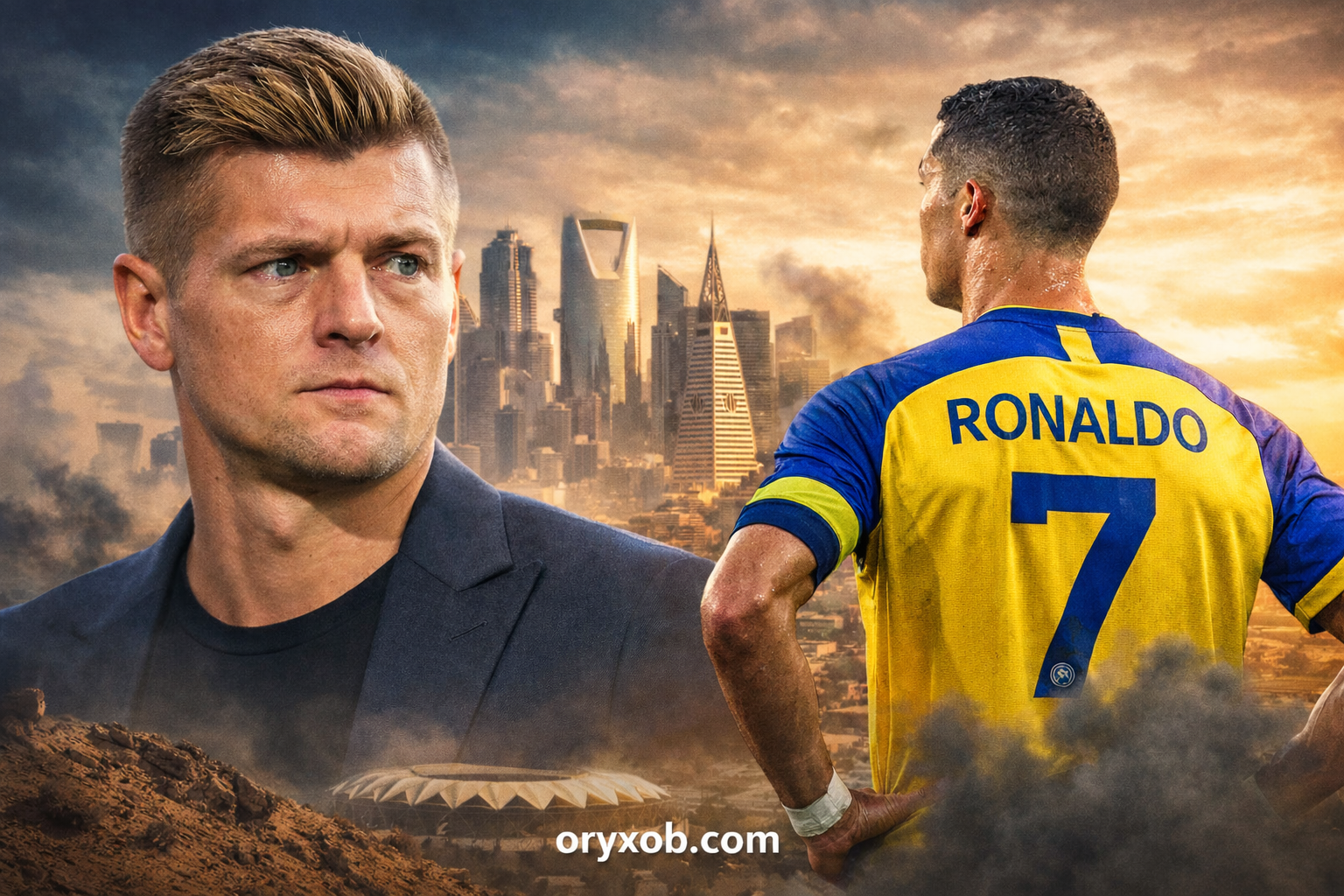
Toni Kroos’s Remarks on Cristiano Ronaldo and the Saudi Pro League — Sporting Reality vs. Image Engineering
The recent intervention by Toni Kroos, the retired German midfield great, has ignited fresh controversy around the relationship between Cristiano Ronaldo, the Saudi Pro League, and the broader strategic ambitions of Saudi Arabia in global sport. Kroos’s sharply worded comments — delivered on his podcast and reproduced across international media — represent not only a critique of how the Saudi league has handled Ronaldo’s situation, but also a wider commentary on the sporting and commercial foundations of the Saudi project.
Kroos’s Core Argument
Kroos’s central assertion is unequivocal: the Saudi Pro League’s recent global interest and visibility are fundamentally tied to Ronaldo’s presence, and the league’s apparent mistreatment of him risks undoing that value. In his own words, “if Cristiano leaves tomorrow, nobody watches the league any more,” underlining his belief that the competition’s international profile depends disproportionately on the Portuguese star’s continued engagement. He also criticised a perceived lack of respect for Ronaldo — a player who, by Kroos’s account, “gave them global recognition” — framing the situation as both commercially and ethically misguided.
This support is significant coming from a peer who, as a former elite professional, has previously expressed scepticism about player moves to Saudi Arabia on sporting grounds rather than competitive ambition. Kroos has, in the past, spoken broadly about the motivations behind high-profile transfers to the region and the extent to which they are driven by financial incentives rather than genuine competitive growth.

Context: Saudi Arabia’s Strategic Utilisation of Ronaldo
When Cristiano Ronaldo signed for Al‑Nassr in January 2023 in what was widely reported as one of the most lucrative contracts in football history, it was hailed as a coup for the Saudi Pro League. The transfer was not merely a sporting acquisition — it became a pillar of Saudi Arabia’s broader strategy to reposition itself on the global cultural and economic stage.
This strategy, often characterised by critics as sportswashing, involves leveraging high‑profile sporting assets, events, and personalities to enhance the Kingdom’s international image and distract from contentious human rights records and political critiques. Bringing global icons such as Ronaldo — followed by other marquee names — into Saudi sport has been used to signal openness, modernisation, and global relevance, even as socio‑political concerns persist. These efforts are closely aligned with Vision 2030 objectives, where sport plays a prominent role in diversifying the economy and shaping external perceptions.
Although Saudi officials frame such signings as part of a legitimate effort to develop competitive football domestically, sceptics argue that the symbolic power of these figures often outweighs genuine sporting infrastructure or grassroots development — and that their presence can be instrumentalised to soften or rebrand systemic narratives about governance and civil liberties in international discourse.
The Ongoing Ronaldo–Saudi Dispute
Kroos’s comments arrive amid a highly publicised dispute between Ronaldo and Saudi football institutions, particularly related to his club, Al‑Nassr, and the wider role of Saudi investment in the sport.
In early 2026, Ronaldo refused to play for Al‑Nassr in consecutive Saudi Pro League matches, not due to injury but in protest against aspects of the club’s management and perceived lack of institutional support — especially in transfer strategy and backing compared with rival clubs. Reports indicated that his absence was tied to dissatisfaction with the Public Investment Fund’s (PIF) handling of football operations, notably after rival signings that he felt left his own squad at a competitive disadvantage.
Subsequent negotiations did lead to a temporary resolution: the club addressed certain grievances, including outstanding obligations, and Ronaldo returned to training, with reports suggesting his participation in forthcoming matches. Nevertheless, speculation remains intense about his long‑term future, with European and MLS interests reportedly monitoring developments and with uncertainty over whether he will remain in Saudi Arabia beyond the current season.

Analysis: Sporting Reality vs. Image Engineering
Kroos’s intervention reflects a broader tension at the heart of Saudi sport’s global positioning. On the one hand, figures like Ronaldo undeniably boost global engagement, sponsorship, broadcasting reach, and commercial interest. On the other, the very reliance on such personalities exposes a vulnerability — as Kroos suggests — to reputational risk if these players feel undervalued or mismanaged.
In this sense, the Saudi experiment represents both a bold reimagining of sports economics and a cautionary example of how brand‑centric strategies can collide with professional sporting culture. For commentators such as Kroos, the fundamental question is whether sustainable sporting excellence can truly be cultivated in an environment where image and investment overshadow competitive integrity and respect for player agency.
Toni Kroos’s comments have resonated because they speak to deeper structural questions about the Saudi Pro League’s model and the role of elite athletes within it. His defence of Ronaldo is not simply an emotional gesture from a former teammate, but a pointed critique of a system that, in his view, elevates spectacle over substance and commercial leverage over genuine competitive respect.
Whether the Saudi football project can evolve beyond its reliance on marquee signings to foster authentic sporting culture remains an open question — but Kroos’s intervention has undeniably shifted the conversation in a more critical direction.